Published on: 2026-03-17
In financial markets, not all investment gains are driven by underlying company fundamentals such as earnings, revenue growth, or asset value. Sometimes prices rise simply because someone else is willing to pay more later. This idea is encapsulated in the Greater Fool Theory, which suggests that investors may knowingly buy overvalued assets with the expectation of selling them to someone else, a “greater fool”, at a higher price.
This theory is most closely associated with speculative bubbles and historically dramatic market episodes in which prices soared far beyond reasonable valuations. While the Greater Fool Theory has obvious implications for speculative markets, understanding it also gives traders valuable insight into market psychology, risk management, and when price action might be driven by sentiment rather than fundamentals.
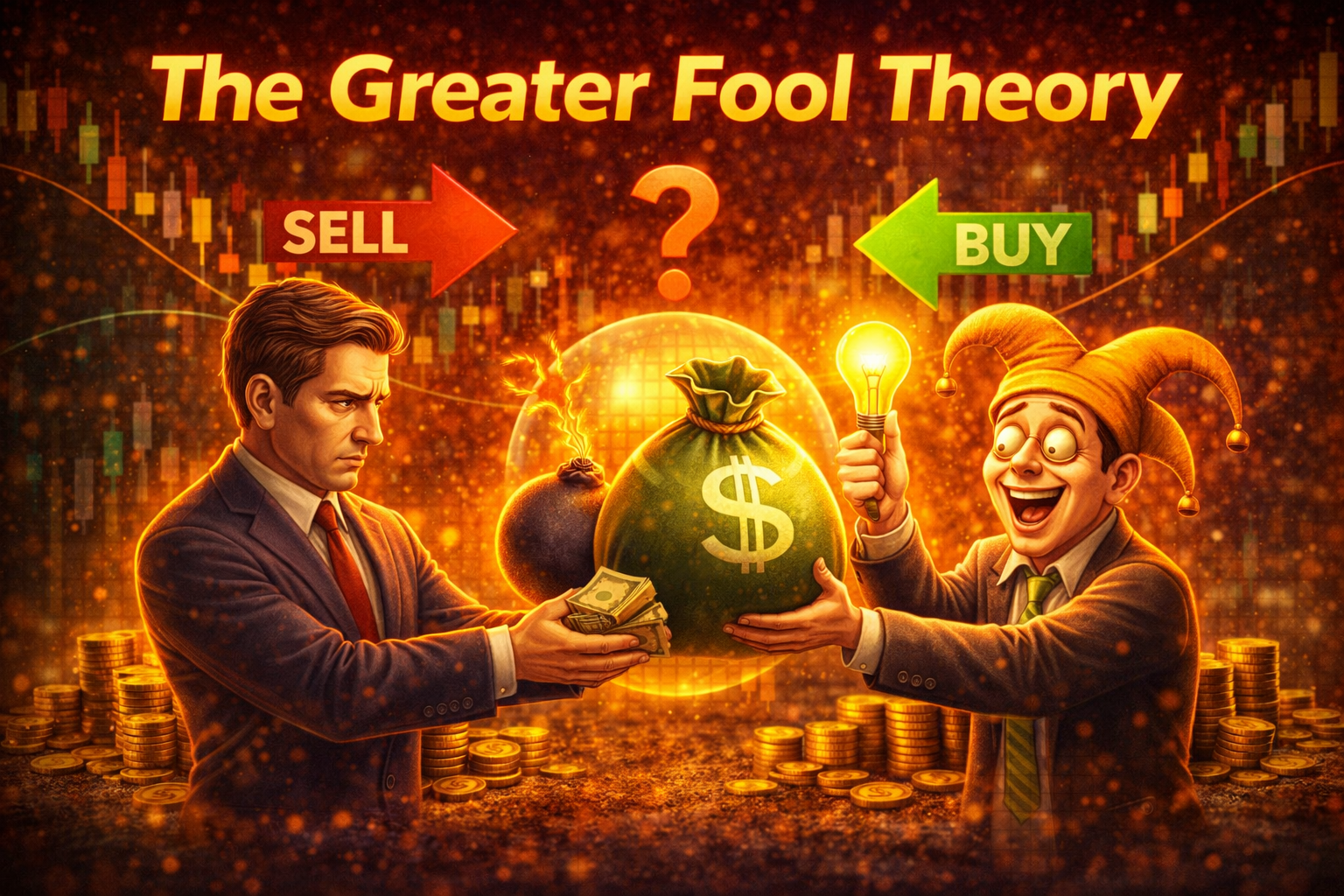
The Greater Fool Theory is an investment idea in which assets are bought not for their intrinsic value but because investors hope to sell them to someone else at a higher price.
Speculative bubbles often form when investors collectively adopt a greater‑fool mindset, driving valuations above sustainable levels.
Recognising when a market may be influenced by the Greater Fool Theory helps traders avoid overpaying and improves risk management.
Greater Fool dynamics have been observed in markets as varied as tech stocks, real estate, and meme stocks.
The Greater Fool Theory is a concept in behavioural finance that describes a situation in which investors buy assets not because they believe the price is justified by fundamentals, but because they assume someone else will buy them at a higher price later.
The basic logic is: If you can find someone willing to pay more than you did, then it does not matter whether the asset is overvalued.
This mindset can create self‑fulfilling price gains, but it also increases the likelihood of sharp corrections when the pool of potential “greater fools” dries up.
Imagine bidding on a collectible with no intrinsic value other than what others think it is worth.
Person A pays $100.
Person B pays $200, thinking they can find someone to pay $300.
Person C pays $300 for the same reason.
Each buyer believes they can find a “greater fool” ahead of them.
Eventually, the chain collapses when no one is willing to pay more.
The Greater Fool Theory is rooted in behavioural biases and market psychology:
When asset prices surge, traders fear missing upside and may buy even if valuations appear irrational.
When many market participants buy aggressively, others may follow without assessing value.
Traders may prioritise quick gains over long‑term fundamentals.
Belief in one’s ability to sell at the perfect moment before a downturn increases willingness to engage in speculation.
These psychological drivers can fuel speculative demand and push markets far beyond fundamental value, until sentiment shifts.
Markets influenced by the Greater Fool Theory often exhibit:
Rapid price increases without fundamental support
High trading volume with intense media coverage
Wide divergence between price and valuation metrics
Frenzied investor sentiment with frequent headline news
Sudden and sharp reversals occur once sentiment shifts
The following table summarises typical signs:
During the tech boom of the late 1990s, many internet companies had soaring stock prices despite little to no earnings. Investors relentlessly bought technology stocks, assuming prices would continue rising, and hoped to sell to someone else at a higher price.
In the mid‑2000s U.S. real estate market, home prices rose dramatically as buyers speculated that prices would continue to escalate. Many borrowed aggressively, assuming they could sell at a profit, leading to a housing bubble that eventually burst.
Stocks such as GameStop and AMC Entertainment saw massive short‑term rallies driven by social media sentiment and a willingness to buy at extreme price levels, with many participants assuming they could exit to someone else at higher prices.
It is informative to contrast the Greater Fool Theory with traditional investment philosophies like value investing:
A value investor often avoids situations where the price is disconnected from fundamentals, while a Greater Fool investor may temporarily embrace such disconnections.
Identifying when a market is driven by Greater Fool logic can help traders avoid buying at unsustainable valuations.
Risk controls like stop losses and position sizing become crucial in speculative environments to protect capital when prices reverse.
Traders who recognise Greater Fool markets can adjust strategies to avoid late‑stage participation and reduce exposure when sentiment peaks.
Understanding emotional drivers, such as FOMO and herd behaviour, provides valuable context for price movements that do not align with fundamentals.
Even traditionally stable sectors such as the defence industry can be subject to speculative excesses in certain market conditions. While many defence companies exhibit strong fundamentals, momentum can sometimes outpace fundamentals when broader sentiment becomes irrational.
Examples of defence stocks are typically regarded for quality but not immune to market sentiment:
Lockheed Martin Corporation: Large defence contractor with stable earnings and dividend history
Northrop Grumman Corporation: Major aerospace and defence innovator
Raytheon Technologies Corporation: Mixed defence and commercial aerospace exposure
These companies generally have solid underlying value. However, if a sector experiences speculative inflows, for example, due to geopolitical headlines, prices may temporarily detach from valuations, thereby creating a greater‑fool dynamic.
While no signal is perfect, several indicators can suggest that speculation may be outweighing fundamentals:
Look for significant deviations from average valuation metrics such as Price‑to‑Earnings or Price‑to‑Sales ratios.
Rapid, parabolic rises without clear fundamental drivers are often a hallmark of speculative momentum.
When retail trading activity surges, it may reflect sentiment‑driven, rather than fundamentally driven, price moves.
Sentiment indicators (such as the Fear & Greed Index) at extreme bullish readings can signal that speculation, not fundamentals, is driving prices.
While the Greater Fool Theory helps explain speculative markets, it also has limitations:
It does not provide precise timing for reversals.
Not all price increases reflect speculation; some reflect real growth prospects.
Markets can remain irrational longer than individual traders expect.
These limitations underline the importance of combining greater‑fool awareness with robust risk controls.
The Greater Fool Theory is the idea that investors may buy overvalued assets expecting to sell them to someone else at a higher price, regardless of underlying value.
No, it applies to any asset class where speculative demand drives prices above reasonable valuations, including real estate, collectables, and commodities.
Fundamental investors can benefit by recognising when sentiment is driving a market and then tactically reducing exposure before a correction.
Not always, but the Greater Fool Theory is often a key psychological driver of speculative bubbles, where prices rise on expected resale rather than on cash flow.
Traders avoid this risk by using valuation analysis, setting strict entry and exit rules, managing position sizes, and avoiding assets that have lost their connection to intrinsic value.
The Greater Fool Theory offers a compelling explanation for why asset prices can rise far beyond their fundamental values and why speculative bubbles form. This theory is rooted in human behaviour, fear of missing out, herd dynamics, and the belief that someone else will pay more later.
In speculative markets, where prices are driven by sentiment and momentum rather than underlying earnings, the risk of being left holding an overvalued asset increases dramatically when the pool of “greater fools” dwindles.
Disclaimer: This material is for general information purposes only and is not intended as (and should not be considered to be) financial, investment or other advice on which reliance should be placed. No opinion given in the material constitutes a recommendation by EBC or the author that any particular investment, security, transaction or investment strategy is suitable for any specific person.