Published on: 2026-03-31
The Nasdaq correction is being driven primarily by an oil supply shock from the ongoing Iran war, not by weak technology earnings.
Brent crude has surged well above the triple-digit mark for the first time since the Russian invasion of Ukraine, putting pressure on growth stocks.
Federal Reserve rate cut expectations have collapsed as traders reprice inflation risk, with bond markets now pricing in limited to zero easing in 2026.
The rotation from growth to defensives and energy names is accelerating, and the macro picture suggests this correction may have further to run.
Scroll through the financial headlines, and you will find the usual suspects: weak chip guidance, AI spending fatigue, antitrust heat. All of that is real, but none of it explains why the Nasdaq Composite fell into official correction territory on March 26, 2026 and has continued grinding lower since.
The real driver is sitting in the energy market. Oil crossed a threshold that has rewired everything in financial markets, and most retail investors are not yet fully connecting those dots.
If you own tech stocks, an index fund, or anything with "growth" in its description, the Iran conflict and the crude price surge that came with it are directly eating into your portfolio right now.
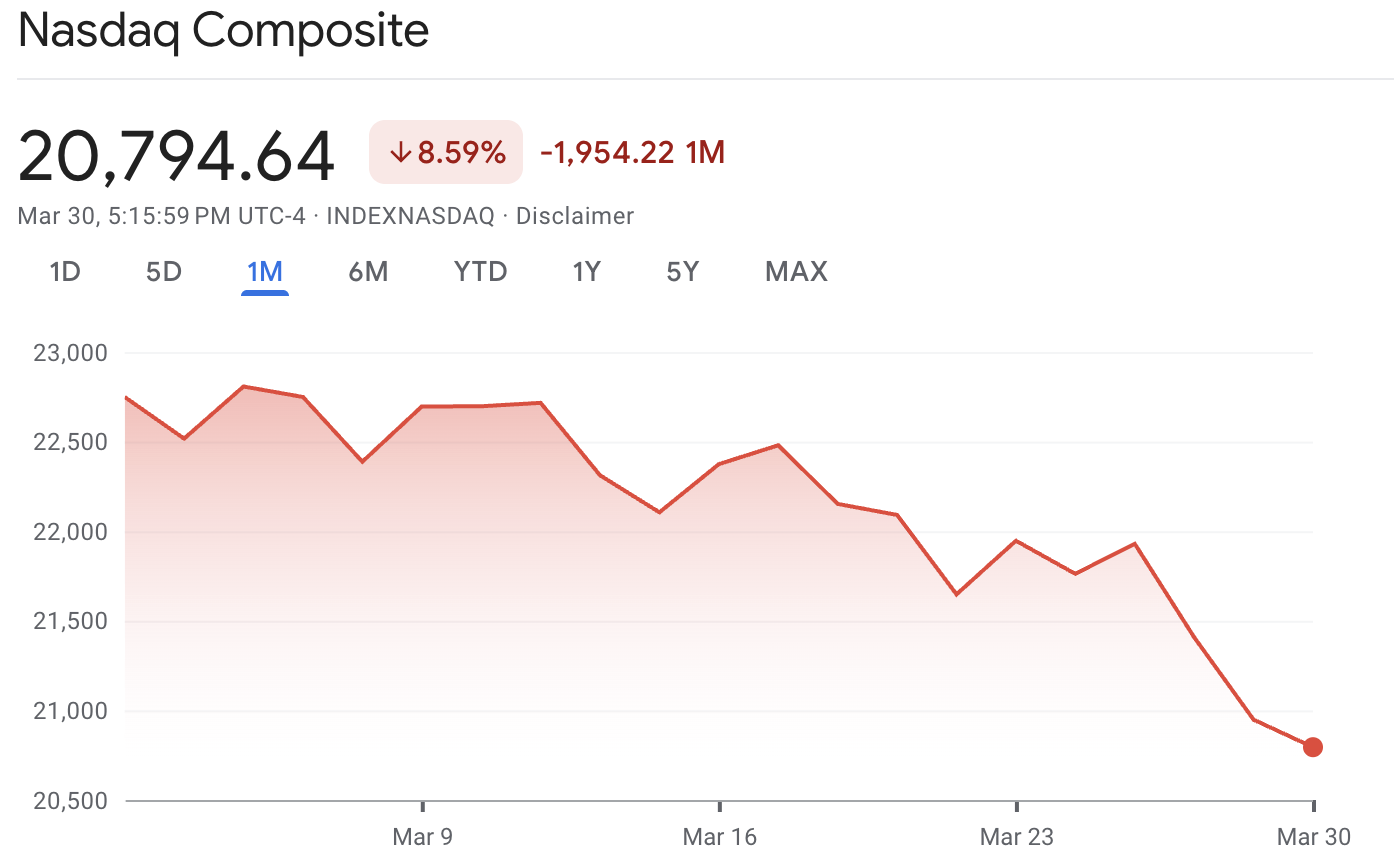
Thursday, March 26, was the day the Nasdaq entered correction territory in the 2026 Iran war selloff. The Nasdaq Composite fell 2.38% to close at 21,408.08, down more than 10% from its October 2025 record close, meeting the technical definition of a correction.
| Index | Status as of March 30 | Main market signal |
|---|---|---|
| Nasdaq Composite | In correction | Tech and growth repricing |
| Nasdaq-100 | In correction | Mega-cap pressure |
| S&P 500 | Near correction territory | Broad market weakness |
| Dow Jones | Relatively firmer on the day | Rotation into defensives |
| VIX | Elevated near 30 | Fear has replaced complacency |
The selling continued on March 27. The Nasdaq Composite sank another 2.15% to 20,948.36, marking its fifth consecutive weekly drop and its longest such streak since 2022. The CBOE Volatility Index closed at 31.05, its highest level since last April's tariff disruptions.
By Monday, March 30, the Russell 2000 and the Nasdaq were still down over 1% as growth and tech stocks continued to be hammered by investors increasingly worried about the Iran conflict.
Some stock-specific headlines did hit sentiment, but they do not explain why the entire tech complex was sold off as a single unit.
On March 26, the Nasdaq fell 2.4% and dropped more than 10% below its record high, while Brent settled at $101.89 and the 10-year Treasury yield touched 4.43%. That was a macro repricing, not a routine earnings wobble.
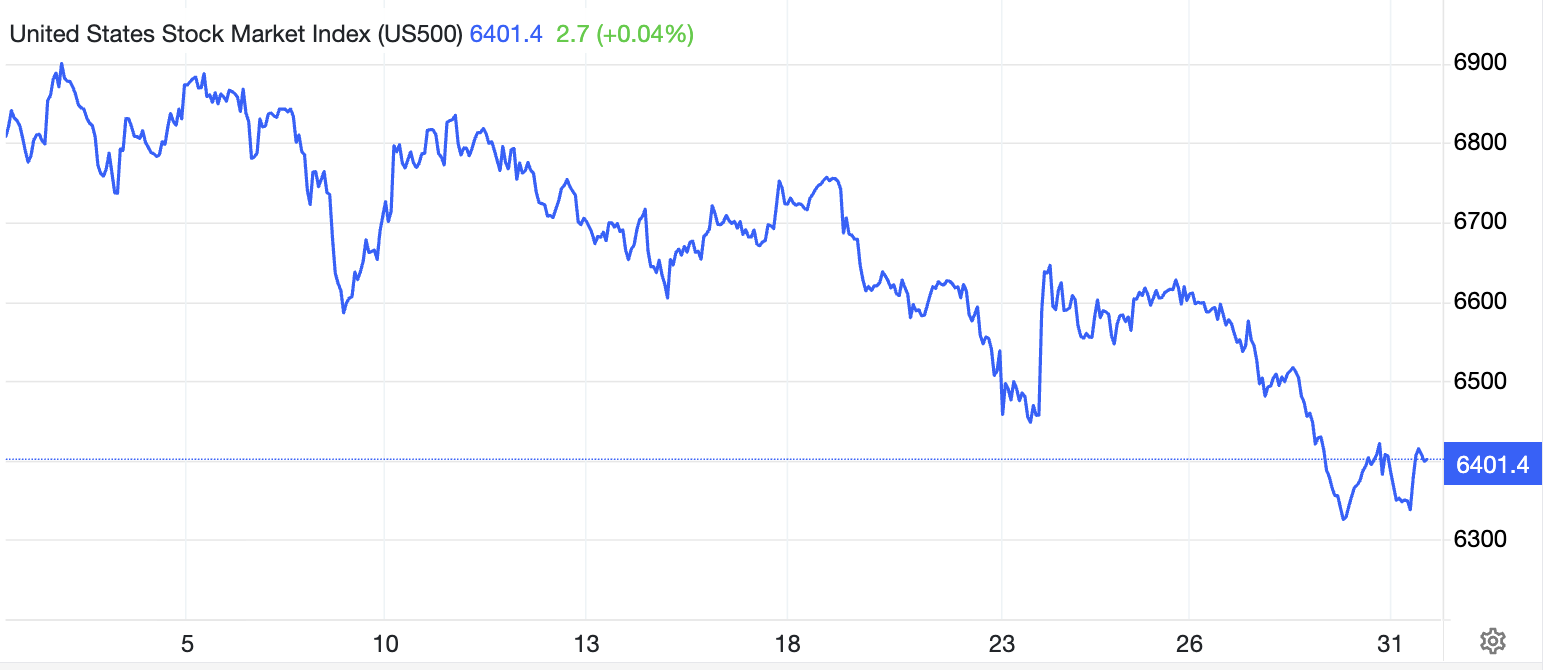
The same pattern held on March 30. The Dow managed a small gain, but the S&P 500 and Nasdaq both fell again, with the Nasdaq closing at its lowest level in roughly eight months. If earnings were the main issue, the damage would have been narrower.
Instead, investors were selling duration, reducing exposure to growth, and rotating toward areas that could better absorb an energy shock.
Oil prices rose sharply, with Brent crude trading above $106 a barrel and West Texas Intermediate topping $100.
The 10-year Treasury yield climbed to 4.46%, its highest level since July, as expectations of higher inflation driven by surging oil prices led investors to scale back their bets on Federal Reserve rate cuts. The Magnificent Seven lost over $330 billion in market capitalisation in a single session.
As the Iran war enters its fifth week, high oil prices continue to weigh on markets. Brent crude closed at $114 on March 30, and WTI crude peaked above $105, its highest level since 2022.
Most investors understand that oil matters for airlines or consumer goods. Fewer fully appreciate the direct channel through which crude prices punish long-duration growth stocks.

Higher oil prices feed into inflation expectations, which push Treasury yields higher, thereby raising the discount rate applied to future earnings.
For tech companies trading at elevated multiples on earnings projected years out, even a modest rise in discount rates destroys enormous present value.
The Nasdaq's largest constituents, including Microsoft, Amazon through AWS, Alphabet through Google Cloud, and Meta, collectively operate some of the world's most energy-intensive commercial facilities.
A modern hyperscale AI data centre can consume as much electricity as a small city, and that electricity is generated in part from natural gas and oil-derived fuels whose prices have soared alongside crude.
Higher energy costs function as a tax on disposable income, reducing the addressable market for premium tech products and subscription services.
By the third week of March, the VIX had spiked above 30, signalling that the "buy the dip" mentality of the previous year had been replaced by genuine fear of a prolonged downturn.
High-growth sectors that led the 2025 charge, including software-as-a-service and semiconductor equipment, saw intraday swings of 5% or more.
This is where the correction stops looking like a simple earnings story and becomes a policy story.
Wall Street entered 2026 expecting several Fed cuts. By the end of March, that view had been largely erased as oil surged and inflation worries returned.
The Wall Street Journal reported that the probability of rate cuts fell from about 80% to less than 2% before Powell's March 30 remarks helped restore only a modest chance of one cut by year-end.
It was later reported that futures traders lifted the probability of at least one cut by December to 19.5% after Powell said the Fed could look through a supply shock, while the chance of a hike dropped sharply.
Energy is leading the rotation: Higher Brent crude prices are lifting the earnings outlook for producers such as Exxon Mobil, Chevron, and Suncor Energy.
Defensive stocks are gaining support: Consumer staples like PepsiCo are attracting inflows as investors seek steadier margins and more predictable cash flow.
Utilities and materials are also benefiting: These sectors tend to hold up better when inflation risk rises, and commodity prices stay firm.
Tech remains under pressure: Micron and Sandisk extended their declines as the memory chip selloff deepened and investors cut exposure to high-beta growth.
The market's message is clear: Investors are selling stocks priced for perfection and buying companies that benefit from higher energy prices and inflation.
The old winners are losing leadership: The Magnificent Seven trade that dominated 2023 through 2025 is facing growing structural pressure as rates, oil, and volatility reshape positioning.
The Nasdaq has more expensive growth stocks, which are more sensitive to oil, inflation, and rate repricing. The Dow has more financials, industrials, and defensive names.
Not yet. As of March 30, the S&P 500 was down 9.1% from its record, close to correction territory but not officially there.
It is one of the main reasons. Higher oil revives inflation fears, delays Fed easing, and puts more pressure on long-duration tech valuations.
Yes, but the hurdle is higher. Powell said the Fed can look through a temporary shock, but persistent inflation expectations would complicate any move to ease.
Energy, consumer staples, utilities, and other dividend-heavy defensive areas are holding up better than semiconductors and high-beta growth.
The NASDAQ correction is best understood as an oil shock working its way through valuations, inflation expectations, and Fed pricing. Weak earnings may add noise, but they are not the main driver of this move.
Until Brent crude retreats meaningfully from current levels, or until a credible resolution to the Iran conflict emerges, the pressure on the Nasdaq correction will remain.
The investors who have navigated this environment most successfully are those who understood early that this was an oil shock dressed up as a tech story.
Disclaimer: This material is for general information purposes only and is not intended as (and should not be considered to be) financial, investment or other advice on which reliance should be placed. No opinion given in the material constitutes a recommendation by EBC or the author that any particular investment, security, transaction or investment strategy is suitable for any specific person.