Published on: 2026-03-26
Oil price spikes are one of the fastest ways to disrupt financial markets. When crude oil prices rise sharply, the effects spread beyond the energy sector, influencing business costs, consumer behaviour, inflation, and stock market performance.
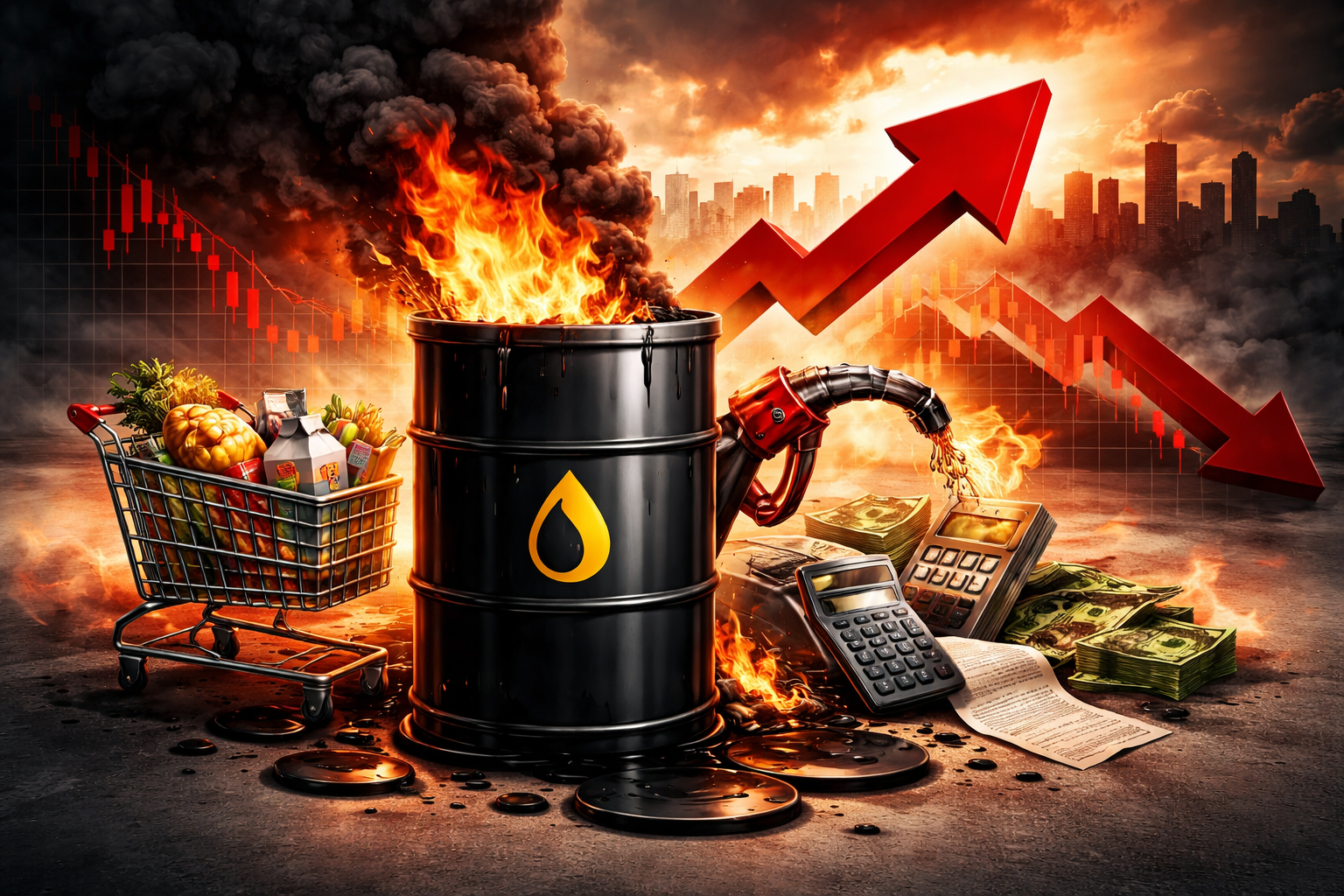
For example, the ongoing 2026 conflict involving the U.S., Israel and Iran has disrupted key oil flows through the Strait of Hormuz, pushing crude prices sharply higher and rattling markets. During these spikes, energy stocks like ExxonMobil and Chevron rose on higher profit expectations, while fuel‑dependent sectors such as airlines and logistics faced pressure from rising fuel costs. Understanding how oil price shocks affect the stock market therefore requires first examining their impact on the real economy.
Oil price spikes increase operating costs for businesses across industries.
Companies often pass higher costs to consumers, reducing spending power.
Rising oil prices contribute to inflation and possible interest rate hikes.
Energy stocks tend to benefit, while transport and consumer sectors struggle.
The overall market reaction depends on the cause of the oil price increase.

Companies that rely heavily on fuel or transportation are the first to feel the impact. Airlines, shipping firms, and retailers often see their costs rise faster than their revenues. For instance, airlines cannot always raise ticket prices immediately when fuel costs increase. This reduces profit margins and can lead to falling share prices.
As living costs increase, consumers cut back on non-essential spending. This affects sectors such as retail, travel, and leisure. Lower demand leads to weaker earnings reports, which often result in declining stock prices across consumer-driven industries.
Oil price spikes are a major driver of inflation. As energy costs rise, prices across the economy rise as well. Central banks such as the Federal Reserve may respond by raising interest rates. Higher interest rates reduce liquidity and make borrowing more expensive.
This tends to pressure stock valuations, especially for growth companies that rely on future earnings.
Oil price spikes are often linked to geopolitical risks or supply disruptions. This creates uncertainty in financial markets. Investors may reduce exposure to equities and shift toward safer assets. This behaviour increases market volatility and can trigger short-term declines.
Not all stocks react the same way to oil price spikes. Some sectors benefit, while others face challenges. In the past, lower oil prices were generally positive because they reduced costs for businesses and consumers. Today, the effect is more nuanced:
This illustrates a balanced but complex market effect: while energy sectors gain from rising oil prices, transportation, logistics, and consumer sectors may struggle, highlighting the importance of sector rotation during volatile periods.
During the Russia-Ukraine conflict, oil prices surged due to supply concerns.
The market reaction included:
Strong gains in energy stocks
Rising inflation globally
Weak performance in the consumer and technology sectors
Increased market volatility
This shows that oil price spikes create divergence in the stock market rather than a single direction.

The oil market in 2026 presents a more complex picture than a simple rise or fall in prices. It is defined by a mix of short-term price spikes and longer-term supply dynamics, which have important implications for the stock market.
In the short term, oil prices have been highly volatile due to geopolitical tensions, particularly in the Middle East. Recent conflicts have pushed prices sharply higher, with analysts warning that supply disruptions could keep prices elevated if conditions worsen.
At the same time, these spikes are already feeding into financial markets. Rising oil prices have increased inflation expectations, pushed bond yields higher, and triggered declines in equity indices in some regions.
However, the broader outlook for 2026 is not purely bullish. Several major forecasts suggest that global oil supply may exceed demand over the year, which could eventually bring prices down after short-term shocks.
For example:
Global oil supply is expected to rise significantly in 2026, potentially creating a surplus.
Some forecasts place average oil prices at 60 to 80 dollars per barrel once disruptions ease.
Prices may remain elevated in the near term but decline later in the year if supply stabilises.
This creates a two-phase market environment:
Short Term: Shock-Driven Volatility: Oil price spikes caused by geopolitical risks are driving inflation fears and stock market volatility. During this phase, energy stocks tend to outperform, while broader equity markets face pressure.
Medium to Long Term: Rebalancing: As supply recovers and inventories build, oil prices may stabilise or decline. This could ease inflation and support a recovery in stock markets, particularly in consumer and growth sectors.
The current 2026 oil environment reinforces a key point. Oil price spikes do not operate in isolation. They are part of a broader cycle that includes supply responses, policy reactions, and changing investor expectations.
For stock market participants, this means:
Short-term oil spikes are more likely to create volatility rather than sustained market declines.
Sector rotation becomes more pronounced, especially between energy and consumer sectors.
Monitoring geopolitical developments is just as important as tracking supply and demand data.
In simple terms, the 2026 oil market shows that while oil price spikes can still disrupt stocks, their long-term impact depends on how quickly supply adjusts and whether inflation pressures persist.
Understanding the impact of oil price spikes helps investors make more informed decisions. A few practical strategies that can be approached are:
Increase exposure to energy companies during rising oil prices.
Reduce exposure to sectors heavily dependent on fuel costs.
Monitor inflation and interest rate trends closely.
Diversify into defensive sectors such as utilities and defence.
Oil price spikes increase operating costs for businesses, especially those that rely on transportation and energy. Many companies pass these costs to consumers, which reduces demand and affects overall profitability and stock performance.
Stock markets often react negatively when oil prices rise, as higher prices lead to inflation, lower consumer spending, and reduced corporate profits. These factors create uncertainty and can weaken investor confidence.
Energy companies benefit the most because their revenues are directly linked to oil prices. Defence stocks may also perform well during geopolitical tensions associated with oil supply disruptions.
Oil price spikes do not always cause market declines. The impact depends on whether the increase is driven by strong demand or supply disruptions, and how different sectors respond.
Investors should diversify their portfolios, monitor macroeconomic trends, and adjust their exposure to sectors sensitive to oil prices. A balanced approach helps manage risk during periods of volatility.
Oil price spikes affect the stock market by increasing business costs and reducing consumer spending. These changes lead to lower corporate profits, higher inflation, and potential interest rate hikes. However, the impact is uneven. Energy and defence sectors may benefit, while cost-sensitive industries often struggle. Understanding these dynamics allows investors to better navigate market movements and manage risk effectively.
Disclaimer: This material is for general information purposes only and is not intended as (and should not be considered to be) financial, investment or other advice on which reliance should be placed. No opinion given in the material constitutes a recommendation by EBC or the author that any particular investment, security, transaction or investment strategy is suitable for any specific person.