Published on: 2026-03-13
Updated on: 2026-03-13
The latest Dow Jones falling is driven by a familiar yet dangerous combination: surging oil prices, firmer Treasury yields, and renewed concern that inflation could remain sticky as growth expectations weaken.
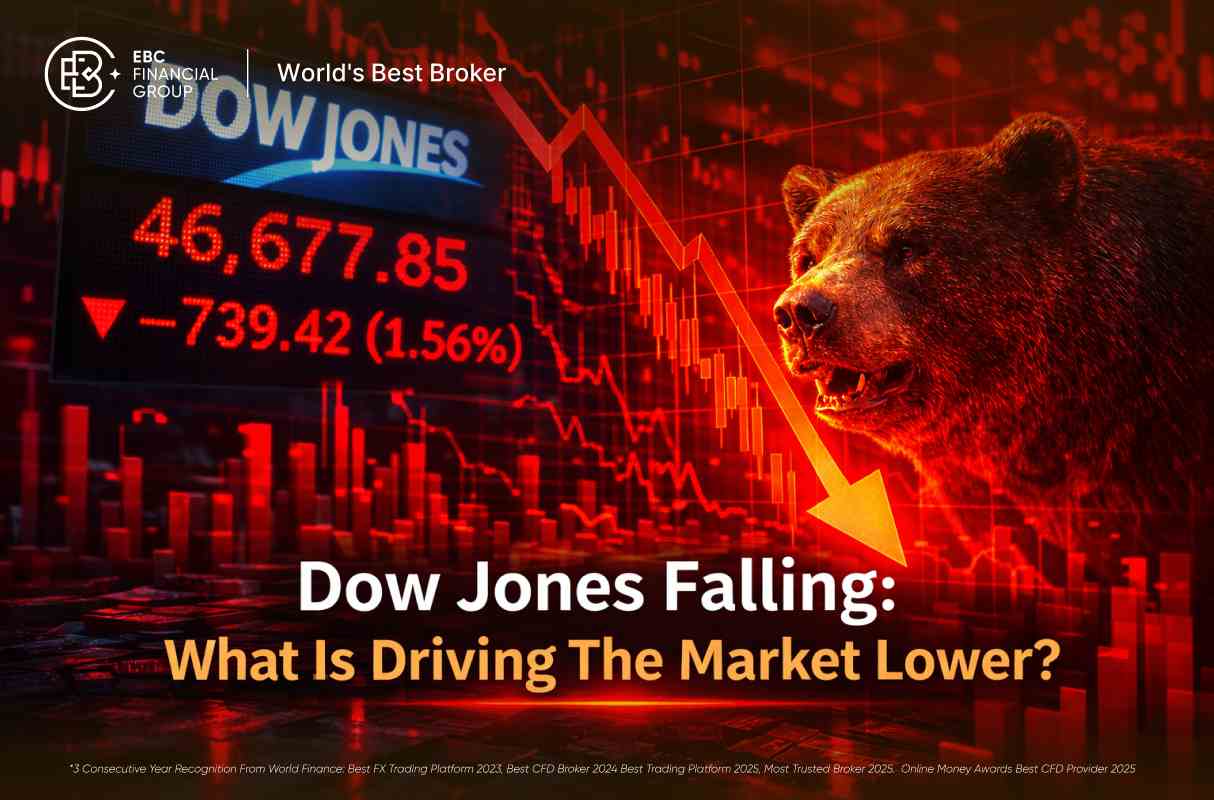
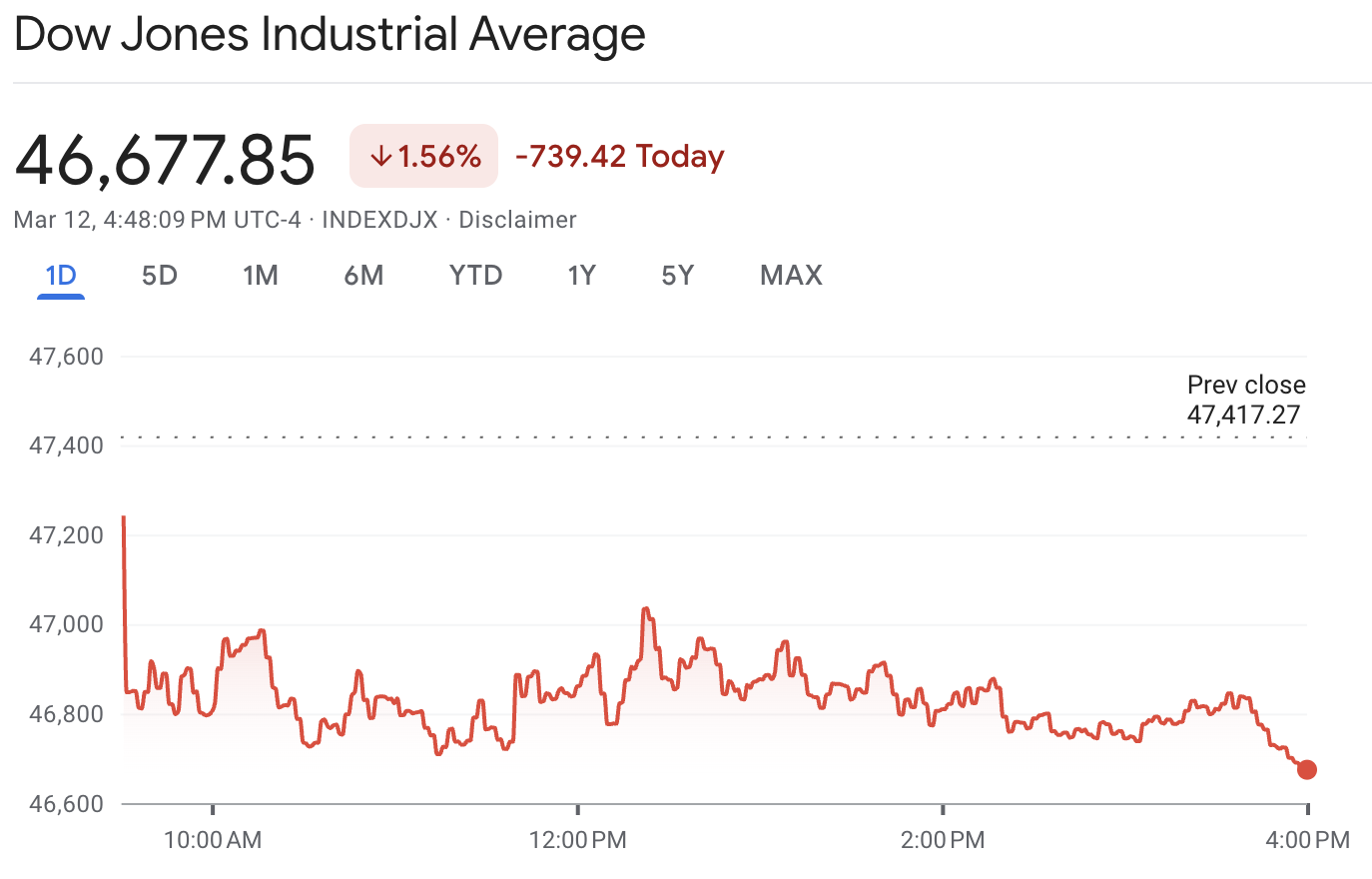
On March 12, 2026, the Dow Jones Industrial Average fell 1.6% to 46,677.85, while the S&P 500 lost 1.5% and the Nasdaq fell 1.8%. Early on March 13, U.S. futures edged higher, but the forces behind the selloff remained in place.
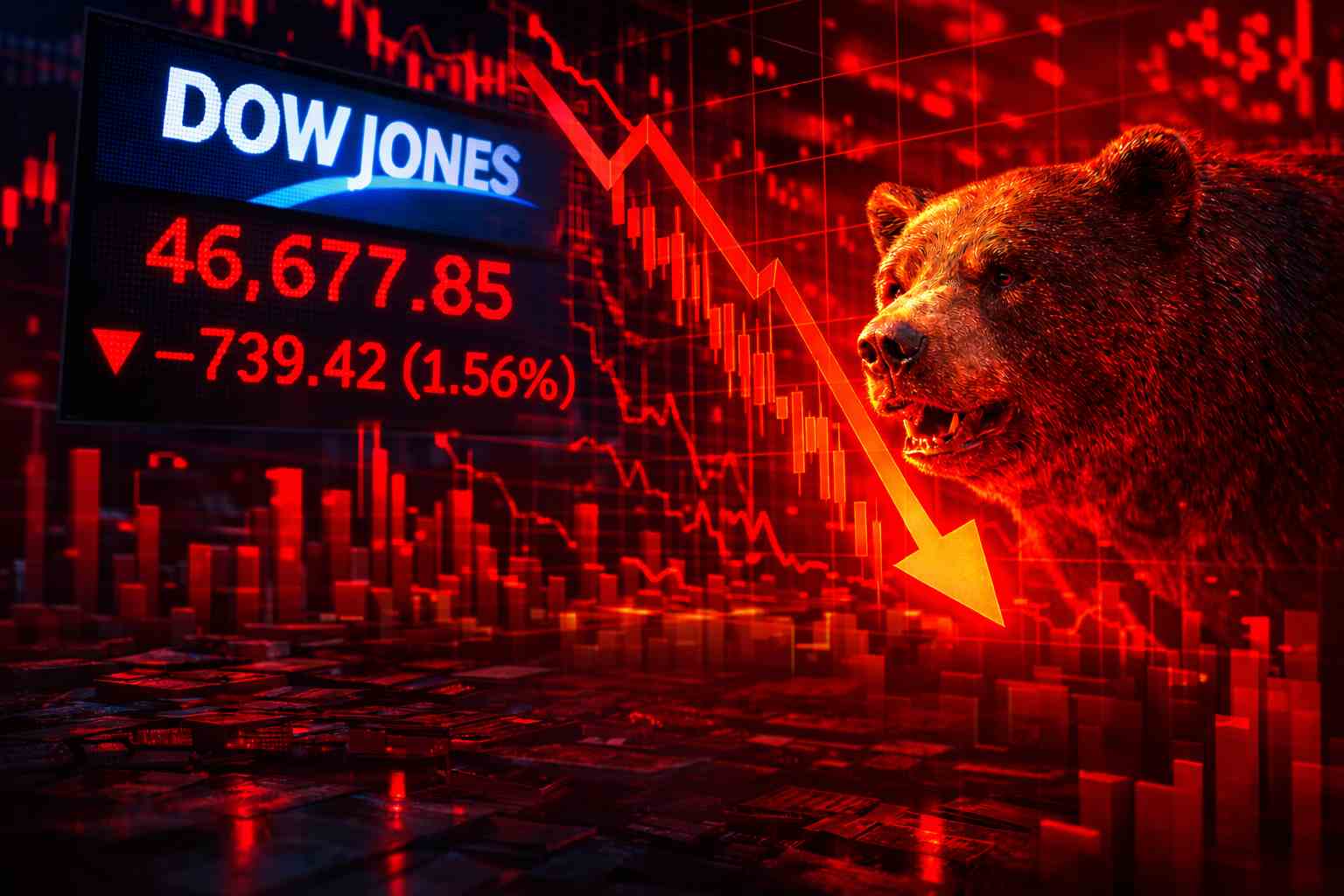
The Dow Jones falling is being driven by an oil shock, renewed inflation fears, and rising Treasury yields tied to the escalating Iran conflict.
Higher energy prices are squeezing margins across transport, travel, and manufacturing stocks.
The Dow's price-weighted structure is amplifying losses, making the index drop harder than the broader market.
Gold, oil, and Treasury yields are all sending a consistent risk-off signal.
The next move depends on whether the Strait of Hormuz reopens or the energy shock deepens further.
The Dow Jones Industrial Average fell 739.42 points, or 1.6%, on March 12, 2026, closing at 46,677.85. The move marked one of the sharpest recent daily drops for the index and reflected broad risk-off sentiment across U.S. equities.
The decline was not isolated to the Dow. The S&P 500 fell 1.5%, and the Nasdaq Composite dropped 1.8%, indicating the selloff was part of a broader market retreat rather than a Dow-only event.
 Cross-Asset Snapshot
| Asset | Latest Reading | Why Traders Care |
|---|---|---|
| Dow Jones (DJIA) | 46,677.85, down 1.56% | Confirms broad equity weakness; below 47,000 for first time in 2026 |
| S&P 500 | 6,672.62, down 1.52% | Shows selloff extends well beyond the Dow |
| Nasdaq Composite | 22,311.98, down 1.78% | Growth and tech stocks under meaningful pressure |
| Brent Crude | Above $100 per barrel | Revives sticky inflation and corporate margin fears |
| WTI Crude | ~$95.73 per barrel | Signals domestic energy supply strain |
| U.S. 10-Year Yield | 4.27% | Points to higher-for-longer rate expectations |
| Gold | ~$2,919 per ounce | Safe-haven demand remains elevated amid geopolitical risk |
The clearest reason the market is under pressure is energy. On Friday, Brent crude was hovering near $100 a barrel, after briefly nearing $120 earlier in the week, while U.S. crude was around $95.55.
West Texas Intermediate futures rose 9.72% to settle at $95.73 per barrel, one of the sharpest single-day crude moves of the year.
That matters because oil is no longer just an energy story. It is an inflation story, a profit-margin story, and a confidence story all at once.
Roughly 20% of the world's oil flows through the Strait of Hormuz, which is why even a partial disruption can push investors out of equities and into a defensive posture.
Higher oil prices immediately raise the risk that inflation stops improving or reverses course. That concern lands on a backdrop that was already unresolved.
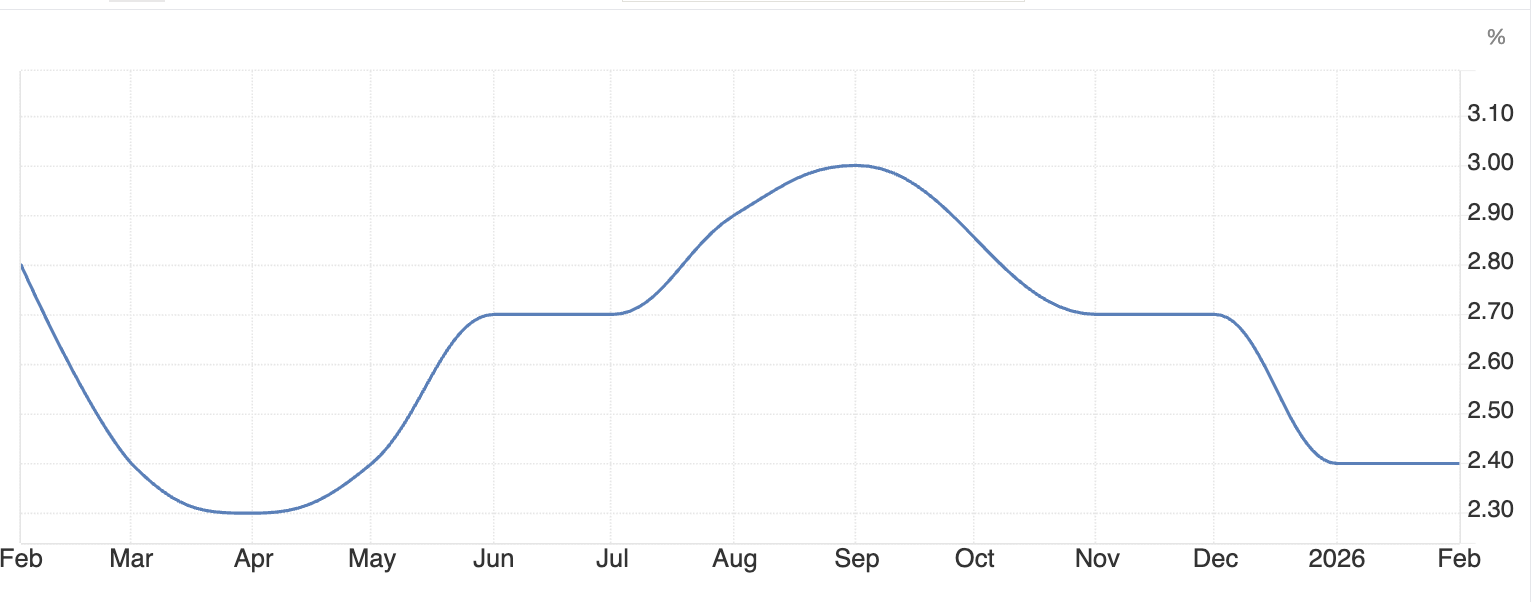
The U.S. Bureau of Labor Statistics said the Consumer Price Index rose 0.3% in February from the prior month and 2.4% from a year earlier, while the energy index increased 0.6% in February.
Some reports showed the U.S. 10-year Treasury yield at 4.27% on March 13, near five-week highs, with the move tied to rising oil prices, the escalation in the Middle East, and market expectations that the Federal Reserve may need to keep rates higher for longer.
The oil shock reignited fears of sticky inflation, forcing investors to price out near-term interest rate cuts from the Federal Reserve and sparking a broad-based retreat from risk assets.
The Dow is not just falling because the market is lower. It is also falling because of how the index is built.
Unlike the S&P 500, the Dow Jones is price-weighted, meaning higher-priced stocks carry greater influence than lower-priced ones, regardless of company size. A single dollar move in any Dow component translates into roughly 6.16 index points.
Goldman Sachs fell 3.44%, and JPMorgan fell 2.32% on the day, with Boeing also declining 2.64%, each contributing disproportionate downside pressure to the index.
When expensive industrial and financial names sell off together, the Dow drops faster than any market-cap-weighted benchmark would.
The market is also pricing in slower growth. When oil prices rise sharply, the pressure spreads into transportation, travel, manufacturing, and other fuel-sensitive parts of the economy.
Carnival fell 7.9%, and United Airlines dropped 4.6% on Thursday, showing how quickly traders are repricing companies whose costs rise when fuel prices spike.
That matters for Dow sentiment too because it reinforces the broader fear that the market is sliding from a simple oil shock toward a stagflation trade.
When stocks fall on geopolitical shock, investors typically rotate into defensive assets. That pattern is playing out here.
Gold remains elevated, reflecting sustained safe-haven demand.
The IEA announced the largest emergency reserve release in its history, making 400 million barrels available to the market, but traders largely shrugged it off, with one investment officer noting the decision does not solve the broader issues affecting the global economy.
Treasury yields, meanwhile, moved higher rather than lower, which is unusual in a risk-off environment.
Strait of Hormuz: Any credible sign of reopening would immediately ease oil prices and likely spark a sharp equity relief rally
Federal Reserve guidance: With rate cuts effectively priced out, any shift in tone from policymakers could be a significant market mover
Earnings guidance revisions: Companies with fuel-sensitive cost structures will likely begin revising outlooks, which could extend selling pressure
Gold and Treasury divergence: If yields rise further while gold stays elevated, stagflation concerns will deepen
The main drivers are higher oil prices, firmer Treasury yields, and the concern that inflation could remain elevated as growth weakens.
Higher oil prices raise input costs, squeeze margins, and can slow consumer spending. It also lifts inflation risk, which can keep interest rates higher.
Partly, yes. February CPI held at 2.4% year over year, but the market is focused on the risk that the latest oil shock pushes inflation higher again.
Gold often acts as a defensive asset during periods of market stress. On Friday, gold was around $5,119.50 an ounce, even after a slight pullback.
Not by itself. A falling Dow signals risk aversion, but recession calls depend on a wider mix of data, including jobs, spending, profits, and credit conditions.
The Dow Jones is falling because the market is confronting a more difficult macro mix.
Oil is near $100, Treasury yields are back near recent highs, inflation risk has returned to the foreground, and the Dow’s price-weighted structure is magnifying weakness in expensive industrial and financial names.
That is why the selloff looks sharper than a routine down day. It is a cross-asset repricing driven by energy shock, rate pressure, and growing doubt that the market can absorb both at once.
Disclaimer: This material is for general information purposes only and is not intended as (and should not be considered to be) financial, investment or other advice on which reliance should be placed. No opinion given in the material constitutes a recommendation by EBC or the author that any particular investment, security, transaction or investment strategy is suitable for any specific person.