Published on: 2026-03-31
Updated on: 2026-03-31
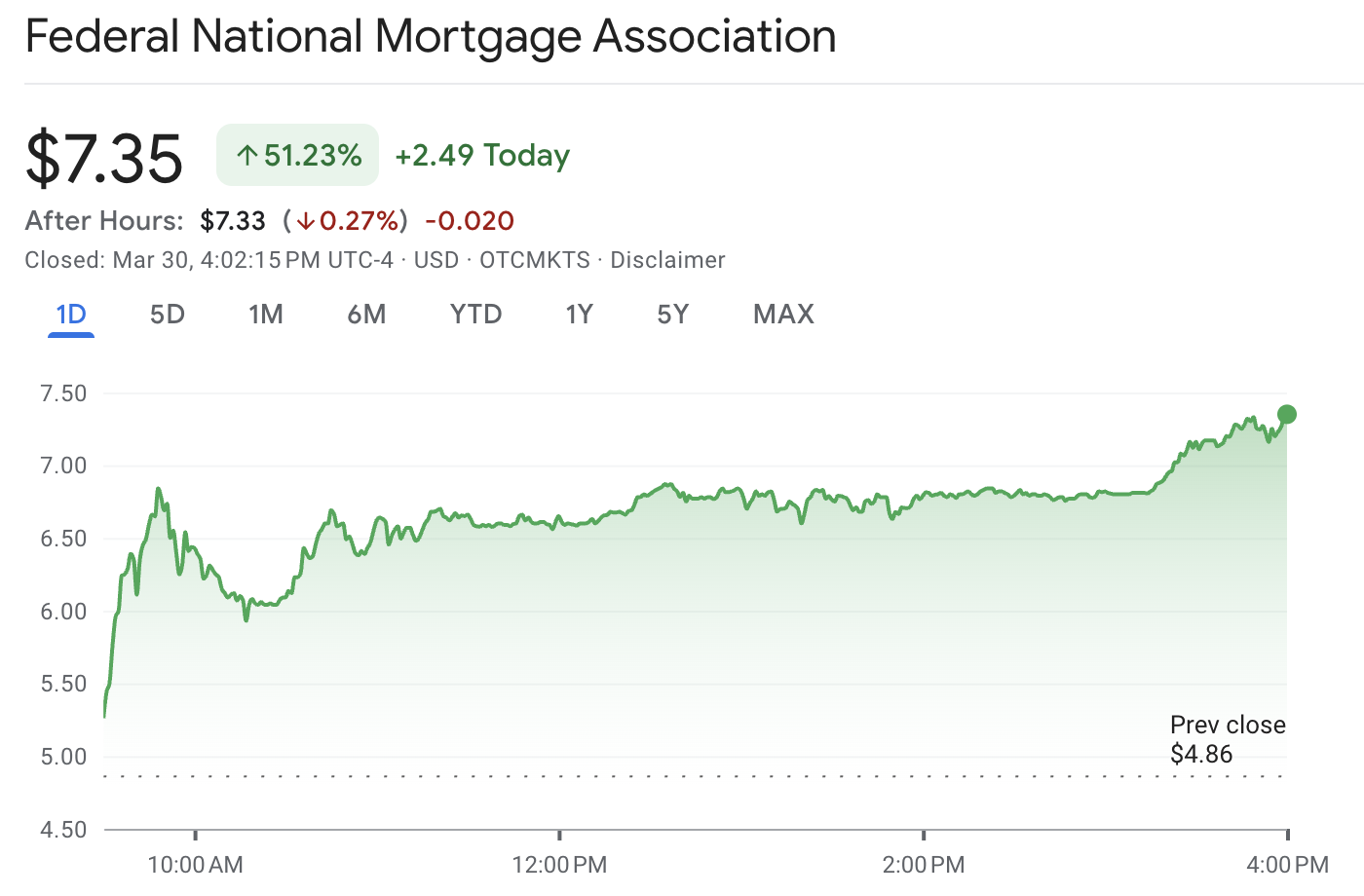
Bill Ackman has put Fannie Mae back in the spotlight. After he called FNMA stock "stupidly cheap," the shares jumped hard, and that was enough to pull many traders back into an old debate. Is this finally a genuine value story, or is it still a political and legal gamble masquerading as a cheap stock?

The high-probability base case over the next 6 to 12 months is not a straight-line move to Ackman's headline upside, but a volatile re-rating as traders weigh a real operating franchise against an unresolved policy and capital structure problem.
The biggest risk is that Fannie Mae can continue to earn money while its common stock fails to reflect that value, as the Treasury and FHFA control the outcome. The line in the sand is $5.25. A sustained break below that level would suggest the latest policy-driven squeeze is fading rather than building into a durable re-rating.
The honest answer is that FNMA is cheap, but not simple. If conservatorship ended on terms that treated common shareholders well, the current stock price could look very low in hindsight. The company is profitable, systemically important, and accumulating net worth.
| Scenario | Probability | Target Range | Primary Trigger | Invalidation Point |
|---|---|---|---|---|
| Base case | 50% | $8.00 to $12.00 | Continued profitability, stable credit metrics, and incremental policy progress without a full release plan | Weekly close below $5.25 |
| Bull case | 25% | $15.00 to $25.00 | Formal FHFA-Treasury roadmap toward recapitalization, relisting, or restructuring of the senior preferred overhang | Failure to reclaim and hold above the 200-day average near $9.86 after a policy headline |
| Bear case | 25% | $3.00 to $5.00 | Conservatorship drags on, the Ackman premium fades, and housing or credit data weaken | Clear release framework from Treasury/FHFA plus sustained trade above $9.86 |
These probabilities are a market framework, not a certainty. They are based on the official terms of conservatorship, Fannie Mae's current capital position, and recent price actions demonstrating how quickly FNMA stock can reprice in response to political headlines.
The operating backdrop is better than the stock's history suggests. Fannie Mae earned $14.4 billion in full-year 2025 and $3.5 billion in the fourth quarter, while total stockholders' equity reached $109.0 billion at year-end.
Its February 2026 monthly summary also showed a $4.13 trillion guaranty book of business and a conventional single-family serious delinquency rate of 0.60%. In terms of pure business quality, this is not a distressed platform.
The macro setup is also supportive at the margin. Fannie Mae's March 2026 housing forecast projects the average 30-year fixed mortgage rate to be 5.8% in 2026. Total home sales are expected to rise to 4.885 million, while single-family mortgage originations are projected to reach $2.426 trillion. Lower rates and higher turnover should help activity, refinancing, and guarantee volumes.
However, none of that makes FNMA a standard value stock. Treasury and FHFA revised the preferred stock purchase agreements in January 2025 to restore Treasury's consent right over any release from conservatorship.
Additionally, FHFA committed to seeking public input before any release. That means the timing and structure of any exit are explicitly political and administrative, not just financial.
Ackman's "stupidly cheap" argument rests on a simple idea: the market is underpricing the odds that Fannie and Freddie will eventually exit conservatorship and regain a more normal equity valuation. That thesis is plausible. The market's reaction to his latest comments indicates a significant pool of capital still willing to pay for that optionality.
The problem is that FNMA's common stock is not a clean claim on reported book value. Under Fannie Mae's own 2025 Form 10-K, the common stock is junior to Treasury's senior preferred stock, common shareholders have no voting rights during conservatorship, no common dividends can be paid without Treasury and FHFA approval, and Treasury holds a warrant that would let it buy shares equal to 79.9% of the fully diluted common base.
That capital stack is the key to the whole story. As of December 31, 2025, Fannie Mae reported $109.0 billion of net worth, but the aggregate liquidation preference of Treasury's senior preferred stock stood at $227.0 billion. It was set to rise to $230.5 billion by March 31, 2026. Fannie also disclosed that the adjusted total capital needed to meet its capital requirements and buffers was $193 billion, while its available capital deficit was $22 billion.
In other words, the business is profitable, but the common equity remains subordinate to a policy-created overhang that dwarfs ordinary value screens. A move into $8 to $12 would be consistent with better sentiment, stable operations, and a market that starts to price in a nonzero probability of a release without yet addressing dilution and senior preferred treatment.
The bull case requires more than a strong earnings print. It needs a concrete policy catalyst. If the Treasury and the FHFA transition from procedural language to establishing a clear framework for recapitalization or asset release, the market will start pricing the common stock based on what it will look like after the restructuring, rather than before.
In this scenario, reclaiming the 200-day moving average around $9.86 would be significant, as it would indicate a shift from a temporary spike in response to events to a genuine trend reversal.
The bull case will be invalidated if any headlines cause a drop below that level or if policymakers clearly indicate that the warrant, the senior preferred stock, and the conservatorship structure will remain largely unchanged.
The bear case is equally realistic. If no formal pathway emerges, then FNMA risks slipping back into the pattern that has trapped it for years: profitable business, unresolved ownership structure, and repeated bursts of speculative enthusiasm that fade. A weaker housing tape would reinforce that.
The bear case is invalidated by a formal release roadmap and sustained trading above $9.86, indicating the market is pricing in a new regime rather than entering another cycle of rumors.
Pivot: $7.20.
Line in the sand: $5.25.
Lower supports: $4.55 and $3.60.
Resistance: $8.40, then $9.20 to $9.80.
FNMA stock is not a conventional deep-value buy. It is a policy-driven special situation with a profitable operating core and a capital structure that still leaves common shareholders behind Treasure's senior preferred claim and a massive dilution overhang.
Ackman may be right that the stock is cheap relative to a favorable release scenario. Under the current circumstances, it's more accurate to say that FNMA provides asymmetric optionality rather than just straightforward value.
While the base case still supports a reevaluation, the thesis will remain robust only if Washington begins to address the structural issues rather than merely debating them.
Disclaimer: This material is for general information purposes only and is not intended as (and should not be considered to be) financial, investment or other advice on which reliance should be placed. No opinion given in the material constitutes a recommendation by EBC or the author that any particular investment, security, transaction or investment strategy is suitable for any specific person.