Published on: 2026-05-19
The TLT ETF decline in 2026 has exposed a critical weakness in how many investors read bond funds. A yield near 5% looks attractive after years of volatile rates, but the iShares 20+ Year Treasury Bond ETF has continued to slide because income is only one side of the trade. The larger force is duration, and duration remains unforgiving when long-term Treasury yields move higher.
TLT traded around $83.56 on May 19, 2026, near the bottom of its 52-week range of $83.30 to $92.19. The fund’s 30-day SEC yield of 4.98% and monthly distribution profile have not been enough to offset pressure from rising long-term yields. With duration near 16 years, even a modest increase in the 20-year or 30-year Treasury yield can erase months of income almost immediately.
TLT’s near-5% yield has not protected investors because long-duration bonds remain highly sensitive to rising Treasury yields.
The ETF has fallen nearly 4% year-to-date, with its price sitting near 52-week lows as the long end of the Treasury curve reprices higher.
A 25 basis point rise in long-term yields can create a price loss of roughly 4%, depending on duration and curve movement.
The fund’s weakness is not a credit-risk story. It is a duration, inflation, real-yield, and term-premium story.
TLT can stabilise only when long-term yields stop rising. Monthly income alone is not enough to reverse the trend.
The main misunderstanding around TLT is that many investors treat it as a simple income product. It is not. TLT is a long-duration Treasury ETF. Its price responds sharply to changes in long-term interest rates, especially the 20-year and 30-year Treasury yields.
Bond prices and yields move in opposite directions. When long-term yields rise, the market value of existing bonds falls. The longer the maturity of those bonds, the larger the price decline. TLT holds long-dated U.S. Treasuries, so its duration risk is structurally high.
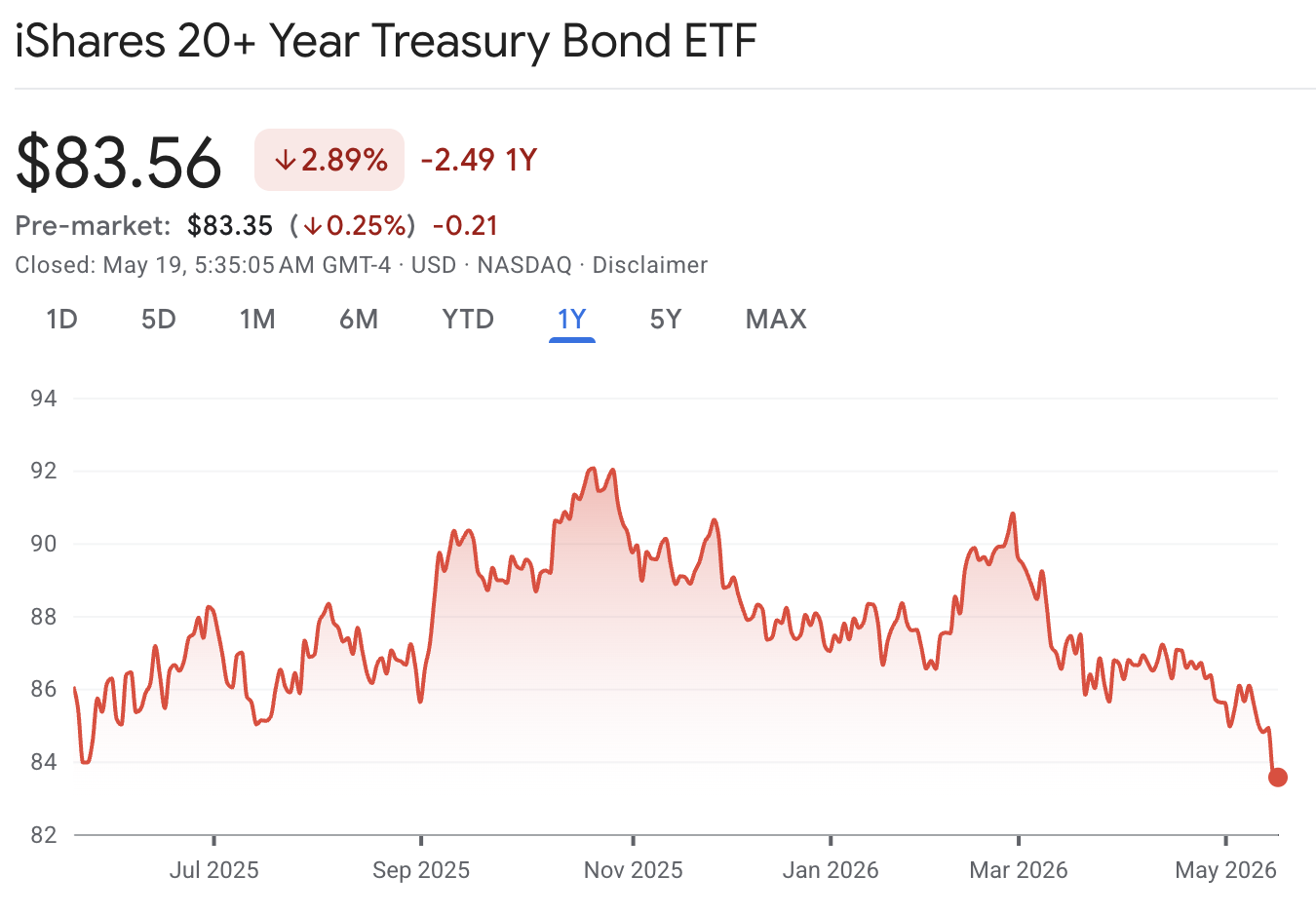
The fund’s yield has risen because bond prices have fallen. That higher yield improves future income potential, but it does not erase the mark-to-market losses that created the higher yield in the first place. This is why a 5% yield can coexist with a falling ETF.
| TLT ETF Metric | May 2026 Reading | Market Meaning |
|---|---|---|
| Price | $83.46 | Near 52-week lows |
| 30-Day SEC Yield | 4.98% | Attractive income, but not full price protection |
| Dividend Yield | 4.59% to 4.66% | Monthly distribution support |
| Expense Ratio | 0.15% | Low cost structure |
| Assets Under Management | About $41.8 billion | Deep liquidity and broad market use |
| 52-Week Range | $83.30 to $92.19 | Price remains near the lower boundary |
| Duration Sensitivity | Around 16 years | High exposure to long-term yield moves |
TLT’s decline is therefore not a contradiction. It is the normal result of long-duration exposure in a rising-yield environment.
Duration is the most important number in the TLT story. It estimates how much a bond fund’s price may change when yields move by 1 percentage point.
For a fund with duration near 16 years, a 100 basis point rise in yields can imply a price decline of about 16%. A 50 basis point increase can imply a decline of roughly 8%. Even a 25 basis point move can matter.
| Long-Term Yield Move | Approximate TLT Price Impact |
|---|---|
| -100 bps | +16.0% |
| -50 bps | +8.0% |
| -25 bps | +4.0% |
| +25 bps | -4.0% |
| +50 bps | -8.0% |
| +100 bps | -16.0% |
This table explains why the yield has failed to stop the slide. A year of income can disappear quickly if long-term rates rise by only a few tenths of a percentage point. The distribution arrives gradually, but price losses arrive immediately.
That timing difference is crucial. Investors collect monthly income over time. The market reprices bond duration every day. In 2026, the repricing has dominated.
Many traders assume TLT should rise whenever the Federal Reserve moves closer to cutting interest rates. That view is too simple.
TLT is more exposed to the long end of the Treasury curve than to overnight policy rates. Short-term rates respond closely to Fed expectations. Long-term yields respond to a broader mix of forces, including inflation expectations, real yields, fiscal deficits, Treasury issuance, foreign demand, auction strength, and term premium.

This distinction explains why TLT can fall even when investors expect future rate cuts. If markets believe inflation will remain sticky, or if investors demand more compensation to hold long-dated debt, the 20-year and 30-year yields can rise anyway. That is damaging for TLT.
The term premium is especially important. It reflects the additional return investors require to hold long-term bonds instead of repeatedly rolling short-term debt. When the term premium rises, long yields can climb even without a major change in Fed policy expectations.
For TLT, that is a direct headwind. The fund does not need the Fed to turn more hawkish to decline. It only needs long-term yields to move higher.
A 5% yield is meaningful, but it should not be confused with a 5% safety margin. In long-duration bond ETFs, the yield is not a floor under the price.
TLT’s yield reflects the income available from the underlying Treasury portfolio. It does not guarantee a positive total return. Total return combines income and price movement. When yields rise, the price movement can be negative enough to overwhelm the income.
This is the hidden risk many traders miss. Higher yield improves the future income profile, but the path to that higher yield often comes through lower bond prices. Investors buying after a decline receive better income than earlier buyers, but they still carry the risk of further losses if yields continue rising.
TLT is therefore best understood as a rate-sensitive macro instrument with income attached. The income matters, but the main trade remains long-term Treasury duration.
The 2026 downtrend reflects more than technical weakness. It shows that the bond market is still demanding a higher return for holding long-term U.S. debt.
Persistent inflation concerns have kept pressure on the long end of the curve. Fiscal deficits have increased attention on Treasury supply. Investors are also more cautious after the severe bond-market losses of recent years. These forces have made long-duration exposure harder to hold, even with higher yields.
The ETF’s large asset base also matters. TLT is widely used by institutional investors, hedge funds, and active traders to express views on long-term rates. That liquidity makes it efficient, but it can also amplify tactical flows when yields break higher. When the long-bond selloff accelerates, TLT often becomes one of the most direct vehicles for that move.
TLT does not need a dramatic policy shift to stabilise. It needs confirmation that long-term yields have stopped rising.
Several conditions would help. Inflation data would need to soften more convincingly. Real yields would need to ease. Treasury auctions would need to show steady demand. The term premium would need to stop expanding. A weaker growth backdrop would also support demand for long-duration Treasuries.
In that environment, TLT’s duration could turn from a liability into an asset. The same sensitivity that hurts the fund when yields rise can drive strong gains when yields fall. A 50 basis point decline in long-term yields could produce a meaningful price recovery before income is included.
That is why TLT remains important despite its 2026 decline. It is still one of the cleanest instruments for trading the long end of the U.S. Treasury market. The issue is not whether TLT has value. The issue is whether investors understand the size of the duration bet they are taking.
TLT is declining because long-term Treasury yields have risen. The ETF holds long-maturity U.S. Treasuries, so its price falls when long-end yields rise. Its income has improved, but the price impact from higher rates has been larger.
The yield accrues over time, while price losses happen immediately when yields rise. With duration near 16 years, even a small increase in long-term yields can erase several months of income.
TLT has low credit risk because it holds U.S. Treasury securities. It does not have low interest-rate risk. Its long maturity profile makes it highly sensitive to changes in long-term yields.
The most important drivers are 20-year and 30-year Treasury yields, inflation expectations, real yields, Treasury supply, and term premium. Fed policy matters, but TLT is driven more by long-end rates than by overnight policy rates.
TLT would need long-term yields to stop rising. Softer inflation data, lower real yields, stronger Treasury auction demand, and a stabilising term premium would all help reduce pressure on long-duration bonds.
The TLT ETF decline in 2026 is best understood as a duration problem, not a yield problem. A near-5% yield has improved the fund’s income profile, but it has not fully protected investors from the sharper force of rising long-term Treasury yields. With its long maturity exposure, TLT remains highly sensitive to even modest changes in the 20-year and 30-year parts of the curve.
TLT still has a clear role for investors seeking exposure to long-dated U.S. Treasuries, especially if inflation cools, real yields fall, and long-term bond demand improves. Until that shift becomes clearer, the fund’s monthly income should be viewed as only one part of the equation.
As long as long-term yields remain under upward pressure, TLT’s yield will remain only a partial cushion against the larger force driving the ETF lower: duration.