Published on: 2026-05-04
Updated on: 2026-05-04
The SMH ETF has become one of the most closely watched vehicles for investors seeking exposure to the artificial intelligence hardware boom. After a sharp rally in semiconductor stocks, the VanEck Semiconductor ETF now sits at the centre of a market debate: whether AI chip demand still justifies premium valuations, or whether the trade has become too crowded.
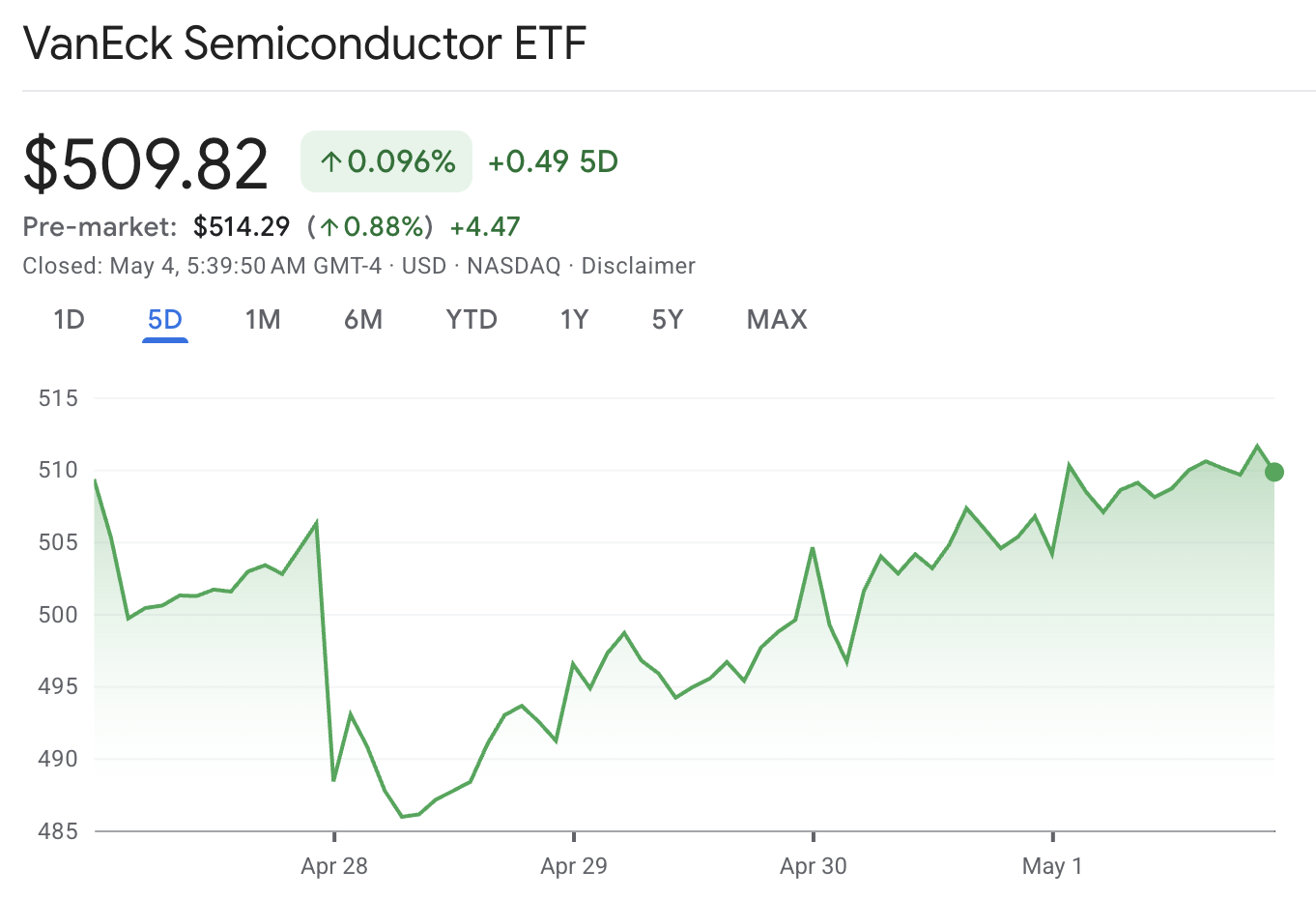
SMH is no longer a niche semiconductor fund. It has become a liquid proxy for the companies building the physical infrastructure behind artificial intelligence, including Nvidia, Taiwan Semiconductor Manufacturing, Broadcom, Intel and AMD. As of May 1, 2026, the fund had $59.33 billion in total net assets, a $509.78 net asset value and a 41.56%year-to-date return.
| SMH ETF Fact | Detail |
|---|---|
| Full name | VanEck Semiconductor ETF |
| Ticker | SMH |
| Launch date | December 20, 2011 |
| Expense ratio | 0.35% |
| Index tracked | MVIS US Listed Semiconductor 25 Index |
| Total net assets | $59.33 billion |
| NAV | $509.78 |
| YTD return | 41.56% |
| Total holdings | 26 |
| 30-day SEC yield | 0.19% |
| 12-month yield | 0.22% |
SMH seeks to track the MVIS US Listed Semiconductor 25 Index, which is designed to follow companies involved in semiconductor production and equipment. Its structure makes it more targeted than broad technology funds such as QQQ, but also more sensitive to sector-specific earnings, valuation and supply-chain risks.
The investment case for SMH rests on a simple but powerful premise: artificial intelligence requires massive computing infrastructure. Training and running AI models depends on GPUs, custom accelerators, high-bandwidth memory, advanced packaging, networking chips and leading-edge foundry capacity.
That demand has turned semiconductors into one of the market’s most important growth themes. The sector is no longer driven only by traditional cycles in PCs, smartphones and consumer electronics. It is increasingly tied to the capital-expenditure plans of the world’s largest technology companies.
For SMH, that creates a direct link between investor returns and AI infrastructure spending. When hyperscalers expand data-centre budgets, chipmakers, foundries and equipment suppliers benefit. When those budgets are questioned, semiconductor valuations can reprice quickly.
SMH’s appeal comes from its exposure to the dominant companies in the semiconductor value chain. Its risk comes from the same place. The below shows the top 10 holdings of SMH's during March 2026.
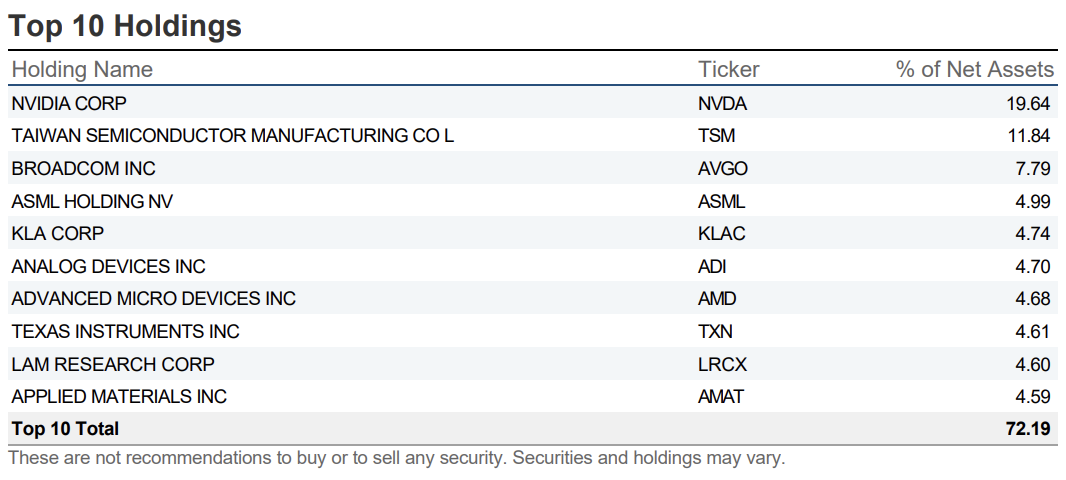
In VanEck’s latest holdings snapshot available in May 2026, Nvidia was the fund’s largest holding at 17.01% of net assets, followed by Taiwan Semiconductor Manufacturing at 10.50%, Broadcom at 7.95%, Intel at 7.02% and AMD at 6.17%. Together, those five holdings accounted for 48.65% of the portfolio.
| Holding | Weight | Role in the AI Chip Chain |
|---|---|---|
| Nvidia | 17.01% | AI GPUs and accelerators |
| TSMC | 10.50% | Advanced chip manufacturing |
| Broadcom | 7.95% | Networking and custom silicon |
| Intel | 7.02% | CPUs, foundry strategy and manufacturing |
| AMD | 6.17% | CPUs and AI accelerators |
This is not broad diversification in the traditional sense. SMH owns 26 positions, but performance can still be dominated by a small group of mega-cap chip leaders. That concentration can amplify gains when the AI trade is strong, but it can also deepen losses if Nvidia, TSMC or Broadcom miss expectations.
The strongest argument for SMH is that AI infrastructure demand remains in a multi-year buildout. Large technology companies are still expanding data centres, securing accelerator supply and investing in faster networking infrastructure.
This supports several layers of the SMH portfolio. Nvidia benefits from AI compute demand. TSMC benefits from leading-edge chip production. Broadcom benefits from custom silicon and networking. AMD competes in AI accelerators and data-centre processors.
Equipment suppliers such as ASML, Lam Research and Applied Materials benefit when foundries expand fabrication capacity.
The fund also benefits from the strategic importance of semiconductors. Chips are now central to national security, cloud computing, defence systems, industrial automation and advanced manufacturing. That policy and corporate support gives the sector a stronger long-term foundation than a conventional cyclical hardware trade.
The challenge is that investors are no longer buying the AI chip theme early. Semiconductor stocks have already priced in years of strong demand, resilient margins and heavy AI capital spending.
That leaves a thinner margin for error. Earnings do not simply need to be good. In many cases, they need to be strong enough to support elevated expectations. If guidance slows, order growth weakens or hyperscalers signal more disciplined AI spending, SMH could be vulnerable to multiple compression.
The fund’s low yield reinforces its growth orientation. With a 30-day SEC yield of 0.19% and a 12-month yield of 0.22% as of May 2026, SMH is a capital-appreciation vehicle rather than an income investment.
SMH also carries geopolitical risk. The fund has meaningful exposure to Taiwan through TSMC, which remains central to advanced semiconductor manufacturing. US-China technology competition, export controls and Taiwan-related tensions can all affect sentiment toward the sector.
These risks may not dominate daily trading, but they matter for valuation. Semiconductor supply chains are global, capital-intensive and politically sensitive. Any disruption to advanced manufacturing or equipment access could move the entire ETF.
SMH remains one of the clearest ETF vehicles for investors who want direct exposure to the AI chip cycle. Its scale, liquidity and concentrated portfolio make it a powerful way to express a bullish view on semiconductor demand.
But the trade has matured. With assets above $59 billion, a year-to-date gain above 41%, and heavy exposure to a handful of AI-linked leaders, SMH is no longer a quiet sector allocation. It is a high-expectation growth trade.
For investors, the question is not whether semiconductors matter. They are essential to AI, cloud infrastructure and advanced computing. The real question is whether the price already reflects too much of that future.