Published on: 2026-05-20
Updated on: 2026-05-20
The SPY ETF, formally known as the SPDR S&P 500 ETF Trust, is one of the world’s most liquid instruments for gaining exposure to U.S. large-cap equities. For traders, SPY provides a direct way to track the S&P 500, the benchmark covering leading U.S. companies across technology, financials, health care, consumer sectors, industrials and energy.

SPY is not only widely used because it tracks the S&P 500. It is valued for its scale, deep liquidity, options availability and long operating history. Launched in January 1993, SPY was the first exchange-traded fund listed in the United States and remains a core instrument for institutional traders, hedge funds, active investors and retail market participants.
| Category | Detail |
|---|---|
| Ticker | SPY |
| Name | SPDR S&P 500 ETF Trust |
| Issuer | State Street SPDR |
| Investment Focus | U.S. Large Cap |
| Management Scale | Mega-scale, around $760 billion |
| Benchmark | S&P 500 Index |
| Inception Date | Jan 22, 1993 |
| Gross Expense Ratio | 0.0945% |
| Distribution Frequency | Quarterly |
| Options Available | Yes |
SPY is issued by State Street SPDR, one of the largest ETF providers globally and the creator of the first U.S.-listed ETF. The fund seeks to track the price and yield performance of the S&P 500 Index before expenses, giving traders exposure to a diversified basket of large-cap U.S. companies.
Its scale matters. A mega-scale ETF typically attracts deep liquidity, active institutional participation and tighter market pricing. For traders, those qualities can make SPY more practical than narrower or less liquid funds when entering or exiting positions quickly.
SPY is driven by the same forces that move the S&P 500. The most important include U.S. corporate earnings, Federal Reserve policy, inflation data, Treasury yields, employment figures and investor appetite for risk assets.
Sector leadership also matters. Because the S&P 500 is market-cap weighted, large technology and communication-services companies can have an outsized effect on SPY performance. When mega-cap growth stocks rise, SPY often benefits. When those same names fall, SPY can weaken even if some defensive sectors remain stable.
Traders should also watch market breadth. A SPY rally supported by many sectors is usually healthier than one driven by only a handful of large stocks. Breadth helps confirm whether the move reflects broad market strength or concentrated leadership.
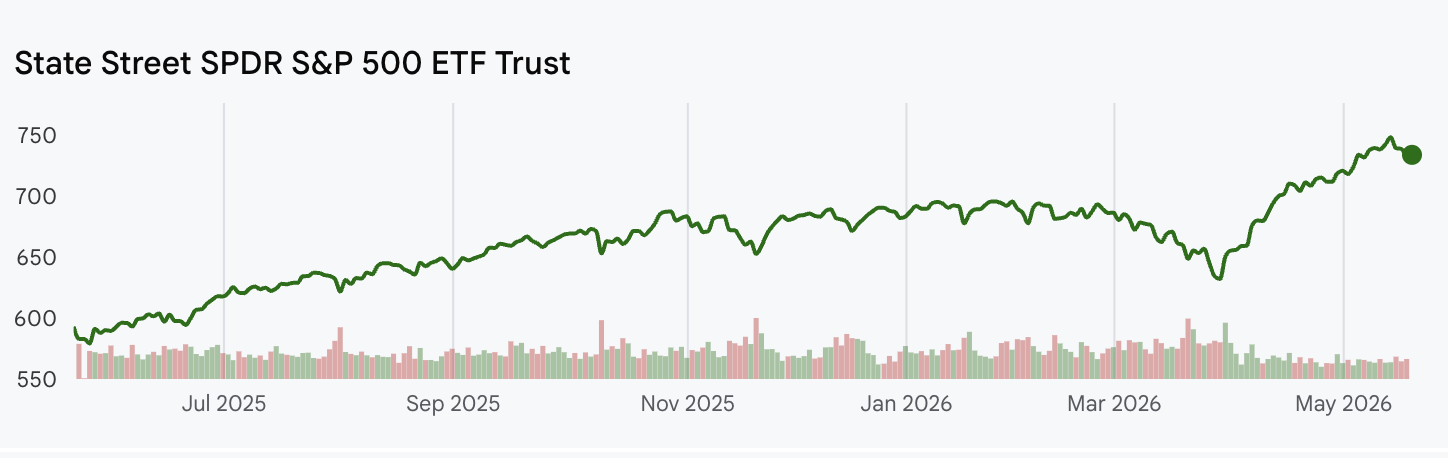
SPY’s historical performance reflects the strength of U.S. large-cap equities across multiple market cycles. The latest total return data show strong performance over one, three, five and 10 years. Total return includes price appreciation and reinvested distributions.
| Period | SPY Return |
|---|---|
| 1-year total return | 25.60% |
| 3-year annualised return | 22.37% |
| 5-year annualised return | 13.82% |
| 10-year annualised return | 15.44% |
These figures explain why SPY remains central to global ETF trading. The 1-year return reflects recent momentum, while the longer annualised returns show how SPY has compounded through different interest-rate, earnings and liquidity cycles.
That said, historical returns should not be treated as a trading signal. SPY can still experience sharp drawdowns during recessions, valuation resets, inflation shocks or aggressive monetary tightening.
Trading SPY begins with understanding what the instrument represents. SPY is not a single-company trade. It is a broad U.S. equity-market trade. When traders buy SPY, they are effectively taking a view on U.S. large-cap equities through the S&P 500.
A bullish trader may look at SPY when market breadth is improving, earnings expectations are rising and risk appetite is strong. A defensive trader may reduce exposure, hedge, or use short exposure where suitable when valuations are stretched, earnings momentum weakens or macro risks rise.
Direct ETF trading
Traders buy or sell SPY units through a securities brokerage account. This is suitable for those who want direct ETF ownership.
ETF CFD trading
Traders speculate on SPY price movements without owning the underlying ETF units. This structure allows long and short trading, often with leverage.
Options trading
More advanced traders use SPY options to express directional, volatility or hedging strategies.
For traders focused on flexibility, ETF CFDs can be useful because they allow exposure to SPY price movement without requiring direct ownership of the ETF.
EBC Financial Group provides access to SPY through its ETF CFD product range. The platform offers 100 popular global ETF CFDs, including equity, bond, thematic and leveraged ETFs. EBC’s ETF CFD structure allows traders to access ETF price movements without owning the underlying ETF shares.
For SPY, this means traders can take positions on the price movement of the SPDR S&P 500 ETF Trust without holding the fund units directly. EBC’s ETF CFD framework supports long and short trading, with leverage available on the platform.

This structure suits traders who want to react quickly to shifts in U.S. equity sentiment. SPY ETF CFDs can be used to express views on Federal Reserve policy, earnings season, inflation releases, employment data or broader risk appetite.
EBC also highlights access to more than 25 top-tier liquidity venues, supported by Smart Order Routing and real-time market depth. For active ETF CFD traders, execution quality and transparent pricing are as important as product access.
Visit the EBC Financial Group official website at ebc.com and select Sign Up or Open Account.
Complete the registration form with the required personal details and follow the identity verification process.
Once the account is approved, choose the trading platform and account type available in your region.
Fund your account using one of the supported payment methods.
Search for ETF CFD products available on the platform, including major ETF-linked instruments such as SPY, VOO, QQQ, sector ETFs, commodity-linked ETFs and leveraged ETF CFDs.
Review the product specifications before trading, including spreads, margin requirements, leverage and overnight financing terms.
Place long or short ETF CFD trades according to your market view, while applying suitable position sizing and risk management.
SPY is diversified, but it is not risk-free. It remains an equity-market instrument and can decline when the S&P 500 falls.
The main risks include:
Market risk: SPY can fall during broad equity sell-offs.
Concentration risk: Large index constituents can heavily influence performance.
Rate risk: Higher Treasury yields can pressure equity valuations.
Macro risk: Inflation, recession concerns and policy shocks can affect sentiment.
Leverage risk: Trading SPY as a CFD can magnify both gains and losses.
For ETF CFD traders, leverage requires particular discipline. A leveraged position can increase capital efficiency, but it also means smaller market moves can have a larger impact on account equity.
SPY remains one of the most important ETF products in global markets. Its issuer, State Street SPDR, its S&P 500 exposure, its options ecosystem and its mega-scale liquidity profile make it a central instrument for traders seeking broad U.S. equity exposure.
The latest performance record shows strong returns across one, three, five and 10 years, but trading decisions should still be based on market conditions, risk tolerance and execution discipline.
For traders who want to trade SPY price movement without directly holding ETF units, EBC provides SPY access through its ETF CFD lineup. The product structure offers long and short flexibility, access to broader ETF CFD markets and a practical route for active traders who understand both the opportunity and the risks of leveraged CFD trading.