Published on: 2026-02-10
The recent surge in CRDO stock is tied to a sharp upward revision in near-term revenue expectations, rather than a broad shift in market sentiment. Credo’s latest update points to stronger demand for high-speed connectivity in AI data centres, where each additional GPU rack typically increases spending on cables, retimers, and optical interconnects.
As this spending accelerates, suppliers with qualified designs can shift quickly from a growth narrative to measurable financial performance.
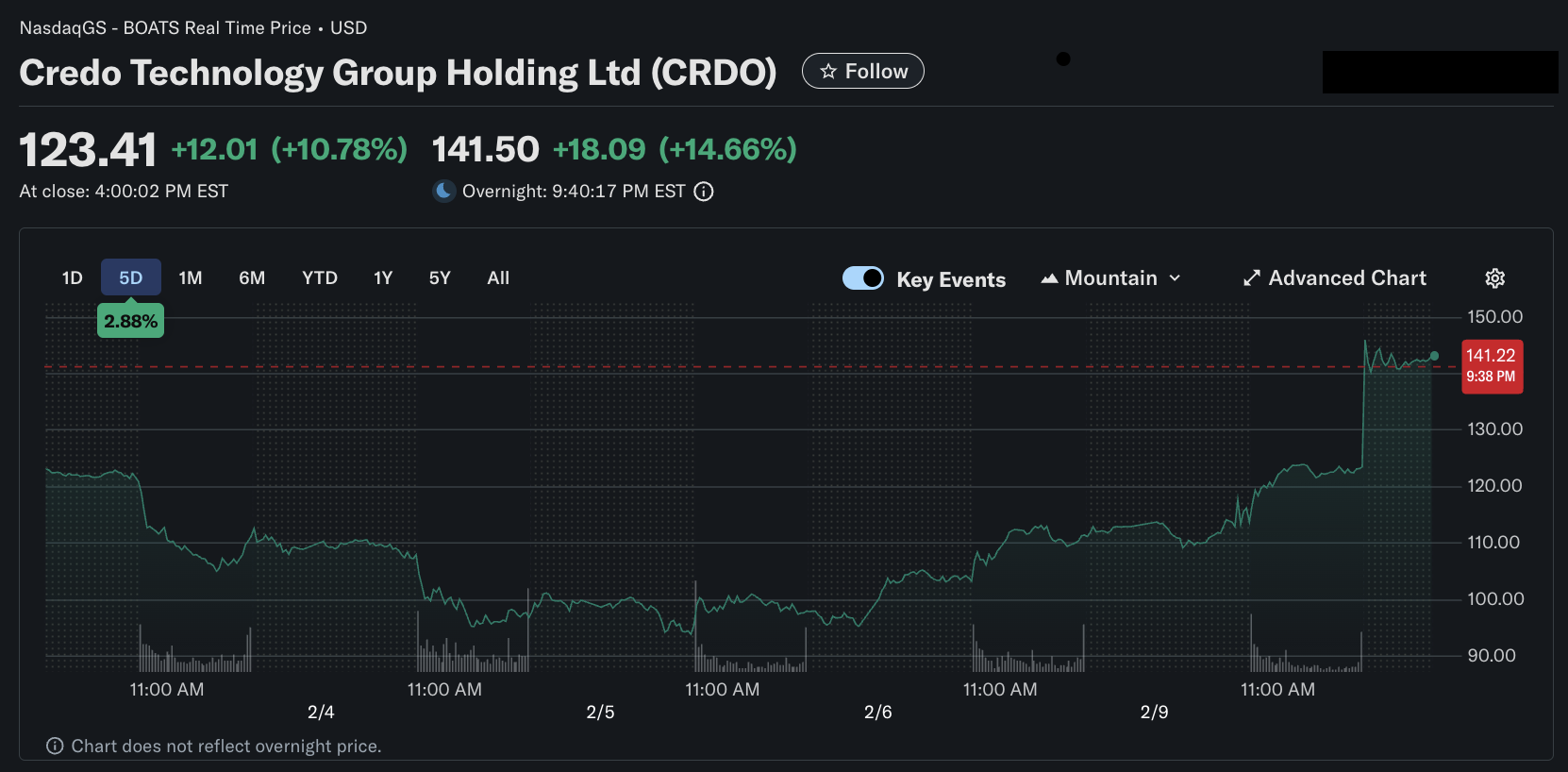
The latest CRDO stock jump was decisive: CRDO closed on February 9, 2026 at $123.41, up $12.01 or 10.78 percent from the prior close of $111.40, with volume around 7.7 million shares. In after-hours trading the same day, the stock traded near $143.13, implying a further 15.98 percent move from the regular-session close. This highlights how quickly positioning can shift after a company update.
| Period (as of Feb 10, 2026 update) | Return |
|---|---|
| 1 day | +10.78% |
| 1 month | -17.96% |
| Year-to-date | -14.23% |
| 6 months | +4.08% |
| 1 year | +59.69% |
Put differently, CRDO is about 42.28 percent below its 52-week high of $213.80, yet still about 324.24 percent above the 52-week low of $29.09. That mix of strong longer-term gains and deep peak-to-trough swings explains why the CRDO stock rally can look explosive on headline days even as the broader trend remains prone to sharp, liquidity-driven reversals.

Credo said it expects to report preliminary fiscal Q3 2026 revenue of $404M-$408M, above its prior $335M-$345M outlook. A step change of this size typically forces rapid revisions to revenue and earnings models, and can reset valuation assumptions in the short term.
Management also pointed to mid-single-digit sequential growth in fiscal Q4, suggesting momentum is carrying over rather than reverting. Markets pay up when the beat looks repeatable, not episodic.
The update reinforced that hyperscaler AI buildouts are pulling forward spending on high-speed connectivity (retimers, AECs, optical attach). Credo sits in the “must-have” plumbing layer, where bandwidth upgrades quickly translate into orders.
In the prior reported quarter (fiscal Q2), Credo posted 67.7% non-GAAP gross margin and $0.67 non-GAAP EPS. High margins mean incremental revenue tends to drop through to profit faster, so a revenue upside surprise has an outsized impact on earnings expectations.
Credo Technology Group sells the “plumbing” that enables AI to compute at scale: active electrical cables, retimers, optical DSPs, and related connectivity silicon. When hyperscalers expand clusters, the networking stack becomes more complex and costly because bandwidth requirements increase and signal integrity becomes more challenging over greater distances.
Recently reported results already showed that the engine is running hot:
| Fiscal period | Revenue | YoY growth | QoQ growth | Non-GAAP EPS | Cash and short-term investments |
|---|---|---|---|---|---|
| Q1 FY2026 (ended Aug 2, 2025) | $223.1M | 274% | 31% | $0.52 | $479.6M |
| Q2 FY2026 (ended Nov 1, 2025) | $268.0M | 272% | 20% | $0.67 | $813.6M |
| Q3 FY2026 (ended Jan 31, 2026) (prelim) | $404M-$408M | n/a | n/a | n/a | n/a |
Margins are notably robust for a company experiencing rapid growth. In fiscal Q2, the non-GAAP gross margin reached 67.7 percent, with non-GAAP net income of $127.8 million. This high gross margin indicates that Credo is delivering performance-critical devices with significant pricing power and qualification barriers, rather than merely supplying commoditised components.
The company’s balance sheet is improving in tandem with its growth. Cash and short-term investments increased to $813.6 million at the end of fiscal Q2. This financial strength reduces financing risk and enhances strategic flexibility, particularly as leading AI infrastructure companies seek to expand their product portfolios.
The January product release around Blue Heron is a useful lens for why demand can step higher in bursts.
The device targets 224G scale-up networking, where electrical budgets and physical layout constraints can limit rack-scale design. Credo highlighted the full recovery of a 224G link with 40+ dB, enabling more flexible placement of GPUs and switch silicon. Blue Heron is also built on an advanced 3nm process, using Credo’s 224G SerDes, positioning it at the leading edge of signal integrity and power-efficiency trade-offs.

A key consideration for the market is the implication for content per rack. As GPU fabrics evolve toward rack-scale, heterogeneous architectures, the interconnect bill of materials may increase faster than that of compute units. This is due to the heightened requirements for retiming, error-correction monitoring, and telemetry as speed and density increase. Credo’s product release underscores the importance of telemetry, mission-mode FEC monitoring, and integration with its PILOT platform.
In the Blue Heron release, 650 Group Founder and Analyst Alan Weckel said the scale-up networking market could exceed $40 billion by 2030, driven by rack-scale architectures that use multiple fabrics.
Rapid growth in hardware markets can be undermined if competitors succeed in commoditizing core technologies. Strong intellectual property defensibility is a critical countermeasure against this risk.
Credo announced a patent license and mutual covenant agreement with 3M regarding patents covering active electrical cable technology, with the terms kept confidential. It also disclosed a separate patent license agreement with The Siemon Company tied to the same technology area.
Even in the absence of disclosed financial terms, the signaling effect of these agreements is evident. The licensing outcomes suggest that Credo considers its AEC intellectual property to possess enforceable value. Such agreements can also mitigate litigation risk and create opportunities for additional monetization.
After the latest surge, the stock traded around $123 with a 52-week range of roughly $29 to $214, reflecting high volatility and a wide dispersion of investor expectations.
Analyst price targets vary by provider and change frequently. Several widely used trackers show targets above the current price, with published ranges of $250-$262 and some higher quotes near $260. Use targets as sentiment inputs, not as price promises, and re-check them after the next earnings release.
A key risk is that the company’s valuation may exceed its operational performance. With a price-to-earnings ratio frequently in the triple digits during market rallies, CRDO must continue to deliver strong results rather than relying solely on AI sentiment.
Price action has been fast, and that is visible in indicators:
| Indicator | Latest reading | What it suggests |
|---|---|---|
| RSI (14) | 68.811 | Strong momentum, approaching overbought |
| MACD (12,26) | 3.18 | Trend support remains bullish |
| EMA 20 | 114.87 | Price is above short-term trend |
| EMA 50 | 115.08 | Intermediate trend has turned supportive |
| EMA 200 | 131.67 | Longer trend remains overhead resistance |
| Support (Classic S1 / S2 / S3) | 121.99 / 121.53 / 120.68 | Near-term buy zones cluster tightly |
| Resistance (Classic R1 / R2 / R3) | 123.30 / 124.15 / 124.61 | Breakout needs follow-through volume |
The takeaway is constructive but unstable. With RSI near 69 and pivot points compressed, the stock can move quickly between support and resistance, then retrace just as fast if buyers hesitate. The 200-day EMA above the price also signals the longer-term trend is still rebuilding, which can attract sellers into strength.
1) Customer concentration and capital expenditure timing are significant risks. AI connectivity spending is ultimately determined by hyperscaler build schedules. Any delay in platform transitions or pauses in capital expenditures can rapidly constrain sequential growth, particularly after expectations have been raised.
2) Competitive pressure is intense in the high-speed connectivity market, with both major semiconductor companies and specialized firms targeting retimers, optical DSPs, and interconnect solutions. Securing initial design wins is insufficient; maintaining design integration through subsequent bandwidth transitions is essential to sustaining valuation premiums.
3) Margin durability. Credo’s gross margins are elite for this growth phase. If mix shifts toward lower-margin products or pricing tightens, earnings leverage can weaken even if revenue stays strong.
4) Volatility and investor positioning are notable considerations. A stock that fluctuates from $29 to over $200 within a year tends to attract both momentum traders and long-term investors. This dynamic often heightens the risk of significant price gaps around company updates and earnings announcements.
The next significant catalyst is the upcoming earnings event. Credo will report results for the quarter ending January 31, 2026, with a conference call scheduled for March 2, 2026. The earnings release will be distributed after the market closes on that date.
Three items will likely drive the next leg:
Q4 revenue guide clarity. The market already has a stronger Q3 baseline. The next question is whether Q4 implies a controlled glide path or another step higher.
Product mix details will be closely monitored. Investors will assess whether growth is primarily driven by active electrical cable (AEC) volume, optical attach rates, retimers, or intellectual property licensing, as the product mix has direct implications for margin durability.
Production ramp dynamics are also critical. For products such as Blue Heron, management’s commentary regarding the transition from sampling to full production and the timelines for customer qualification will be important factors.
CRDO is moving higher after Credo said it expects to report preliminary fiscal Q3 revenue of $404 million to $408 million, above its prior guidance range. That magnitude of upside typically forces analysts to revise forward revenue and earnings assumptions, which can drive a rapid re-pricing.
Credo provides high-speed connectivity products across copper and optical interconnect: active electrical cables, optical DSPs, retimers, and related SerDes technology. These components sit on the critical path between GPUs, switches, and racks, where bandwidth and signal integrity constraints are most acute.
The move is anchored in reported and guided numbers. Fiscal Q2 revenue was $268.0 million with non-GAAP EPS of $0.67, and the company’s preliminary fiscal Q3 revenue range implies a sharp sequential step-up. AI sentiment can amplify the move, but the trigger is fundamentals.
The next earnings release and call are the central catalysts because they should convert preliminary revenue into full results and provide forward guidance. Commentary on customer demand, product ramps, and margin trajectory will likely determine whether the market treats the surge as sustainable.
Momentum is strong but nearing stretched levels. RSI(14) around 68.8 is a buy signal but close to overbought territory, while pivot supports and resistances are tightly packed around the low-$120s, suggesting the stock may remain volatile.
The recent surge in CRDO’s stock price reflects a market re-pricing prompted by an exceptionally large upward revision in guidance. Preliminary fiscal Q3 revenue of $404 million to $408 million shifted the narrative from rapid to accelerated growth, reinforcing the view that Credo’s interconnect content is scaling in tandem with the expansion of AI infrastructure.
The bull case rests on two pillars: sustaining elite margins while expanding attach rates in scale-up and scale-out networks, and converting product and IP advantages into durable multi-cycle design wins. The bear case is simpler: expectations have risen sharply, and any deceleration, mix shift, or competitive compression can translate into sudden multiple risks. With earnings expected in early March, the next update will likely determine whether this marks the start of a new trend leg or a momentum spike that needs to be consolidated.
Disclaimer: This material is for general information purposes only and is not intended as (and should not be considered to be) financial, investment or other advice on which reliance should be placed. No opinion given in the material constitutes a recommendation by EBC or the author that any particular investment, security, transaction or investment strategy is suitable for any specific person.