Published on: 2026-02-09
Updated on: 2026-02-09
Hims & Hers (HIMS) stock is falling because of the FDA’s explicit identification of the company in a new enforcement initiative targeting non-FDA-approved compounded GLP-1 drugs. The FDA also issued warnings regarding specific marketing claims and indicated the possibility of legal actions, such as seizure and injunction. These developments have prompted investors to reassess regulatory, supply, and advertising risks simultaneously.
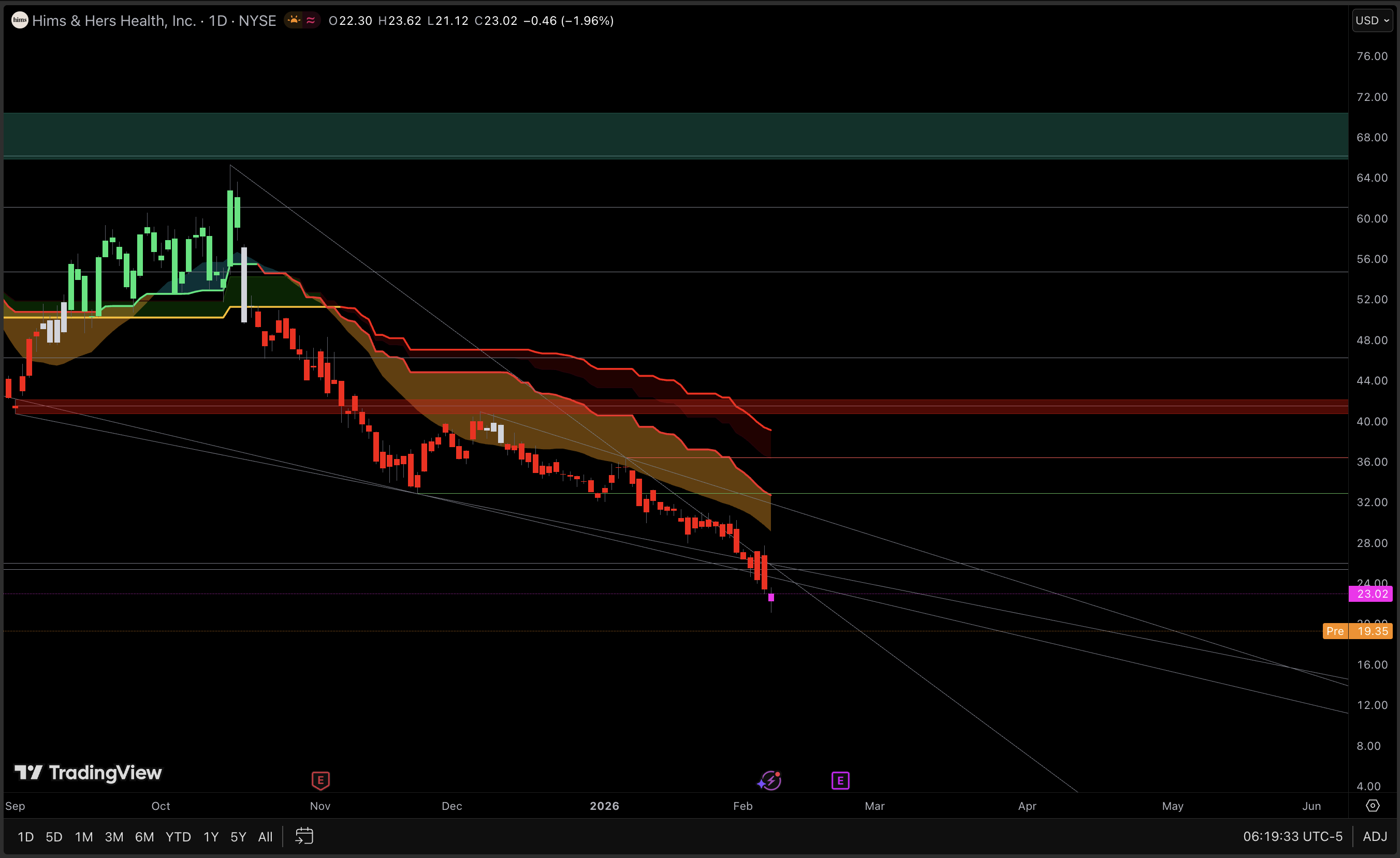
The catalyst was a significant policy shift. When regulators indicate potential restrictions on access to essential drug ingredients and explicitly warn that certain advertising claims may constitute violations, investors shift their valuation approach. Instead of focusing on optimistic growth projections, they prioritize survival probabilities and anticipated compliance costs.
The FDA stated it intends to restrict GLP-1 active pharmaceutical ingredients used in non-FDA-approved compounded drugs that are mass-marketed as alternatives, and it named Hims & Hers directly. That is broader than one product launch.
The launch of Hims’ $49 compounded semaglutide pill became a focal point because its economic viability relied on large-scale marketing, which the FDA directly addressed in its enforcement message.
Investors are also pricing a “repeat offense” problem. The FDA previously warned Hims about language implying that compounded semaglutide was the same as approved drugs and “clinically proven,” and the company used a similar framing again in its recent announcement.
The negative impact extends beyond the oral pill. If the crackdown further restricts the availability of active pharmaceutical ingredients (APIs) and marketing claims for compounded GLP-1s, it may adversely affect conversion rates, customer retention, and profit margins across the broader weight-loss segment.
Given HIMS’s elevated valuation multiple, any increase in regulatory uncertainty prompts investors to apply a higher discount rate to projected future growth, resulting in rapid share price adjustments.
Hims announced on February 5, 2026, that it would expand its weight-loss offering by enabling providers to prescribe a compounded semaglutide pill, with an introductory price of $49 for the first month, then $99 per month on a multi-month plan.
Within a day, the FDA issued a statement that went past general caution and into explicit enforcement intent: it said it plans “decisive steps” to restrict GLP-1 APIs intended for non-FDA-approved compounded drugs that are being mass-marketed as similar alternatives, specifically including Hims & Hers. It also warned companies against making certain claims in promotional materials, including stating that compounded products are the same as FDA-approved drugs, use the same active ingredient, or are clinically proven to produce results.
This combination of factors explains the sharp decline in the stock price. The FDA’s actions went beyond general criticism of compounding and specifically targeted the two essential elements necessary for the $49 offer to succeed at scale:
ingredient access at a reliable volume, and
conversion-friendly messaging that makes consumers feel they are buying the equivalent of a branded GLP-1.
The economics of compounded GLP-1 products are driven more by input availability and regulatory permissions than by telehealth delivery models. If access to APIs becomes restricted, the marginal cost of serving additional patients increases, fulfillment reliability declines, and overall customer experience worsens.
The FDA has already been building infrastructure to police GLP-1 ingredients, including border measures to prevent certain GLP-1 APIs with quality concerns from entering the supply chain.
The market, which previously valued Hims’ weight-loss initiatives as an expanding, repeatable growth channel, must now reassess them as a constrained, compliance-intensive business segment.
The FDA’s phrasing is not accidental. It singled out compounded GLP-1s being “mass-marketed” as alternatives.
Mass marketing transforms a niche compounding process into a scalable consumer subscription model, which is a key concern for investors. If regulatory enforcement restricts large-scale promotion, telehealth platforms lose their primary advantage over localized, patient-specific compounding: the ability to acquire customers efficiently at scale.
Consumer demand for GLP-1 products in the cash-pay segment is highly price-elastic. While a low initial price attracts potential customers, conversion is often driven by reassurances of product equivalence, such as claims of “same active ingredient,” “same results,” or “clinically proven” efficacy.
The FDA explicitly listed those exact claim categories as unacceptable for non-FDA-approved compounded products.
Even if companies retain the ability to compound under specific conditions, the loss of high-conversion marketing language necessitates a revision of the sales funnel. This typically results in reduced conversion rates, increased customer acquisition costs, and a longer payback period for marketing expenditures.

The current selloff also reflects concerns about the company’s credibility, as well as policy-related risks.
In September 2025, the FDA issued a warning letter addressed to Hims & Hers leadership after reviewing the forhers.com website and identifying compounded semaglutide claims it called false or misleading, including language asserting a “weekly injectable GLP-1 with the same active ingredient as Ozempic and Wegovy” and “clinically proven ingredients.”
Now look at the February 2026 weight-loss pill announcement: it describes a compounded semaglutide pill “with the same active ingredient as Wegovy.”
Separately, the FDA’s February 2026 enforcement statement again called out the “same active ingredient” and “clinically proven” claim types as lines companies cannot cross in promotional materials.
This pattern prompts investors to question whether these incidents represent isolated missteps or a recurring issue with the company’s regulatory compliance approach. When market participants perceive a lack of boundary discipline, they assign greater probability to forced product removals, fines, injunctions, and increased ongoing compliance costs.
A $49 entry price does two things economically:
It expands the addressable market by attracting consumers priced out of branded GLP-1s.
It reframes the purchase as a subscription decision rather than a high-stakes medical expense.
But the economics only work if three conditions hold:
predictable ingredient supply,
consistent fulfillment quality, and
stable conversion rates from advertising into paid plans.
The FDA’s concerns page highlights issues that directly threaten those conditions: shipping temperature problems for injectables, fraud risks in the supply chain, and dosing errors that can lead to adverse events and hospitalizations.
Even if Hims maintains robust internal pharmacy standards, regulatory authorities are indicating systemic consumer risks across the category. This perception increases compliance costs for all large-scale operators.
Hims is coming into this with real operating momentum. In Q3 2025, it reported $599.0 million in revenue, 2.471 million subscribers, and $80 in monthly online revenue per average subscriber. It also guided to $2.335 billion to $2.355 billion in 2025 revenue and $307 million to $317 million in adjusted EBITDA.
The market does not doubt Hims’ ability to sell telehealth services. Instead, it questions whether the weight-loss segment will remain as scalable and profitable as previously anticipated by investors.
Here is the practical earnings bridge investors are now stress-testing:
| Pressure point | What changes if enforcement tightens | Why the stock reacts fast |
|---|---|---|
| Customer acquisition | Lower conversion without “equivalence” messaging | CAC rises, payback stretches |
| Revenue durability | Higher churn if supply or access becomes inconsistent | LTV assumptions fall |
| Gross margin | Ingredient and QA costs rise with tighter API scrutiny | Margins compress |
| Operating expense | Legal, compliance, and monitoring costs step up | EBITDA sensitivity increases |
| Strategic optionality | Partner talks become harder under legal friction | Growth multiple compresses |
The FDA has been explicit that compounding exceptions narrow when shortages resolve. For semaglutide injections, the FDA determined the shortage was resolved in February 2025 and subsequently laid out time-limited enforcement discretion windows.
This historical context is significant because it positions the industry’s compounded GLP-1 expansion as a temporary opportunity that will diminish as branded supply stabilises. When regulators determine that the temporary phase has concluded, the resulting shift can be abrupt, disproportionately affecting platforms reliant on scale.
Website and funnel changes: Whether Hims materially rewrites GLP-1 marketing language to align with the FDA’s stated boundaries.
Scope of ingredient restriction: The practical impact of any API restrictions on compounded GLP-1 availability and lead times.
Brand partnerships: Hims previously disclosed discussions to make branded Wegovy injections and the oral Wegovy available through its platform, but with no definitive agreement. Any update here can reset the narrative.
Earnings and Guidance: The next significant milestone is the company’s Q4 and full-year 2025 results, scheduled for February 23, 2026. Investors will closely evaluate management’s commentary on weight-loss demand, compliance strategy, and margin outlook.
Because the FDA signaled it may restrict GLP-1 ingredients used in mass-marketed compounded drugs and warned against the exact advertising claims that drive conversion. That combination raises the probability of forced product pullbacks and higher compliance costs, which compresses the stock’s growth multiple.
Not broadly in a single sentence. The FDA’s message is narrower but sharper: it intends to take action against non-FDA-approved compounded GLP-1s that are mass-marketed as alternatives, and it warned that violations can lead to seizure or an injunction. That is enough to materially chill the category at scale.
It signaled a push to make GLP-1 weight loss a mainstream, cash-pay subscription product. That changes growth expectations. When regulators challenged the ability to market and supply the offer at scale, investors repriced the entire upside of weight loss rather than just one SKU.
In 2025, the FDA cited Hims-related marketing language implying compounded semaglutide was the same as approved drugs and “clinically proven.” A similar “same active ingredient” framing appeared again in the 2026 pill announcement. Markets punish repeated boundary-testing because it increases the odds of escalated enforcement.
Yes, but the margin and growth profile can change. Branded partnerships, alternative weight-loss therapies, and expansion in core categories can offset some pressure, but investors will demand clearer evidence of durable unit economics without regulatory gray zones driving acquisition.
The next scheduled catalyst is earnings: Hims plans to report Q4 and full-year 2025 results after the close on February 23, 2026, followed by a conference call. This is where management can quantify any demand disruption and outline how the weight-loss roadmap adapts.
Hims & Hers stock is falling because regulators are targeting the exact mechanism that made mass-market compounded GLP-1 growth investable: scalable access to ingredients paired with persuasive equivalence-style marketing. The FDA’s language was unusually direct, naming Hims and spelling out what companies cannot claim, while also warning of legal action tools like seizure and injunction.
From a market perspective, this represents a transition from growth-driven optionality to a focus on compliance constraints. Until investors gain clarity on how Hims can sustain weight-loss growth without relying on mass-market compounding, the stock is likely to trade with an elevated regulatory risk premium and reduced tolerance for aggressive customer-acquisition strategies.
Disclaimer: This material is for general information purposes only and is not intended as (and should not be considered to be) financial, investment or other advice on which reliance should be placed. No opinion given in the material constitutes a recommendation by EBC or the author that any particular investment, security, transaction or investment strategy is suitable for any specific person.
(U.S. Food and Drug Administration)(Hims Inc.) (U.S. Food and Drug Administration)(U.S. Food and Drug Administration)