Published on: 2026-05-11
Updated on: 2026-05-11
Rain Industries share price jumped more than 10% in intraday trade on May 11 after the company’s Q1 CY26 results showed a return to profit, stronger adjusted EBITDA, improved operating performance and a Carbon-led margin recovery.
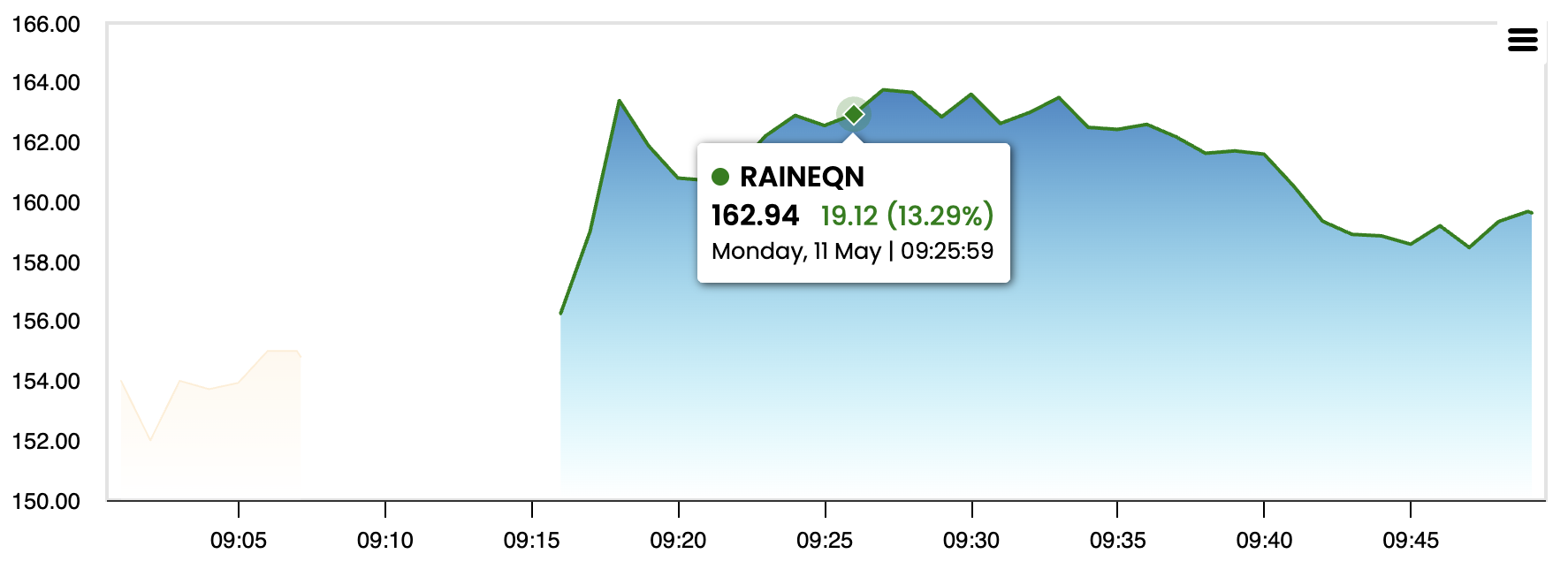
At 9:25:59 AM IST on May 11, Rain Industries traded at ₹162.94, up ₹19.12 or 13.29% for the session, according to the market snapshot. The stock had opened at ₹154.80, touched an intraday high of ₹163.78 and a low of ₹153.20, with volume at 7.67 million shares against average volume of 2.98 million. Market data is intraday and may change after publication.
The earnings trigger was clear. Rain reported revenue from operations of ₹45.21 billion, up 20% year-on-year, while adjusted EBITDA rose 65% to ₹7.15 billion. Adjusted profit after tax stood at ₹1.25 billion, with adjusted EPS at ₹3.70. (1)
Rain Industries rose because Q1 CY26 showed an operating recovery, not just a swing from loss to profit.
The company reported net profit for the period of ₹1.58 billion for the quarter ended March 31, 2026, compared with a loss of ₹1.15 billion in the year-ago quarter. Profit before tax improved to ₹2.56 billion, compared with a loss before tax of ₹259.5 million a year earlier. (2)
The stronger reaction was tied mainly to adjusted EBITDA growth and the Carbon segment. Adjusted EBITDA rose faster than revenue, with margin improving to 15.8% from 11.5% in Q1 CY25. That points to better operating conversion during the quarter.
| Metric | Q1 CY26 | Q1 CY25 | Change |
|---|---|---|---|
| Revenue from operations | ₹45.21 billion | ₹37.68 billion | Up 20% |
| Adjusted EBITDA | ₹7.15 billion | ₹4.34 billion | Up 65% |
| Adjusted EBITDA margin | 15.8% | 11.5% | Improved |
| Net profit / loss for period | ₹1.58 billion | Loss of ₹1.15 billion | Turnaround |
| Profit / loss attributable to owners | ₹1.21 billion | Loss of ₹1.38 billion | Turnaround |
| Adjusted PAT | ₹1.25 billion | Loss of ₹0.98 billion | Turnaround |
| Adjusted EPS | ₹3.70 | Loss of ₹2.91 | Turnaround |
Rain’s Q1 numbers show three separate improvements: revenue growth, margin expansion and a return to profitability. The durability of the rally depends on whether those gains can repeat, especially in Carbon.
Carbon was the strongest part of the quarter.
Rain’s statutory segment table showed Carbon revenue rising to ₹35.28 billion in Q1 CY26 from ₹28.82 billion in Q1 CY25. Carbon segment results increased to ₹6.20 billion from ₹4.13 billion a year earlier.
The company’s earnings presentation also showed adjusted Carbon improvement, supported by stronger Calcination volumes, higher prices across major products, favourable currency movement, improved cost pass-through and cost-saving initiatives implemented in 2025.
The main test is whether Carbon’s margin recovery can hold beyond one quarter or whether part of the improvement came from temporary pricing, currency and cost effects.
Advanced Materials also supported the recovery. Segment revenue rose to ₹9.75 billion from ₹8.07 billion, while segment results improved to ₹639.22 million from a loss of ₹82.90 million a year earlier.
Cement remained the weak spot. Segment revenue fell to ₹2.74 billion from ₹2.88 billion, while segment results slipped to a loss of ₹11.33 million from a profit of ₹47.35 million in Q1 CY25.
That segment split defines the quarter: Rain’s recovery was mainly Carbon-led, helped by Advanced Materials and held back by Cement.
Rain’s liquidity position gives the company some breathing room. The company reported liquidity of US$362 million, including US$163 million of cash and US$199 million of undrawn loan facilities. It also said there were no major term debt maturities until October 2028.
Debt risk has not disappeared. A commodity-linked business with meaningful leverage can see earnings and debt metrics shift quickly when prices, demand, raw-material costs or currency rates move against it.
For readers assessing the rally, the balance-sheet question is not whether liquidity improved. It is whether Carbon earnings can stay strong enough to keep leverage under control.
The first near-term level is the intraday high of ₹163.78. A move above that level with strong volume would show continued buying after the earnings reaction.
On the downside, the opening price of ₹154.80 and intraday low of ₹153.20 are the first reference points. A fall back toward that zone would weaken the early breakout.
The 52-week high of ₹176.00 is the next visible upside marker. A move toward that level would need continued confidence in Carbon margins and no fresh pressure from raw-material costs, Cement weakness or debt sensitivity.
The positive case depends on Carbon margins staying firm beyond one quarter. Sustained volumes, disciplined pricing, cost pass-through and continued Advanced Materials improvement would support that view.
The rally could fade if Carbon pricing weakens, raw-material costs rise faster than selling prices, Cement competition worsens, currency support reverses or debt concerns return.
Rain’s official consolidated results also include a disclosure on regulatory and sanctions-related uncertainties linked to geopolitical issues. The auditor’s conclusion was not modified, but the disclosure belongs in the risk context for financial readers.
Rain Industries’ 13% early-trade rally was backed by a real earnings catalyst: a return to profit, 65% adjusted EBITDA growth and a sharp rebound in the Carbon segment.
The result does not yet prove a full-company turnaround. Cement remained weak, leverage is still relevant, and the next test is whether Carbon’s margin recovery can survive weaker pricing, raw-material cost pressure and currency swings.
The rally looks justified by Q1 CY26 numbers, but further upside needs evidence that the Carbon-led recovery is repeatable.
(2) https://www.rain-industries.com/assets/pdf/ril---consolidated--financial-results_20260508151834.pdf