Published on: 2026-04-28
Updated on: 2026-04-28
RMBS stock sold off after hours because Rambus delivered a solid Q1 2026 report but did not show enough near-term AI revenue acceleration to justify the stock’s sharp pre-earnings rally.
The quarter itself was not weak. Rambus reported Q1 GAAP revenue of $180.2 million, product revenue of $88.0 million, licensing billings of $70.8 million, and contract and other revenue of $22.6 million. Product revenue rose 15% year over year, and the company generated $83.2 million in operating cash flow. (1)
The market reaction came from the next part of the story. Rambus guided Q2 product revenue to $95 million to $101 million, implying about 11% sequential growth at the midpoint. That is healthy growth, but after a major run in RMBS stock, investors appeared to want clearer evidence of a faster AI-driven breakout.
Rambus Q1 GAAP revenue rose to $180.2 million, above the midpoint of company expectations, while product revenue climbed 15% year over year to $88.0 million.
Non-GAAP EPS was $0.63. MarketBeat considered this a beat compared to $0.61, while Benzinga viewed it as a miss against $0.64, highlighting that the “mixed results” headline partly reflects differences in consensus estimates.
Q2 product revenue guidance of $95 million to $101 million implies approximately 11% sequential growth at the midpoint, which is strong but does not indicate hypergrowth.
GAAP operating margin declined to 34% from 38% a year ago, as total operating expenses increased to $81.9 million from $70.7 million.
Yes, mostly.
Rambus’s Q1 results were better than the company’s own framework across several key metrics. Product revenue landed inside the guided range and above the midpoint. Royalty revenue exceeded the high end of guidance. Licensing billings were above the midpoint. Contract and other revenue came in within the range, but below the midpoint.
| Metric | Q1 guidance | Q1 actual | Read-through |
|---|---|---|---|
| Product revenue | $84M–$90M | $88.0M | Above midpoint |
| Royalty revenue | $61M–$67M | $69.6M | Above high end |
| Contract and other revenue | $21M–$27M | $22.6M | Within range, below midpoint |
| Licensing billings | $66M–$72M | $70.8M | Above midpoint |
| GAAP revenue | Implied by revenue components | $180.2M | Above midpoint |
That matters because the sell-off should not be described as a simple earnings miss. Rambus delivered a respectable quarter. The problem was that the stock had already priced in more than “respectable.”
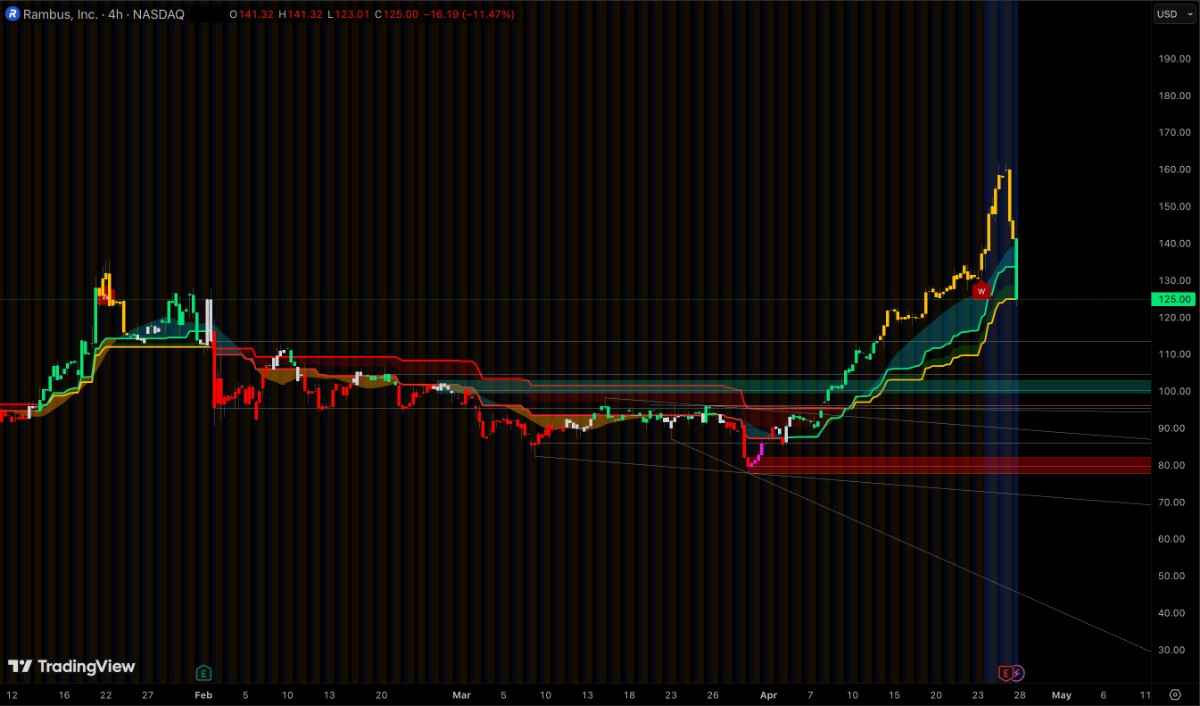
The simplest explanation is the gap between the stock’s rally and the visible revenue ramp.
RMBS closed at $89.73 on March 27, 2026 and $158.40 on April 24, 2026, a gain of about 76.5% before the earnings report. Meanwhile, Q2 product revenue guidance implies about 11.4% sequential growth at the midpoint.
That comparison is not a valuation model. It is a pressure test. It shows how much the share price had moved relative to the next observable operating improvement.
This helps explain why a guidance beat was not enough. Rambus’s Q1 results showed recovery from earlier supply issues, but they did not show AI-related product revenue accelerating fast enough to support the most aggressive version of the bull case.
The sell-off was also about valuation.
After the sharp pre-earnings rally, investors no longer viewed RMBS solely as a profitable semiconductor IP and memory-interface company. They were judging it as an AI infrastructure growth story. That is a higher bar.
For that kind of valuation to hold, investors usually want to see evidence of accelerating product growth, expanding new-product mix, named customer traction, or stronger guidance. Rambus delivered healthy growth, but not a step-change.
No. Q2 guidance was not weak in absolute terms.
Rambus guided Q2 revenue to $192 million to $198 million, product revenue to $95 million to $101 million, royalty revenue to $72 million to $78 million, licensing billings to $76 million to $82 million, and non-GAAP EPS to $0.65 to $0.73.
That implies sequential growth across major revenue categories. The issue is not direction but speed.
For a normal semiconductor supplier, 11% sequential product growth is strong. For a stock that had recently traded as an AI beneficiary, investors may have wanted a steeper ramp, stronger product upside, or more evidence that newer AI-related products are becoming material faster.
Rambus does have real AI exposure. Its chips and IP address memory bandwidth, data movement, security, DDR5 server modules, MRDIMM, HBM controller IP, PCIe/CXL-related IP, and newer server-memory form factors. Rambus’s own investor materials position the company around data center and AI infrastructure.
But exposure is not the same as near-term revenue velocity. Management said SOCAMM2, the company’s LPDDR5X server module chipset, is strategically important, but the financial impact in 2026 should be minimal because both volume and Rambus content are small. Management also said the current SOCAMM content includes voltage regulators and an SPD Hub, but again described the revenue contribution as limited in the near term.
That weakens the near-term bull argument. SOCAMM2 may matter later, but it does not appear large enough to carry the 2026 revenue story on its own.
The stronger AI case is in DDR5, MRDIMM, companion chips, and Silicon IP. Management said newer products contributed a low-double-digit percentage of Q1 product revenue and could move toward a mid-double-digit percentage of product revenue exiting the year. Management also said Silicon IP could grow 10% to 15% annually, helped by custom AI interfaces and security demand.
Rambus also faced a tougher comparison against faster AI-connectivity peers.
Astera Labs reported Q4 2025 revenue growth of 17% sequentially and 92% year over year. Credo reported its latest quarter revenue up 51.9% quarter over quarter and 201.5% year over year. (2)
Those are not perfect comparisons. Rambus has a different model, with product revenue, royalties, licensing billings, and Silicon IP. But investors often compare AI infrastructure names by growth velocity. Against that backdrop, Rambus’s Q2 product guide looked solid rather than spectacular.
That is why the stock reaction makes sense even though the quarter was not bad.
The bull case is delayed, not broken.
| Bull factor | Why it matters |
|---|---|
| Strong cash generation | Q1 operating cash flow was $83.2 million |
| Balance sheet strength | Cash and marketable securities were $786.1 million |
| AI memory exposure | DDR5, MRDIMM, HBM IP, SOCAMM2, and Silicon IP all touch AI infrastructure |
| New product mix | Newer products could become a larger share of product revenue |
| Silicon IP growth | Management expects 10%–15% annual growth |
The bullish view is that Rambus is building a broader AI-memory infrastructure platform. Revenue acceleration could improve if DDR5 transitions, MRDIMM adoption, companion chips, and Silicon IP design wins scale together.
The bear case is valuation and timing.
Rambus can be a strong business and still see its stock fall if investors decide the AI ramp is too slow for the valuation.
| Risk | Why it matters |
|---|---|
| Valuation compression | A solid company can still be overpriced after a large rally. |
| SOCAMM2 timing | Management described current SOCAMM2 content and volume as minimal near term. |
| Margin pressure | GAAP operating margin fell to 34% from 38% a year earlier. |
| Supply-chain constraints | Management said back-end supply remains tight and may stay tight into 2027. |
| Royalty timing | Licensing and royalty revenue can vary by customer agreement timing. |
| Peer growth gap | Faster AI-connectivity peers may continue to receive richer valuation premiums. |
The stock does not need bad news to keep derating if expectations remain too high. It only needs results that are good, but not strong enough for the expectations built into the share price.
The next two quarters matter more than the Q1 headline.
Investors should watch:
Q2 product revenue versus the $95 million to $101 million guide.
Q3 product revenue guidance.
New product mix as a percentage of total product revenue.
SOCAMM2 customer traction and content growth.
GAAP and non-GAAP margin recovery.
Silicon IP growth.
Updates on back-end supply constraints.
MRDIMM timing tied to Intel and AMD platform launches.
RMBS is an AI-memory infrastructure stock, not a pure hypergrowth AI chip stock. Rambus benefits from AI workloads because AI systems require more memory bandwidth, faster data movement, and better security. But the company’s revenue is still spread across product revenue, royalties, licensing, and Silicon IP.
The Q1 report does not support a simple buy-or-sell answer. The business remains profitable and cash-generative, but the stock reaction shows the market is recalibrating valuation against the pace of AI revenue growth. Investors should compare the next two quarters of product revenue acceleration against the valuation multiple before drawing a firm conclusion.
The biggest risk is expectation compression. Rambus may continue to grow, but if product revenue rises only at a low-teens sequential pace and newer AI products remain limited in 2026, the stock may struggle to maintain its premium valuation.
Rambus did not report a bad quarter. It reported a solid quarter that was not strong enough for the stock’s AI-driven expectations.
The sell-off looks more like a valuation reset than a fundamental collapse. RMBS can recover if product revenue continues to accelerate, newer products become a larger part of the mix, and Silicon IP growth remains strong.
But until those signals are clearer, the market may treat Rambus as a profitable AI-memory infrastructure supplier rather than a full hypergrowth AI winner.
(1) https://www.rambus.com/first-quarter-2026-financial-results/