Published on: 2026-03-03
Updated on: 2026-03-03
NVIDIA became the poster child for "multibagger" returns because it sat at the tightest bottleneck in the AI buildout. When the world recognized its need for more computing power, NVIDIA was the quickest solution.
That is the real lesson. Multibaggers usually come from being the bottleneck, not from being "a good company in a hot theme."
So, if you are hunting for multibagger stocks like NVIDIA in 2026, the smartest approach is to build a watchlist across the AI stack and track the signals that tell you whether demand is real, scaling, and profitable.
If you are looking for multibagger potential, these are the seven questions that separate real candidates from hype.
In 2026, the tightest constraints are not only computational. They include optics, interconnect, power delivery, and advanced packaging.
NVDA's own push into photonics highlights that the bottleneck is moving from chips toward data movement and energy efficiency.
A backlog narrative is more compelling when linked to multiyear commitments and capacity rights rather than vague expressions of "interest."
Multibaggers typically arise from an increase in gross profit dollars rather than just revenue growth.
Substantial capital expenditure (capex) is not necessarily negative, but the return on investment must be realistic and achievable.
AI infrastructure often means a few hyperscalers. That can be great until one customer pauses a build cycle.
In 2026, that often means 800G to 1.6T optics, custom silicon ramps, and advanced packaging scale-ups.
A great business can still be a poor "multibagger setup" if the market has already priced the next three years of upside.
The names below are categorized by bottleneck, as these constraints create pricing power in real-time.
| Ticker | What it sells into AI | Why it is on the list |
|---|---|---|
| AAOI | Optical transceivers | 800G ramp and aggressive 2026 revenue targets tied to AI data centers |
| COHR | Photonics, lasers, optics | $2 billion NVDA partnership plus multiyear purchase commitments |
| LITE | Lasers and optical components | $2 billion NVDA partnership and capacity rights for AI optics |
| CRDO | High-speed interconnect | Triple-digit growth trend tied to AI connectivity demand |
| MRVL | Custom AI silicon, electro-optics | Data center growth driven by AI demand and custom programs |
| ARM | CPU IP, data-center CPUs | Data-center adoption and royalty mix shift tied to AI workloads |
| TSM | Foundry and packaging | $52–$56 billion 2026 capex tied to AI and packaging scale |
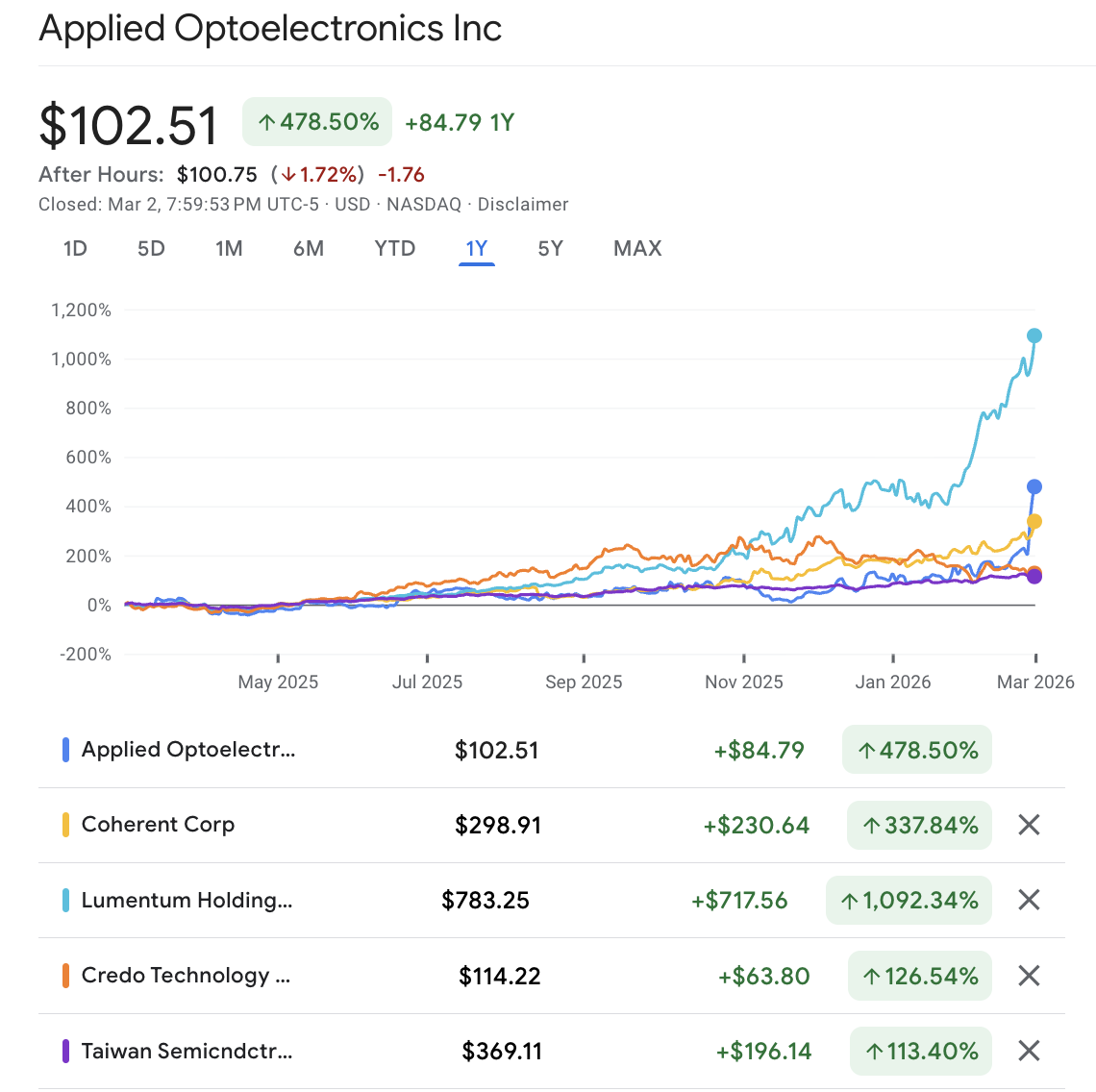
AAOI has become a "Viral AI Stock" market symbol for a simple idea: AI data centers are running out of bandwidth inside the building. That is why 800G optics, and soon 1.6T optics, matter more than almost any consumer-facing AI headline.
Investors reacted because AAOI pointed to a path toward more than $1 billion of revenue in 2026, which is far above the baseline expectations cited in coverage.
What to watch in 2026
800G manufacturing ramp and delivery consistency.
Enhancing customer diversification and ensuring order stability are essential, as there is a high concentration of customers in the disclosures and call summaries.
Why it can be a multibagger setup
If the company executes, optics can deliver operating leverage quickly because each generation shift tends to reset pricing and demand simultaneously.
COHR is on this list because NVDA effectively validated optics as strategic infrastructure by committing $2 billion and signing multiyear purchase commitments and capacity rights.
When a platform leader invests directly in its supply chain, markets usually treat that as a signal that demand is not a one-quarter event.
What to watch in 2026
How quickly can COHR increase its manufacturing capacity without negatively impacting yields?
Whether spending on optics will become widespread across all hyperscalers, rather than being limited to a single ecosystem.
LITE is the other side of the same photonics shift. NVDA announced a strategic partnership that includes a $2 billion investment, U.S.-based manufacturing expansion, and multiyear commitments for laser components and optics capacity.
The significance lies in the AI networking stack transitioning to optical engines closer to silicon, where performance per watt becomes a competitive advantage.
What to watch in 2026
Capacity ramp and margin stability as the product mix shifts.
Any evidence that optical demand is sustained through multiple product cycles.
CRDO is a pure play on data movement inside and between racks. In early March, CRDO reported a significant year-over-year increase in revenue and earnings, highlighting the stock's sensitivity to margin guidance.
CRDO itself has framed its positioning around high-speed, energy-efficient connectivity for AI and hyperscale networks, and it has been updating the market on revenue guidance as demand accelerates.
What to watch in 2026
Whether gross margin holds up as volume scales, because the market is already policing margins closely.
Whether the product roadmap stays ahead of competing connectivity solutions.
The custom silicon wave is not a replacement for NVDA. It is an expansion of total compute, because hyperscalers want cost and power control at scale.
MRVL has been positioned as a beneficiary of that shift, with management citing strong data center momentum driven by AI demand.
What to watch in 2026
The cadence of hyperscaler design wins and production ramps.
Whether custom programs translate into durable margins, not only headline revenue.
ARM is included on this list because AI workloads are straining data centers, making CPU efficiency a primary concern.
ARM's own reporting highlighted growing data center adoption, noting that Neoverse CPUs have surpassed one billion cores deployed and that its share among top hyperscalers is expected to approach 50%.
What to watch in 2026
Royalty mix shifting toward higher-value architectures.
Whether hyperscaler deployments continue to broaden beyond a single flagship design.
If you want one name that behaves like an index on AI hardware capacity, it is TSM. TSM has projected its 2026 capital expenditures to be between $52 billion and $56 billion, directly linking this increase to the demand driven by AI and the necessity to enhance leading-edge and packaging capacity.
This is not a small-cap multibagger profile, but it is a classic "bottleneck owner" profile. When the entire industry is capacity-constrained, the owners of capacity often gain pricing power and strategic relevance.
What to watch in 2026
Whether advanced packaging expansion reduces delivery bottlenecks for AI systems.
Any signals that capex is outrunning demand, because that is how cycles turn.
Firstly, AI capital expenditures (capex) can reach their peak even as AI revenues continue to increase. If the market starts to believe 2026 is "peak build," multiples can compress even on strong results, because investors shift from growth excitement to cash flow scrutiny.
Second, financing and power constraints can change timelines. The development is increasingly dependent on power availability, lead times, and financing costs. This is why some builders of AI infrastructure have indicated significant capital expenditure plans that also come with volatility in short-term profit margins.
A multibagger is a stock that multiplies in value, often 2x to 10x, over time. It usually requires sustained revenue growth, expanding margins, and a valuation rerating. It is a description of past performance, not a reliable predictor.
It is rare for any company to replicate NVDA's exact path, as NVDA combined hardware leadership with a software ecosystem. A more realistic approach is to look for companies that own AI bottlenecks, where demand is forced, and supply is constrained.
Yes. As AI clusters scale, moving data becomes as important as computing it. Recent NVDA partnerships and investments into photonics suppliers highlight that bandwidth and power efficiency are becoming strategic constraints in data centers.
In conclusion, if you are seeking the "next NVDA" potential in 2026, the highest-quality framework is not "find the next chip." The higher-quality framework is "find the next bottleneck."
In 2026, bottlenecks are shifting toward optics, interconnect, custom silicon, and advanced packaging. NVDA's own push into photonics underscores that shift.
The seven tickers above sit on those bottlenecks. Some are high-risk execution stories, and some are capacity gatekeepers. None are guaranteed multibaggers, but all are tied to the parts of AI infrastructure where demand is currently the most urgent.
Disclaimer: This material is for general information purposes only and is not intended as (and should not be considered to be) financial, investment or other advice on which reliance should be placed. No opinion given in the material constitutes a recommendation by EBC or the author that any particular investment, security, transaction or investment strategy is suitable for any specific person.