Published on: 2026-01-08
Updated on: 2026-01-08
AUD/JPY is highly sensitive to three factors: the interest-rate differential, global risk appetite, and inflation trends in both countries. The pair trends when these factors align and becomes volatile when they diverge.
The current environment is prone to sharp reversals as both central banks present two-sided risks. Australia’s inflation is easing but remains above target, while Japan’s policy normalization has made the yen more sensitive to rate changes. This combination destabilizes carry trades and amplifies the impact of major data releases.
AUD/JPY is volatile as traders simultaneously reprice policy paths in both Australia and Japan.
Australia’s latest inflation data reduced some urgency but did not rule out further policy tightening.
Japan’s rate path remains active, and upcoming policy communications carry significant risk.
Carry trades usually build gradually but unwind quickly, so sudden declines can exceed previous gains.
Event risk is concentrated in the coming weeks, encouraging hedging and increasing intraday volatility.
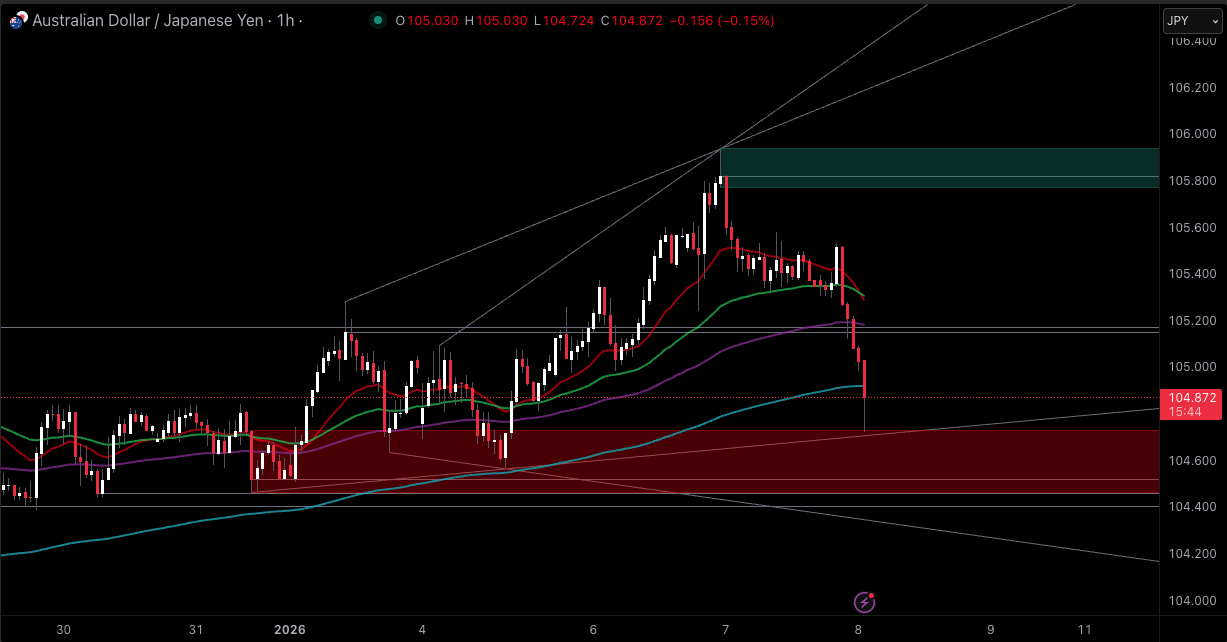
Recent trading has shown a modest weekly range but a choppy intraday pattern that frequently tests stop levels.
| Period Reference | Approximate Level | What It Implies for Volatility |
|---|---|---|
| Past-week high (recent) | 105.796 | Breakouts invite momentum buying and force defensive hedging. |
| Past-week low (recent) | 104.519 | Pullbacks pressure leveraged carry exposure and trigger stop-losses. |
| Approximate weekly range | 1.277 | A tight range can still feel violent when the intraday path is jagged. |
AUD/JPY is often used to seek higher yields during periods of low volatility. This strategy works best when both the high-yield and funding legs are stable. Currently, both are sensitive to data and central bank communication, reducing overall stability.
These are the mechanics that magnify swings:
Carry positions are often leveraged, so small price moves can trigger significant risk adjustments.
Volatility-targeting strategies automatically reduce exposure as price volatility increases.
Liquidity is often lower in early January, which can exaggerate moves around data releases.
Japan has already raised rates and signaled that further increases are possible if the outlook remains unchanged.
This shift prompts markets to consider both the current rate differential and its future direction.
Australia’s latest monthly inflation read showed headline CPI at 3.4% year on year, with trimmed mean inflation at 3.2% year on year.
These figures show progress but remain above target, supporting a restrictive policy stance and keeping markets attentive to upcoming data.
The composition matters as much as the headline:
Housing inflation was a major contributor over the past year, and annual housing inflation remained elevated.
Service inflation typically cools more slowly because it is linked to wages, rents, and domestic demand.
The policy signal remains two-sided. Officials have stated that inflation is still too high and rates could rise further if price pressures persist, despite recent easing.
AUD is sensitive to external balances, as trade income supports currency demand. The latest trade data showed:
Exports fell 2.9% in the month.
Imports rose 0.2% in the month.
The seasonally adjusted balance on goods decreased by $1,417 million in the month.
When trade momentum weakens and rate expectations are uncertain, markets tend to trade AUD more cautiously and apply tighter risk controls.
Japan raised the policy interest rate to around 0.75% in December and stated that it would continue to raise the policy rate and adjust accommodation if the outlook is realized.
This guidance makes the yen highly responsive to signals that confirm or challenge the normalization process.
At the same time, wage dynamics are not offering a clean one-way signal. In November, inflation-adjusted real wages fell 2.8% year on year, and nominal wages rose only 0.5% year on year, with a sharp fall in one-off payments weighing. This creates daily uncertainty, as policy depends on whether wage growth can sustain inflation without additional support. extraordinary support.
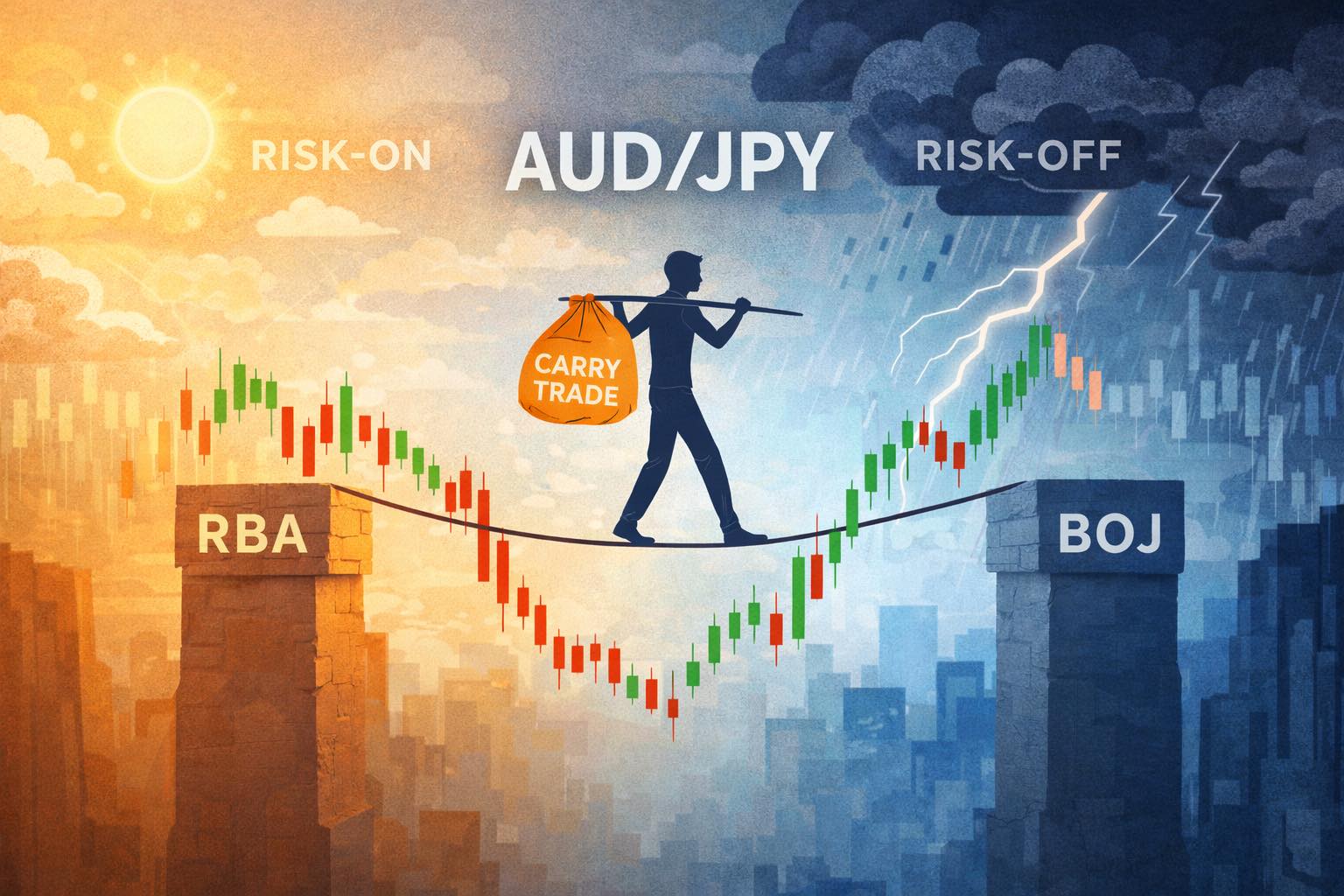
In stable markets, carry exposure builds gradually as investors take on more risk when volatility is low. In volatile markets, exposure is reduced quickly as risk budgets tighten. This asymmetry can cause sharp AUD/JPY declines even on mildly negative news.
Major global releases can move yields and risk appetite, and both inputs matter for carry trades regardless of the currencies in the cross. The next US employment report for December 2025 is scheduled for January 9, 2026, at 8:30 a.m. Eastern Time.
Event clustering increases hedging demand, as traders manage multiple risks instead of focusing on individual events.
| Catalyst | Date | Why It Matters for AUD/JPY |
|---|---|---|
| US Employment Situation for December 2025 | Jan 9, 2026 | It can shift global risk appetite and global rate expectations quickly. |
| Japan policy meeting | Jan 22–23, 2026 | It can reprice the yen funding leg through guidance and projections. |
| Australia’s next monthly inflation release window | Late January 2026 | It can reset expectations for the next policy decision by clarifying whether disinflation is durable. |
This grid illustrates why the pair can move sharply in either direction, even without a single dominant narrative.
| Scenario | Australia Rates Impulse | Japan Rates Impulse | Risk Tone | Typical AUD/JPY Behaviour |
|---|---|---|---|---|
| Carry-friendly drift | Inflation stays sticky enough to keep policy restrictive. | Guidance stays gradual and predictable. | Stable to positive | A steady grind higher with shallow pullbacks. |
| Differential compression | Inflation progress looks convincing and trims tightening risk. | Normalization expectations firm and pull forward the next step. | Neutral | Repeated selloffs on rallies as the spread narrative shifts. |
| Funding shock | Australia data disappoints and yield support fades. | Policy communication turns more assertive than expected. | Risk-off | Fast downside moves as carry positions are forced to cut. |
| Risk relief reversal | Australia data is mixed but not alarming. | Japan data softens and reduces urgency. | Risk-on | A sharp rebound that can be unstable into the next event. |
A disciplined market assessment typically focuses on three key questions:
Are Australian and Japanese yield expectations widening or narrowing today?
Is global risk sentiment improving or deteriorating, as reflected in equity volatility and demand for safer currencies?
Is the move being driven by scheduled event risk, thin liquidity, or a genuine shift in the macro narrative?
If the first two factors align, the move is more likely to continue. If they conflict, volatility often increases.
AUD/JPY combines a high-beta currency with an active funding currency, making it highly responsive to changes in risk sentiment and interest rate expectations.
The differential still matters, but the rate path is more important. Volatility increases when markets repeatedly reprice the differential over the next one to three months.
Headline inflation is easing, but underlying inflation remains above target, and officials have not ruled out further tightening.
Policy normalization is ongoing, but wage dynamics are uneven, so markets can shift between a faster or slower path based on each new data point.
Major labour market and inflation releases, as well as policy meetings, tend to trigger the largest repricing because they can change both the rate path and risk sentiment.
AUD/JPY is volatile because the carry trade is being tested by two active policy developments. Australia’s inflation is cooling but remains above target, keeping the policy outlook sensitive to new data. Japan’s normalization has raised funding costs and increased market focus on guidance, wages, and the next policy step.
In this environment, it is best to view AUD/JPY as a reflection of three factors: the expected yield spread, the pace of Japan’s normalization, and global risk sentiment. When these align, the pair trends; when they diverge, volatility prevails.
Disclaimer: This material is for general information purposes only and is not intended as (and should not be considered to be) financial, investment, or other advice on which reliance should be placed. No opinion given in the material constitutes a recommendation by EBC or the author that any particular investment, security, transaction, or investment strategy is suitable for any specific person.