Published on: 2026-02-25
Updated on: 2026-02-25
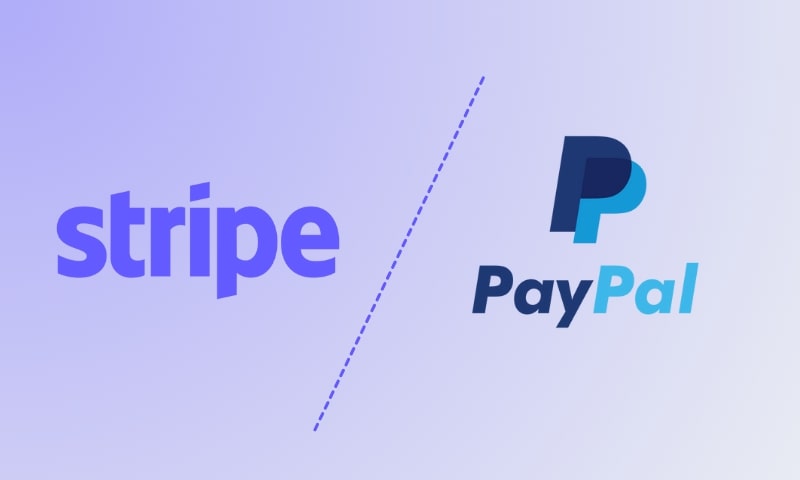
PayPal shares rose after a report indicated that Stripe is exploring an acquisition of all or part of PayPal. The move did not happen in a vacuum. PayPal had already jumped the day before on separate takeover chatter, and this new headline gave traders a clearer "name" to attach to the story.
By the close on Feb. 24, 2026, PayPal stock finished around $47.02, up 6.74% on the day, after trading as high as roughly $48.00. That two-day burst matters because it changes positioning. It attracts momentum traders, triggers short covering, and adjusts the near-term technical outlook even if the rumor dissipates.
Still, one rule holds. A report is not a deal. The market is now trading probabilities, not certainty.
Numerous reports linked the rally to a Bloomberg article indicating that Stripe has expressed initial interest in acquiring all or part of PayPal.
That wording is important for traders.
"All or parts" leaves room for a full buyout, a partial acquisition, or a targeted asset purchase.
"Preliminary" typically means no final structure, no final price, and often no exclusivity.
"No certainty" is the market's reminder that takeover spikes can unwind fast when headlines cool.
PayPal has also received unsolicited takeover interest, with some parties considering acquiring the entire company while others are focused on specific assets.
Yet, neither company has confirmed a deal. That matters because takeover chatter often comes in waves. The first wave is price and volume. The second wave is proof.
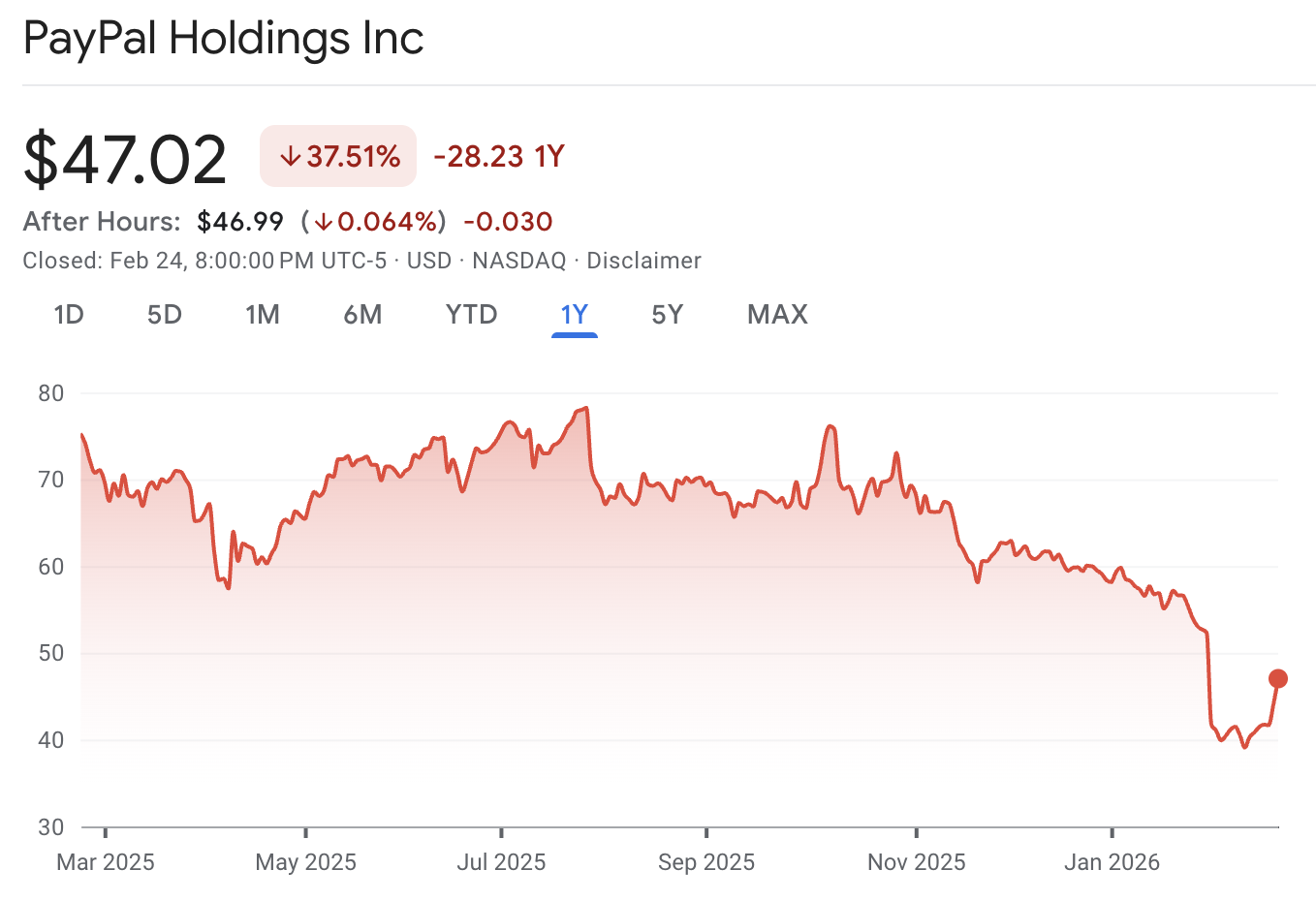
PayPal was already under pressure in early February after a sharp selloff linked to a leadership change and a weaker 2026 profit outlook.
On Feb. 3, PayPal stockfell about 19% after the company replaced its CEO and issued a profit forecast that disappointed investors.
When a stock is already bruised, takeover talk has more force because it introduces a new potential "floor" under the price.
Here is the current setup using the latest quoted levels:
Current price: ~$47.02 (Feb. 24 close)
52-week range: $38.46 to $79.50
Distance from 52-week high: about -40.9% (still a long way down)
A takeover rumor works best when a stock is far below its prior highs, because buyers can argue there is still "room" for a premium without stretching past old levels.
Even before the takeover chatter, PayPal's fundamentals were not collapsing. The company's latest earnings release showed:
| Metric | Result |
|---|---|
| Q4 net revenues | $8.7B (+4%) |
| Full-year net revenues | $33.2B (+4%) |
| Q4 total payment volume | $475.1B (+9%) |
| Full-year total payment volume | $1.79T (+7%) |
| Active accounts | 439M (+1.1%) |
| Full-year free cash flow | $5.6B |
| Share repurchases (trailing 12 months) | $6.0B |
| New quarterly dividend | $0.14 per share (first declared) |
The market's frustration has been more specific. PayPal itself said execution has not been where it needs to be, "particularly in branded checkout," which is the part of the business investors still treat as the core engine.

A potential Stripe–PayPal tie-up makes sense on paper because the two businesses have strengths in different areas.
From the perspective of deal logic, Stripe could be attracted by:
Scale and consumer reach: PayPal still sits on a massive user base (439 million active accounts).
Recognizable consumer products: Venmo is often highlighted by analysts as an asset that could be valued more highly inside a different structure.
Payment volume: PayPal processed $1.79 trillion in TPV in 2025, which signals reach and merchant coverage, even if growth has slowed.
The timing also matters. Stripe's private valuation has reportedly climbed sharply. In 2025, Stripe's valuation increased to approximately $159 billion during an employee share sale, and the company processed $1.9 trillion in payments.
While a higher valuation doesn't guarantee funding for a buyout, it can simplify the concept of a stock-based deal.
PayPal's market value is about $47 per share, totaling around $43 billion, with 920.7 million shares outstanding.
If a buyer had to pay a typical takeover premium, the headline price jumps quickly.
Here is a simple scenario table using today's price as the base. These are not forecasts. They are just the math of common premium ranges.
| Premium vs $47.02 | Implied offer price | Implied equity value (approx.) |
|---|---|---|
| 15% | $54.07 | ~$49.8B |
| 20% | $56.42 | ~$51.9B |
| 25% | $58.78 | ~$54.1B |
| 30% | $61.13 | ~$56.3B |
| 40% | $65.83 | ~$60.6B |
Two trader takeaways stand out:
Even a 40% premium would still be below PayPal's 52-week high of $79.50.
A full buyout can become costly quickly, which is why asset-level interest might be a more practical option than acquiring the entire company.
This is the most common outcome for early-stage chatter.
What you usually see:
The stock gives back part of the spike.
Volume cools.
The price has stabilized within a certain range as traders have stopped paying the "headline premium."
This path can support the stock even without a full takeover.
Why it matters:
If investors believe PayPal might sell assets, spin off divisions, or clarify its strategy, the market may reassess the stock for improved focus.
If a real bid emerges, the stock often trades like a takeover target:
It tends to hover below the implied offer price.
Volatility can drop after the initial gap.
Risk shifts from "direction" to "deal probability."
At this stage, there is no public confirmation of a bid. The market remains in Path 1 or Path 2 territory.
Any direct company comment on strategic options (even a "no comment" can shift tone).
Follow-up reporting that moves from "interest" to "structure" (price, funding, or scope).
Volume and price behavior around $48. If buyers cannot clear it, the stock often stalls.
Guidance narrative from the last earnings release, because the market can snap back to that quickly once takeover chatter cools.
PayPal rose after reports said it had attracted takeover interest and that Stripe is exploring a possible acquisition of all or part of PayPal.
There is no confirmed deal. The reporting described discussions as preliminary and stated that there is no certainty that a transaction will happen.
The key resistance area is near the 200-day moving average around $48. A pullback zone is located in the mid-$40s, while the recent 52-week low of approximately $38.46 serves as a significant downside reference level for sentiment.
In conclusion, PayPal stock jumped because the report created a believable "strategic value" story at a time when PayPal was already depressed and heavily debated. The key now is whether the market gets confirmation, or whether this becomes a short-lived headline trade.
For traders, the cleanest approach is to treat this as a levels-driven setup. If PYPL holds above the mid-$44s, the market is still paying for optionality. If it loses that area, the stock often slides back into the prior downtrend range and forces buyers to prove themselves again.
Disclaimer: This material is for general information purposes only and is not intended as (and should not be considered to be) financial, investment or other advice on which reliance should be placed. No opinion given in the material constitutes a recommendation by EBC or the author that any particular investment, security, transaction or investment strategy is suitable for any specific person.