Published on: 2026-02-25
Updated on: 2026-02-25
If markets sometimes feel unusually fast, precise, or unpredictable, you’re not imagining things. A large share of modern trading activity is no longer driven by humans clicking buy and sell buttons. Mathematical systems drive it.
Rather than asking: “Does this company look promising?”
A quant fund asks: “What does the data statistically predict will happen next?”
These funds analyse massive datasets, including price history, volatility patterns, economic indicators, and even alternative data, to identify trading opportunities automatically.
Quant funds help explain why price moves can appear mechanical, why opportunities disappear quickly, and why trends sometimes look almost “too clean.” Even traders who never use automation are trading inside a market heavily influenced by quantitative strategies.
A quant fund (quantitative fund) is an investment fund that uses mathematical models, statistical analysis, and computer algorithms to make trading decisions based on data rather than human opinion.
Instead of analysing markets through forecasts or intuition, quant funds rely on measurable patterns found in historical and real-time data.
In simple terms:
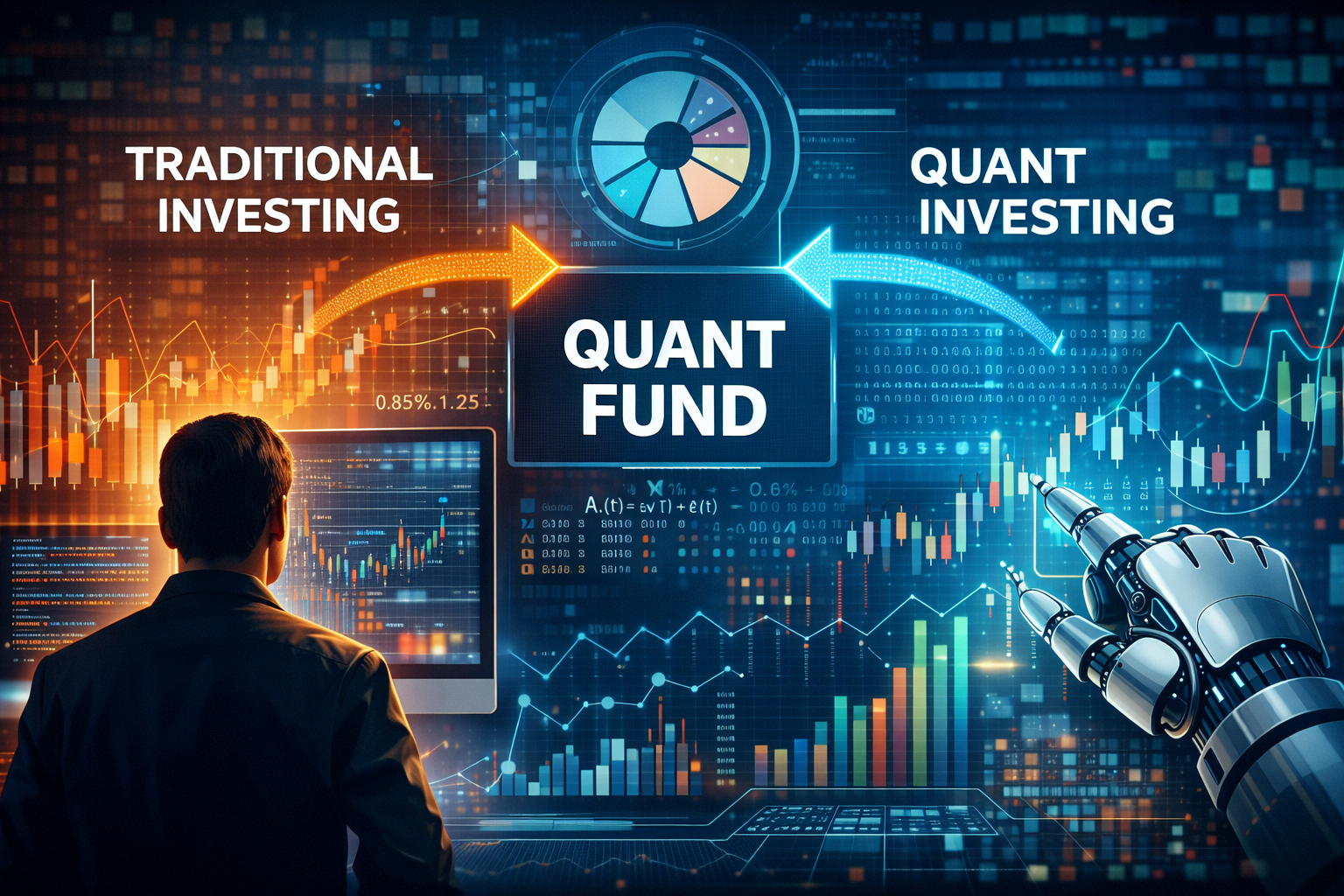
Traditional investing = human judgment first
Quant investing = data first, humans second
A quantitative hedge fund applies this approach within a hedge fund structure, often running multiple strategies simultaneously. An algorithmic trading fund focuses on automated execution, placing trades according to programmed rules.
The goal isn’t to predict the future perfectly. The goal is to find small statistical advantages repeated thousands of times.
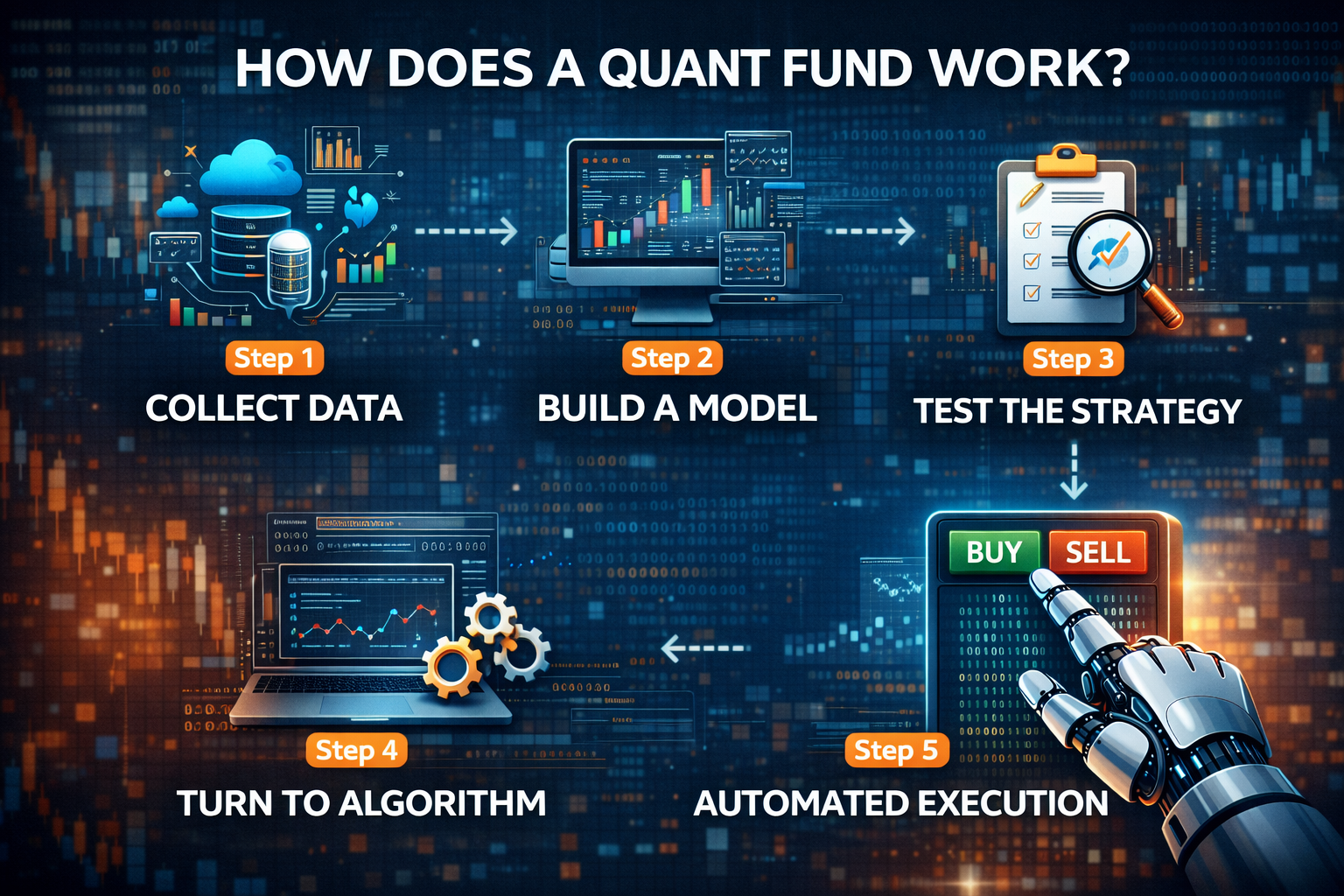
A quant fund operates like a repeatable system rather than a trader making daily decisions.
Markets generate enormous amounts of information every second. Quant funds analysis:
Price movements
Volume changes
Volatility behavior
Relationships between assets
Economic indicators
This forms the foundation of data-driven investing.
Researchers look for patterns that historically repeat. For example:
Assets that tend to revert after extreme moves
Trends that persist under certain conditions
Pricing gaps between related securities
These patterns become hypotheses tested mathematically.
Before risking money, models are backtested using past market data. The question is simple: Did this idea work consistently over time? Consistency matters more than perfection.
Once validated, rules become trading algorithms that define:
Entry conditions
Exit rules
Position size
Risk limits
This creates systematic trading, where decisions are guided by logic rather than emotion.
The system monitors markets continuously and executes trades automatically (sometimes in milliseconds) without hesitation or second-guessing.
Humans supervise the system but don’t manually trade each position.
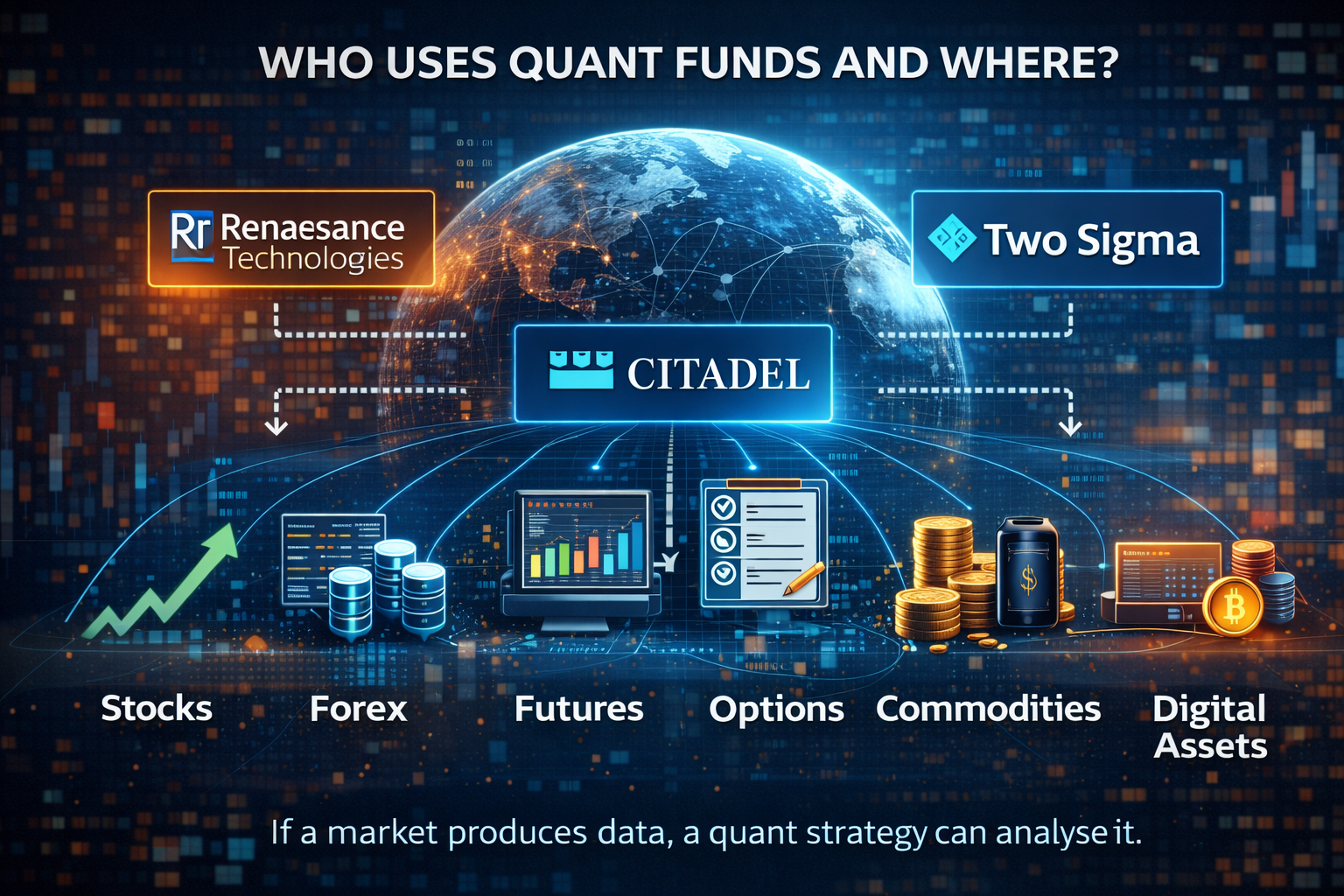
Quant strategies are used across global finance, not just niche hedge funds.
Major quantitative firms include:
Renaissance Technologies: famous for applying advanced mathematical models.
Two Sigma Investments: combines finance with data science and machine learning.
Citadel: integrates quantitative and discretionary trading.
Quant funds operate wherever structured price data exists:
Stocks
Forex
Futures
Options
Commodities
Digital assets
If a market produces data, a quant strategy can analyse it.
Imagine two airline stocks that historically move together.
A quant fund discovers that when one stock rises sharply while the other lags, the lagging stock usually catches up within a few days.
A human trader might notice this occasionally.
A quant system watches hundreds of similar relationships simultaneously. The moment the statistical gap appears, it automatically enters trades designed to profit if prices reconnect.
No opinions. No news interpretation. Just probability. It’s like cruise control in a car, you set rules once, and the system maintains behaviour automatically.
Understanding quant funds helps traders interpret modern market behaviour.
First, they increase market efficiency. Because algorithms constantly search for pricing errors, obvious opportunities tend to disappear quickly.
Second, they influence liquidity. Quant strategies often generate continuous buying and selling, helping markets function smoothly during normal conditions.
Third, they can accelerate volatility. When many models react to the same signal, like a sudden drop in volatility or a trend reversal, price moves can become sharp and fast.
What feels random is often systematic.
Start with structure. You don’t need coding skills to think like a quant trader.
Quant funds treat trading as a probability game played repeatedly over time. Individual trades matter less than overall statistical performance. Adopting predefined rules like entries, exits, and risk limits moves trading closer to systematic thinking.
Tracking performance also mirrors quant behaviour. Recording results transforms guesses into measurable feedback.
The takeaway isn’t automation. It’s discipline supported by data.
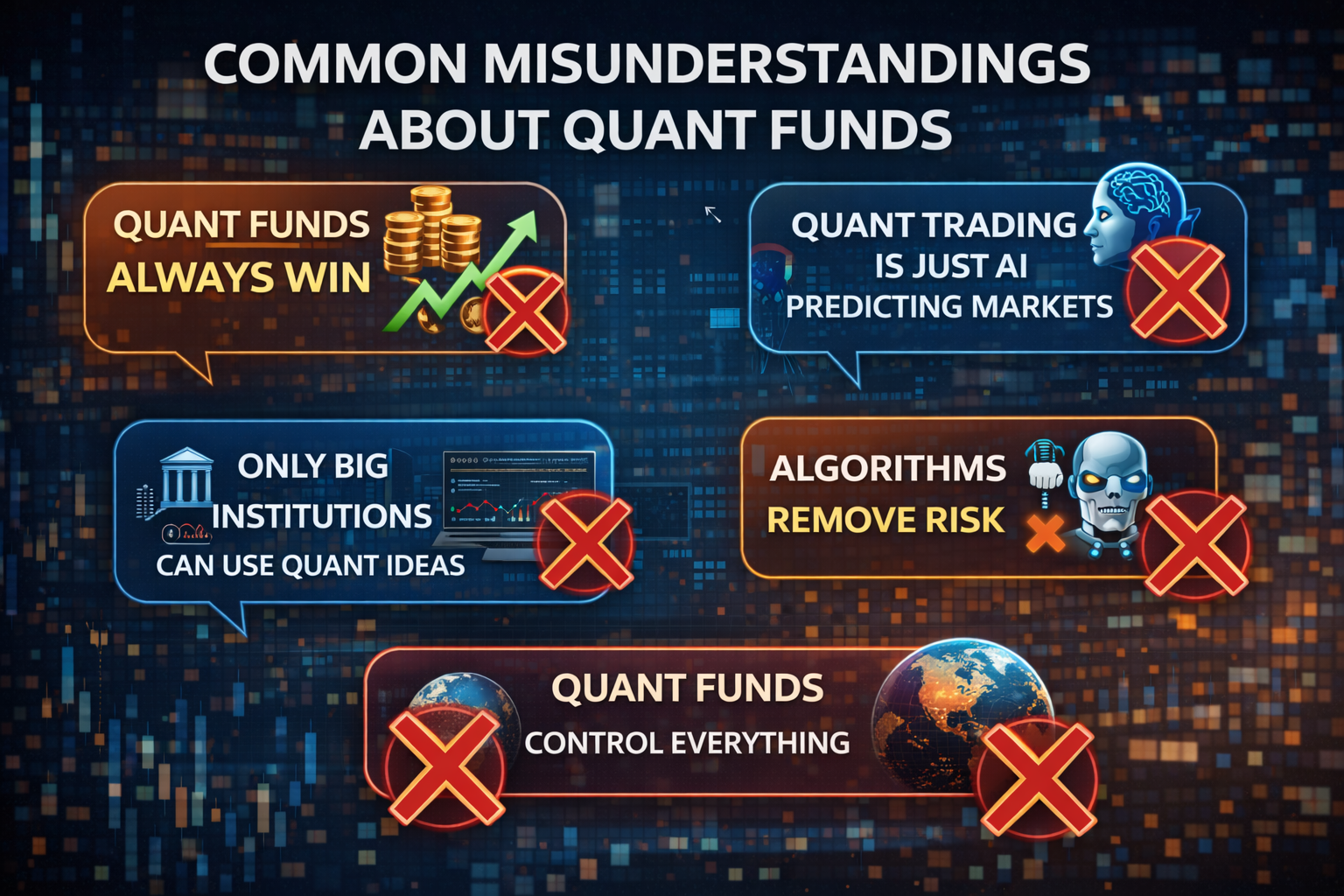
They don’t. Quant strategies fail when market conditions change. Many funds experience periods of losses because historical patterns can stop working. Mathematics improves consistency, not certainty.
Most quant strategies are not futuristic AI systems. Many rely on relatively simple statistical relationships executed extremely consistently. The edge comes from discipline and scale, not prediction magic.
Institutions have better technology, but the mindset is transferable. Rule-based trading, journaling results, and focusing on probabilities are simplified quantitative principles accessible to any trader.
Automation removes hesitation, not uncertainty. Algorithms can lose money quickly if market behaviour changes or assumptions break down. Risk management remains central.
Quant funds are influential but not all-powerful. Markets still reflect economic events, policy decisions, and human behaviour. Quant strategies are participants in the system, not its rulers.
Quant Fund vs Traditional Fund
Quant Fund |
Traditional Fund |
|
Decision Process |
Data & statistical models | Human analysis |
Trading Style |
Systematic trading | Discretionary |
Execution |
Automated | Manual/semi-manual |
Emotion Influence |
Minimal | Present |
Strategy Testing |
Extensive backtesting | Limited testing |
Speed |
Extremely fast | Slower decision cycles |
A quant fund analyses large datasets to find statistical trading opportunities and executes trades automatically using algorithms. Its goal is consistent performance based on probabilities rather than market predictions.
Not exactly. Algorithmic trading refers to automated execution, while quantitative hedge funds include research, modelling, portfolio design, and risk management alongside automation.
They account for a significant portion of trading activity, influencing liquidity, price efficiency, and short-term volatility across global markets.
Direct competition is difficult due to technological advantages, but traders can benefit by understanding systematic behaviour and using structured trading rules.
No. Quant funds operate across multiple markets, including forex, futures, commodities, options, and increasingly cryptocurrency markets.
A quant fund is an investment fund that replaces intuition with structured, data-driven decision-making. Using statistical models, systematic trading rules, and automated execution, quantitative hedge funds and algorithmic trading funds play a major role in modern financial markets.
For traders, the key lesson is practical: markets increasingly reward structure over instinct. Understanding quant funds helps explain price behaviour, manage expectations, and build a more disciplined approach to trading.
When markets feel mechanical, fast, or unusually precise, chances are, a quant system is involved.



World's Best Broker