Published on: 2026-02-27
Updated on: 2026-02-27
The US Producer Price Index (PPI) is released today, February 27, 2026, at 8:30 a.m. Eastern Time.
This report covers producer prices for January 2026, and markets are watching it for two reasons. First, it provides the most accurate near-term measure of the wholesale prices companies charge.
Second, several components of the PPI contribute to the PCE price index, which is the inflation indicator that the Federal Reserve relies on the most.
Today's number matters even more because the PPI tables will be modified starting with the January 2026 report, after changes to the index list and a weight allocation update. That does not change the headline, but it can affect how some sub-indices are presented in the release.
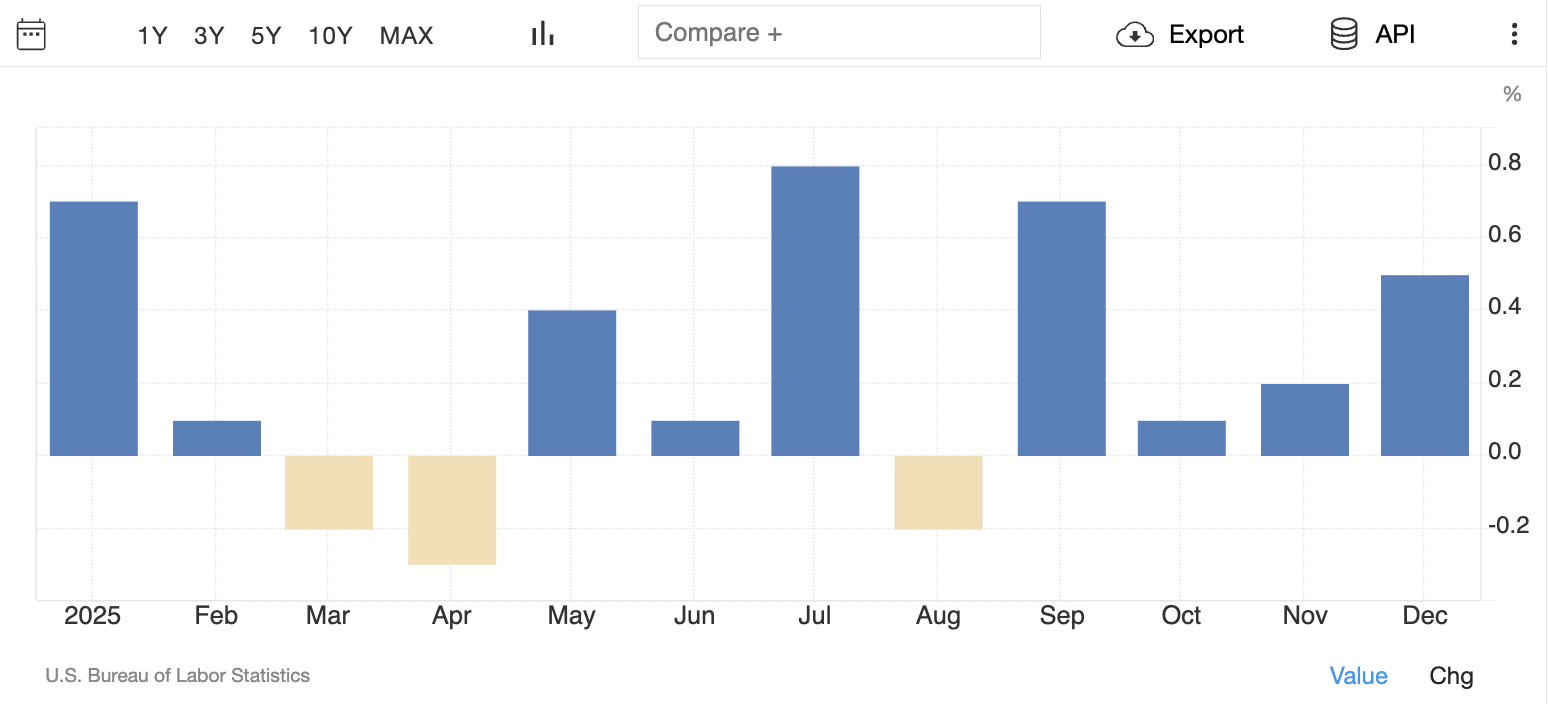
Economists expect PPI inflation to cool from December, but not collapse. The broad consensus view is:
Headline PPI (final demand): +0.3% month over month
Headline PPI: +2.6% year over year
Core PPI (excluding food, energy, and trade services): +0.3% month over month
Core PPI: +3.0% year over year
December's PPI showed strong performance, particularly in the services sector.
| Measure | Dec 2025 actual | Jan 2026 forecast | Why it matters |
|---|---|---|---|
| Headline PPI (m/m) | +0.5% | +0.3% | Sets the tone for inflation cooling vs inflation sticky. |
| Headline PPI (y/y) | +3.0% | +2.6% | The direction matters for long-run inflation expectations. |
| Core PPI ex food/energy/trade (m/m) | +0.4% | +0.3% | This line is watched closely for PCE read-through. |
| Core PPI ex food/energy/trade (y/y) | +3.5% | +3.0% | A meaningful drop would help the cuts later case. |
What the market is really asking: Does inflation pressure remain concentrated in services, or is it spreading back into goods?
Based on current forecasts, January PCE is expected to be:
Headline PCE: +0.2% month over month, about +2.7% year over year
Core PCE: about +2.8% year over year
That PCE release is due March 13, 2026, and it lands just ahead of the next Fed meeting on March 17–18.
Two areas matter most for January PCE nowcasting:
Health care services
Financial services, including portfolio management and investment advice
Additionally, the BLS explicitly notes that health care PPIs are used as estimates in key economic statistics, including the health care service components in the BEA's PCE data, and it lists the specific provider categories that feed into PCE.
| If core PPI ex food/energy/trade prints… | What it usually signals | A reasonable core PCE risk range (m/m) |
|---|---|---|
| 0.1% to 0.2% | Services inflation is easing | ~0.15% to 0.20% |
| 0.3% (forecast) | Inflation is cooling slowly | ~0.20% to 0.25% |
| 0.4% or higher | Services pressure is sticking | ~0.25% to 0.35% |
This is not an official forecast. It is our practical way to translate the PPI surprise into a "PCE risk range," because many market-based PCE components use PPI as an input.
What to Takeaway:
If core PPI is hot and the PCE-relevant service lines are also firm, the market will start marking up the odds of a higher core PCE print in March.
The Fed is currently holding the federal funds target range at 3.50% to 3.75%, per its latest implementation note.
Inflation remains worryingly high relative to the Federal Reserve's 2% target, and the Fed's preferred inflation measure continues to show elevated levels.
To provide some context, the Bureau of Economic Analysis reported that in December 2025, headline PCE inflation was 2.9% YoY, while core PCE inflation was at 3.0% YoY.
That is the backdrop for today's PPI. A "hot" producer inflation print, especially in PCE-relevant services, makes it harder for policymakers to argue that inflation is gliding smoothly back to target.
The Fed does not set policy based on one PPI print. Still, today's number can change the market's confidence around three questions:
Is inflation still trending toward 2%?
Is service inflation staying too firm?
Does the next PCE report risk re-accelerating?
| PPI outcome | Likely market reaction | Fed narrative risk |
|---|---|---|
| Cooler than expected (headline and core) | Lower yields, softer USD, risk assets tend to breathe | "We can stay patient and still get to 2%." |
| In line with forecast | Limited move, focus shifts to PCE and jobs data | "Hold steady, watch the next prints." |
| Hotter than expected (especially services) | Yields can jump, USD can firm, stocks may wobble | "Cuts may be later, because inflation is not done." |
This aligns with today's market framing that a hot PPI could delay the timetable for rate cuts, even if the Fed is unlikely to move at the March meeting itself.
| Date | Event | Why it matters |
|---|---|---|
| Mar 13, 2026 | Personal Income and Outlays for January 2026 (includes PCE inflation) | The market's "final answer" for what January inflation looked like in the Fed’s preferred gauge. |
| Mar 17–18, 2026 | Fed policy meeting | PCE and labor market data will anchor the decision and the messaging. |
The January 2026 PPI is scheduled for release on February 27, 2026, at 8:30 a.m. Eastern Time.
Consensus expectations are for headline PPI around 0.3% month over month and about 2.6% year over year, with core PPI also around 0.3% month over month.
The Personal Income and Outlays report for January 2026, which includes the PCE price index, is scheduled for March 13 at 8:30 a.m. Eastern Time.
Multiple PCE components utilize the PPI series as inputs, particularly in healthcare services and certain financial services. That is why PPI details can shift expectations for the next PCE inflation print.
In conclusion, today's US PPI is not just an inflation headline. It is a PCE setup.
If service inflation remains low and sectors related to PCE, such as healthcare and portfolio management, are stable, the market may view inflation as gradually decreasing.
If those lines run hot, then the March 13 PCE report is more likely to land firm, and that keeps the Fed cautious with rates still in the 3.50% to 3.75% range.
Disclaimer: This material is for general information purposes only and is not intended as (and should not be considered to be) financial, investment or other advice on which reliance should be placed. No opinion given in the material constitutes a recommendation by EBC or the author that any particular investment, security, transaction or investment strategy is suitable for any specific person.