Published on: 2026-05-29
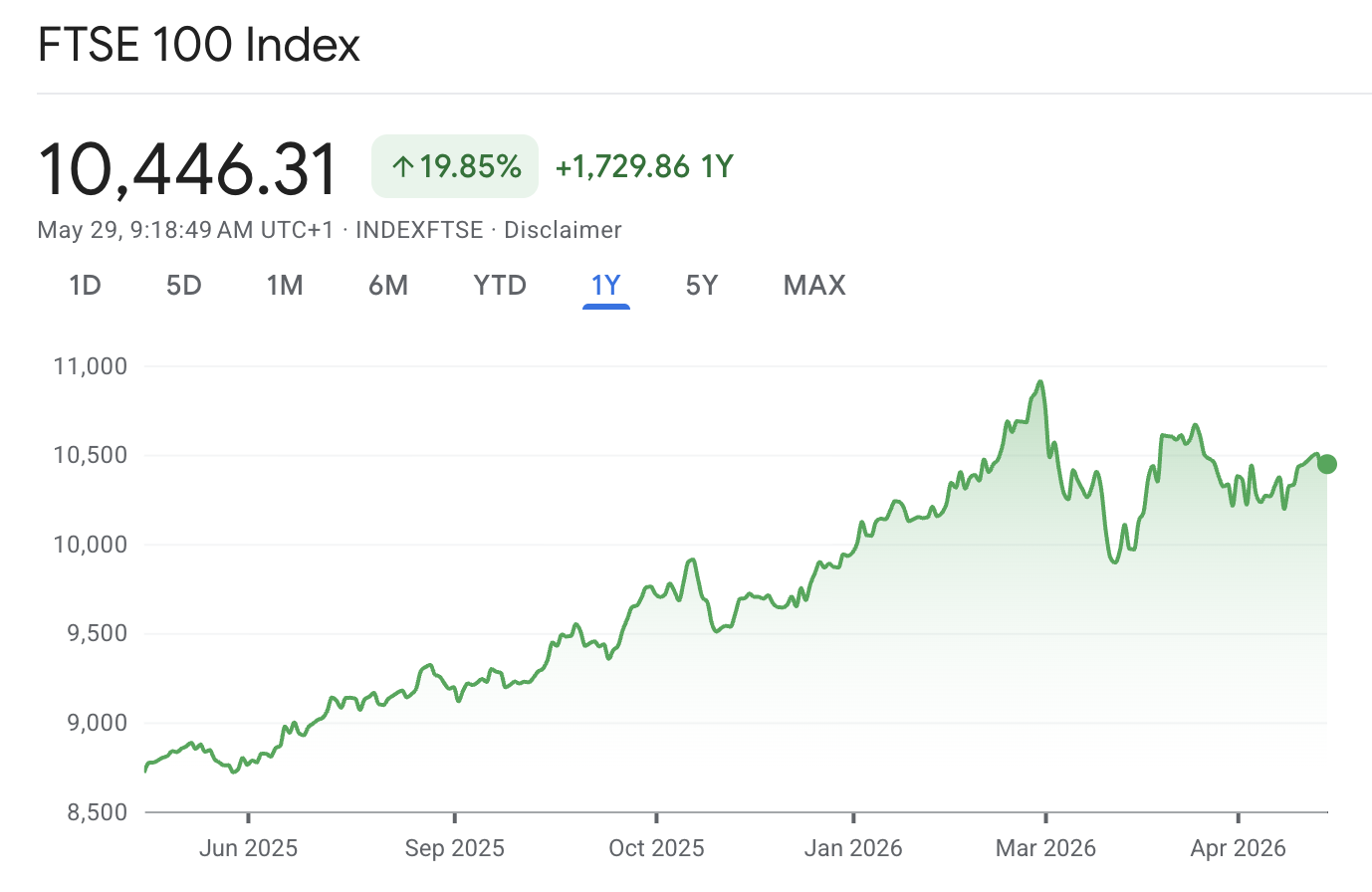
The FTSE 100 first breached 10,000 intraday in January 2026. After briefly slipping back below that threshold during March volatility, it recovered to trade around 10,400 to 10,450 in late May, keeping the index close to record territory. The move is supported by a sector mix that does not need a UK boom to keep delivering: global banks, energy majors, miners, healthcare and consumer staples companies that earn most of their revenue abroad.
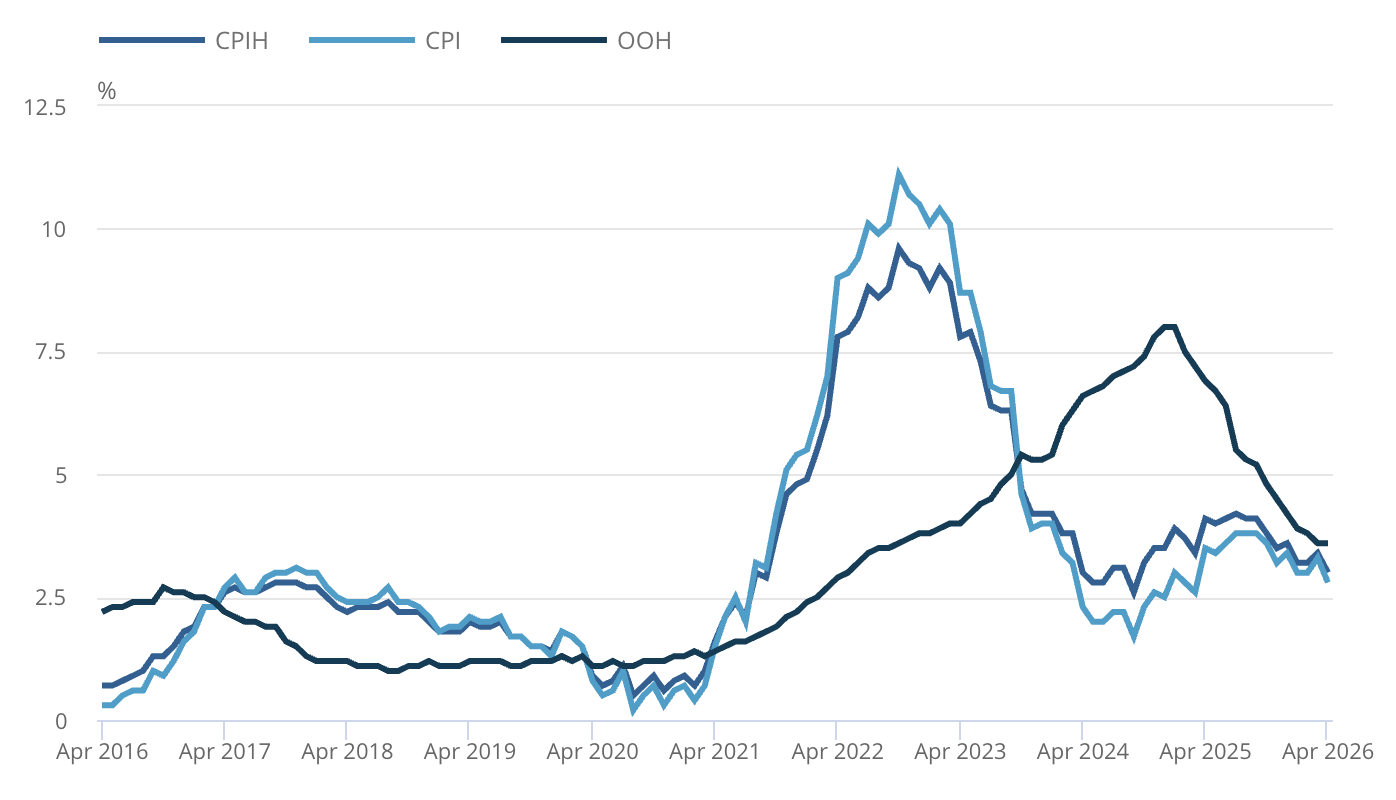
Inflation cooled to 2.8% in April. GDP grew 0.6% in Q1. Bank Rate is at 3.75%, high enough to support bank margins and keep income stocks relevant, though cash remains a meaningful competitor. Aggregate dividends are forecast to reach £88 billion this year, a record. The index has further to run, but the easy part is behind it. What comes next depends on earnings, not re-rating.
More than four-fifths of FTSE 100 constituent revenues come from outside the UK. Energy majors depend on oil and gas prices. Miners respond to Chinese demand and industrial cycles. Pharmaceutical companies rely on global drug markets. Banks and insurers respond to yield curves, capital discipline and shareholder distributions. A weak UK consumer does not automatically mean weak FTSE 100 earnings.
Sterling adds another layer. A softer pound lifts the translated value of overseas revenues for companies reporting in foreign currencies. That channel provided support during periods of domestic uncertainty and remains relevant while global earnings are firm. A sustained sterling rally works in reverse, creating a translation headwind even if underlying demand holds.
This is why the FTSE 100 can outperform when domestic UK data look only modest, and why reading the index purely through the lens of UK economic growth consistently produces the wrong conclusion.
The forecast of £88 billion in aggregate FTSE 100 dividends for 2026 is not a decorative statistic. It is the clearest statement of what the index is offering investors at current levels.
In a global equity market where US benchmark valuations depend heavily on earnings multiples tied to sustained AI and technology growth, the FTSE 100 offers a different return stream:
Banks are distributing capital through dividends and buybacks.
Energy majors are returning oil cash flow to shareholders.
Healthcare names provide earnings consistency.
Consumer staples offer pricing power and margin stability across economic cycles.
The concentration risk is real. A relatively small group of banks, energy companies, miners, insurers and pharmaceutical names carries a disproportionate share of total payouts. If commodity prices fall sharply, credit losses rise, or drug pipelines disappoint, the dividend story can weaken quickly.
But as long as those conditions are not met simultaneously, £88 billion in forecast dividends gives the FTSE 100 a valuation floor that pure growth indices do not have.
As of January 2026, financials were the largest FTSE 100 sector, accounting for 26.15% of the index. That concentration has been an asset in the current rate environment. Higher rates supported net interest margins for banks. Reinvestment yields improved for insurers. Buybacks across parts of the sector lifted per-share returns.
The support is conditional. If rates fall too quickly, margins compress. If rates stay restrictive too long, credit quality weakens and loan growth slows. The most supportive environment for FTSE 100 financials is not simply higher for longer. It is a controlled easing path where inflation continues to moderate, employment holds, and household and corporate balance sheets avoid sharp deterioration.
With CPI at 2.8% and Bank Rate at 3.75%, the Bank of England has room to cut without being forced into it. That is the financial sector’s preferred setup, and it is broadly what the current data allow. Whether it holds through the second half of 2026 depends on whether services inflation and wage dynamics continue to cool alongside goods prices.
The FTSE 100’s energy and mining weights give it commodity exposure that operates independently of UK domestic conditions. Major oil companies and diversified miners link the index to crude prices, Chinese metals demand, industrial cycles and global supply dynamics.
That exposure added meaningfully to the index’s appeal when commodity prices were elevated and global growth was firm. It also adds vulnerability when conditions shift. A slowdown in Chinese construction and industrial activity, weaker oil demand, or a broad commodity repricing would pressure earnings across two of the index’s heaviest sectors at the same time.
Large pharmaceutical names provide a partial offset through their own defensive earnings profile, but those stocks carry separate risks around drug pipelines, US pricing policy and patent expiry cycles.
The FTSE 100’s international earnings base is a genuine buffer against UK-specific shocks. It is not a hedge against global ones.
The macro setting has turned less hostile for UK equities without becoming straightforwardly bullish. Growth has improved from a low base. Inflation has eased. Real rates remain restrictive by recent historical standards.
| Indicator | Latest Reading | Market Interpretation |
|---|---|---|
| FTSE 100 level | Around 10,400 to 10,450 | Consolidation remains constructive rather than corrective |
| UK GDP | +0.6% in Q1 2026 | Supports earnings confidence without signalling overheating |
| UK CPI | 2.8% in April 2026 | Disinflation helps valuation sentiment and real household income |
| Bank Rate | 3.75% | Keeps income stocks relevant; limits aggressive multiple expansion |
| Dividend forecast | £88 billion in 2026 | Reinforces the index’s income-led investment case |
| Largest sector | Financials at 26.15% | Banks and insurers remain decisive for index momentum |
The most important feature of the current setup is policy asymmetry. CPI at 2.8% gives the Bank of England flexibility, but it does not guarantee a rapid easing cycle. Energy price risk, wage persistence and services inflation still matter. The Bank can ease further if inflation continues to normalise, but it has limited room to cut aggressively without risking a rebuild of price pressure.
For FTSE 100 investors, that creates a balanced rather than explosive setup. Lower inflation supports consumer-facing stocks, real incomes and valuation sentiment. Rates that remain relatively elevated support bank margins, insurer reinvestment yields and dividend stocks relative to lower-yielding alternatives. The risk is that rates stay high long enough to squeeze credit demand and corporate refinancing conditions.
The FTSE 100’s sector composition explains much of why it behaves differently from technology-heavy US benchmarks. Financials lead by weight, followed by meaningful exposure to consumer staples, healthcare, energy and basic materials. That structure gives the index a value, income and globally cyclical profile rather than a growth-at-any-price character.
This composition tends to favour the FTSE 100 in three conditions:
Banks and insurers benefit when rates are high enough to support margins without triggering a sharp rise in defaults.
Consumer staples provide earnings stability when household spending becomes more selective.
Healthcare offers defensive growth driven by global demand rather than UK domestic consumption.
Energy and mining add cyclicality. They can boost the index when commodity prices rise but also increase exposure to China demand, global industrial cycles and geopolitical supply disruptions. That is why the FTSE 100 can look defensively valued on paper but still move sharply during commodity repricing episodes.
The strongest version of a FTSE 100 rally is a broad one. Banks provide capital returns. Staples and healthcare provide earnings stability. Energy and miners provide commodity upside. Defence and industrial names add structural spending themes. If leadership narrows to one or two sectors, the index becomes more exposed to reversal when those sectors face headwinds.
The technical picture supports a constructive but selective view of the index. The break above 10,000 in January 2026 changed the structural reference point for medium-term sentiment, and the index has held above that level since.
| Indicator | Signal | Interpretation |
|---|---|---|
| RSI 14 | Neutral | No overbought pressure; momentum is balanced rather than stretched |
| MACD | Soft | Short-term buying pressure has cooled after the record advance |
| 20-day EMA | Mixed | Price is close to short-term dynamic resistance |
| 50-day EMA | Mixed to supportive | Medium-term trend remains constructive but requires confirmation |
| 200-day EMA | Supportive | Long-term trend bias remains positive |
| Support | 10,000 to 10,300 area | Buyers need to defend this zone to prevent deeper retracement |
| Resistance | 10,500 to 10,600 area | Sustained break would confirm renewed upside momentum |
| Overall trend | Constructive | Pullbacks remain corrective while long-term support holds |
RSI in neutral territory suggests the FTSE 100 is not technically stretched, which limits immediate correction risk driven by momentum alone. Softer MACD readings indicate that buying pressure has eased after the strong advance. A sustained move above the 10,500 to 10,600 resistance zone, particularly if driven by broad sector participation from financials, healthcare, energy and consumer staples, would materially strengthen the bull case.
The key risk trigger on the downside is a sustained close below 10,000. That would suggest the market is reassessing the re-rating that drove 2025’s advance rather than simply consolidating within an intact uptrend.
The main risk is not valuation alone. It is the combination of earnings disappointment and sector concentration. Four risks stand out:
Sterling appreciation. A significant pound rally would compress the sterling value of overseas earnings across the index’s largest constituents without any change in underlying business performance. This risk moves quickly during shifts in global risk appetite or UK rate expectations.
Commodity weakness. A slowdown in Chinese industrial demand, weaker oil prices or broad metals repricing would pressure energy and mining earnings simultaneously, removing two of the index’s most reliable sources of cash generation.
Earnings disappointment. Banks could face margin compression if the rate cycle turns faster than expected. Healthcare names could miss on pipeline delivery or face US drug pricing headwinds. Consumer staples could see margin pressure if input costs rise or volumes soften.
Global allocation shift. The index has benefited from investors seeking alternatives to stretched US technology valuations. If that rotation reverses, UK large caps could struggle for incremental demand even if fundamentals remain intact.
The FTSE 100 still has room to run, but the market is no longer rewarding UK equities for being cheap. It is asking whether earnings, dividends and balance sheets can justify the re-rating. As long as inflation eases, global demand holds, and dividends deliver, the answer remains cautiously yes. The upside from here is selective.
Banks need a controlled rate path. Miners need commodity support. Healthcare needs pipeline delivery. This is a year for execution.