Published on: 2026-02-12
Updated on: 2026-02-12
The US Consumer Price Index (CPI) for January 2026 will be released on Friday, February 13, 2026, at 8:30 a.m. Eastern Time.
This January CPI print carries extra weight because it arrives two days after the delayed January jobs report, which showed January payrolls rose by 130,000. The unemployment rate also held around 4.3%, a reminder that the economy is slowing but not rolling over.
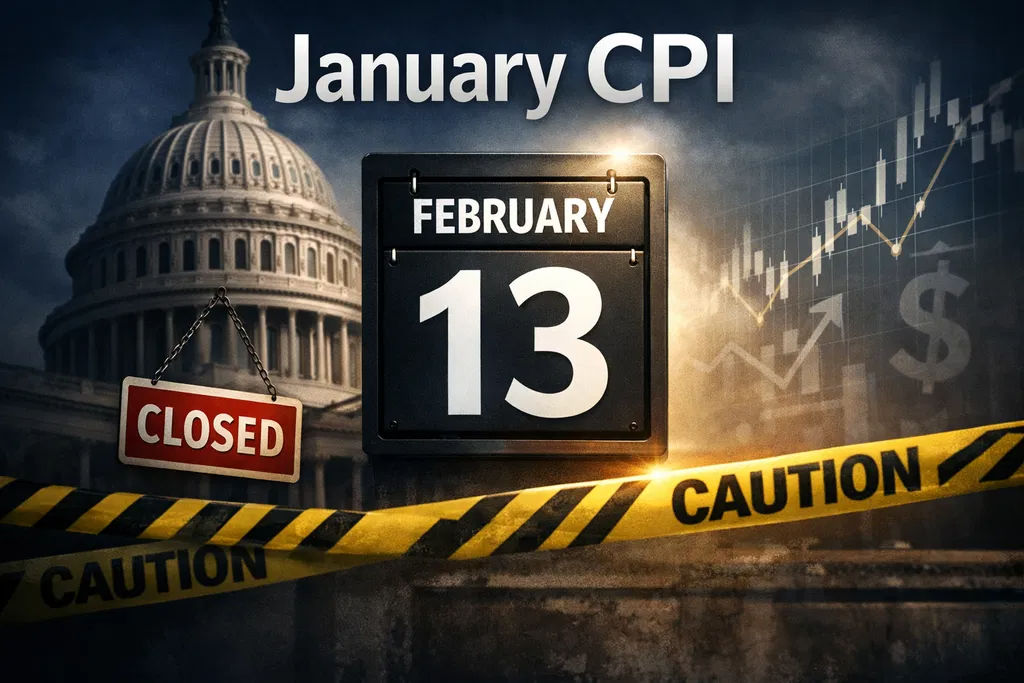
The best way to understand the delayed January CPI is straightforward: January typically experiences volatility due to seasonal adjustments, price changes, and year-end recalibrations.
This year's situation is further complicated by updated seasonal factors and revisions that could change how recent inflation trends are perceived.
Two key numbers are headline CPI, which reflects public sentiment, and core CPI, which guides policymakers. The twist this month is the gap between "street" expectations and model-based estimates.
| Measure (January) | Prior (December) | Consensus expectation | Model-based nowcast (latest) | Why it matters |
|---|---|---|---|---|
| Headline CPI (m/m, SA) | +0.3% | ~+0.3% | +0.13% | Drives yields, risk mood |
| Core CPI (m/m, SA) | +0.2% | ~+0.3% | +0.22% | The Fed’s “stickiness” test |
| Headline CPI (y/y, NSA) | +2.7% | +2.5% | +2.36% | Headline narrative, base effects |
| Core CPI (y/y, NSA) | +2.6% | +2.5% | +2.45% | Signals policy patience vs urgency |
If consensus sits near 0.3% but the nowcast is closer to 0.2% or lower, the market can be more sensitive to a "surprise" that is only one-tenth of a percentage point away from expectations.
In January of last year, the CPI-U rose 3.0% year-over-year, along with a notable non-seasonally adjusted increase for the month. When that high month drops out of the 12-month window, the year-over-year rate can fall even if the current month is only "okay," not great.
Thus, the decline from 2.7% in December to 2.5% in January may be partially mechanical rather than a complete fresh improvement.
With the January CPI release, seasonal adjustment factors are recalculated, and seasonally adjusted indexes for the prior five years can be revised.
That matters because markets don't just trade the headline. They trade the story of momentum: "Is inflation re-accelerating?" Revisions can change that story even if the fresh print is close to expectations.
Energy is a smaller share of the "core" story, but it can drive the headline CPI and shape the initial market reaction.
In December, the energy index rose 0.3%, while gasoline fell 0.5% on a seasonally adjusted basis, and natural gas rose 4.4%.
If January's energy prices differ from traders' expectations, the headline CPI may surprise, even if the core CPI remains stable.
The CPI release is now scheduled for February 13. This change occurred after a funding issue disrupted parts of the BLS release calendar and communications.
When markets get extra time, they often crowd into the same view, which makes the first move after the number bigger.
January CPI is often less about "inflation" as one thing, and more about which bucket is in charge.
In December, shelter rose by 0.4% m/m, the largest driver of the monthly CPI increase. Both rent and owners' equivalent rent increased by 0.3% m/m.
Shelter is the slow-moving heavyweight. Even when goods prices cool, shelter can keep core inflation sticky. If shelter doesn't ease, the Fed tends to stay cautious, even if the headline year-over-year number looks friendly.
December food inflation was firm: food rose +0.7% m/m, with both food at home and food away from home up. Throughout the year, food prices increased by 3.1%.
Food matters less for policy than core, but it matters for confidence and consumer mood. If food prices rise higher, it can keep inflation expectations sticky even when core inflation is behaving.
Energy rose +0.3% m/m in December, but the details were mixed: gasoline fell on the month while natural gas jumped and electricity barely moved.
Energy is the classic headline swing factor. A soft energy month can pull headline CPI down and make the report look "cool," even if core services remain uncomfortable.
The December report already showed areas with notable year-over-year increases outside shelter, including medical care (+3.2%), household furnishings (+4.0%), recreation (+3.0%), and personal care (+3.7%).
January is when many companies update prices and services. That's why markets care so much about core m/m, not just the year-over-year rate.
The Fed maintained the policy rate at 3.50% to 3.75% during the January 28 meeting and reiterated that it will assess incoming data and the balance of risks. The next key decision window is the March 17–18 meeting.
Markets have been trending towards the expectation that the Fed can maintain its current stance for several months, with pricing indicating no interest rate cuts until at least mid-year. The CPI can shift that in two ways:
If core m/m is clearly tame, rate-cut expectations can move earlier, and the front end of the yield curve usually rallies.
If core m/m re-accelerates, the Fed doesn't need to hike to hurt risk assets. It just needs to keep rates where they are for longer than the market expected.
Here's a practical scenario map for Friday. Numbers are illustrative ranges around the current expectations and nowcasts, not a promise of outcomes.
| Scenario | Data outcome (typical thresholds) | Likely rates reaction | Likely USD reaction | Likely equity reaction | Likely gold reaction |
|---|---|---|---|---|---|
| Cool inflation | Core CPI is 0.1% to 0.2% m/m and y/y drifts below 2.5%. | Front-end yields usually fall as cut timing moves forward. | The dollar often softens as rate support fades. | Equities often rise on lower-rate hopes. | Gold often strengthens if real yields drop. |
| In-line base case | Core CPI is near 0.3% m/m and y/y sits near 2.5%. | Yields can be choppy because the result matches positioning. | The dollar often fades after the first spike. | Equities often focus on guidance and other data. | Gold often trades mixed and reacts to yields. |
| Hot inflation | Core CPI is 0.4% m/m or higher and y/y refuses to fall. | Yields usually jump, led by the 2-year sector. | The dollar often strengthens on "higher for longer". | Equities often dip as discount rates rise. | Gold often weakens if real yields climb. |
| Headline-hot, core-cool mix | Energy lifts headline CPI, but core stays calm. | The move can fade if the market trusts core inflation more. | The dollar can whip as traders debate signal versus noise. | Equities can recover after the first shock. | Gold can strengthen if the market fades the spike. |
Even after CPI hits the tape, traders will still have to manage two follow-on risks.
First, the seasonal-factor update can reshape the short-term inflation trend once the revised seasonally adjusted data are absorbed.
Second, the Fed's next decision window is March, and CPI will influence how the market prices that meeting and the months beyond it.
The BLS has scheduled the January 2026 CPI for Friday, February 13, 2026, at 8:30 a.m. Eastern Time, which is 1:30 p.m. in London.
A brief federal funding disruption delayed the release date.
January CPI often includes seasonal quirks, and the BLS also updates seasonal factors with the January release, which can revise seasonally adjusted CPI history.
The headline Consumer Price Index includes all items, like food and energy. The core CPI, however, excludes these categories to provide a clearer inflation trend, which is often more useful for policy-making.
The Fed is keeping rates between 3.50% and 3.75% and will evaluate incoming data and risks. A high core CPI could postpone rate cuts, whereas a lower core CPI might encourage earlier easing.
In conclusion, the market wants to see cooling inflation, but the Fed needs to see it coming from the right places, especially core services and shelter. In December, the CPI was mainly driven by housing costs and food prices, despite more favorable year-over-year growth.
If January core inflation behaves as expected, rate-cut expectations can shift forward quickly. If core runs hot again, the "higher for longer" view wins by default, even without any new hike talk. Either way, the delay has made this print more combustible than usual.
Disclaimer: This material is for general information purposes only and is not intended as (and should not be considered to be) financial, investment or other advice on which reliance should be placed. No opinion given in the material constitutes a recommendation by EBC or the author that any particular investment, security, transaction or investment strategy is suitable for any specific person.