Published on: 2026-03-06
Updated on: 2026-03-06
The US February jobs report is the largest scheduled data release today because it can reset expectations for when the Federal Reserve will cut rates again.

The Bureau of Labor Statistics (BLS) is scheduled to publish the Employment Situation for February 2026 on 6 March 2026 at 8:30 a.m. Eastern Time.
Markets are not only looking for job growth. Markets are seeking clear indications on whether wage pressure is decreasing rapidly enough for the Fed to feel comfortable easing policy later in 2026.
BLS releases the jobs report at 8:30 a.m. Eastern Time. On 6 March 2026, US daylight saving time has not started yet, so Eastern Time is UTC-5.
| Location | Local release time | Notes |
|---|---|---|
| New York (ET) | 8:30 a.m. | Official BLS release time. |
| London (GMT) | 1:30 p.m. | Same as UTC today. |
| Frankfurt / Paris (CET) | 2:30 p.m. | Europe is still on standard time. |
| Dubai (GST) | 5:30 p.m. | UTC+4. |
| Tokyo (JST) | 10:30 p.m. | UTC+9. |
Economists broadly expect job growth to cool from January's upside surprise, with consensus around 50,000 jobs, and the unemployment rate seen holding at 4.3%
| Measure | Consensus-style baseline | More cautious view | More optimistic view |
|---|---|---|---|
| Nonfarm payrolls | +50,000 (median) | +25,000 (Barclays) | +85,000 (Nomura) |
| Unemployment rate | 4.3% | 4.3% | 4.3% |
However, research desks are not aligned, which is why volatility can be high even when the "headline" looks small.
Wages are expected to remain contained:
Average hourly earnings: 0.3% m/m, 3.7% y/y.
Average workweek: 34.3 hours.
Participation rate: 62.5%
A small payroll number alone is not necessarily "dovish" if wage growth and hours remain strong, as it may indicate a supply-constrained labor market instead of a cooling one.
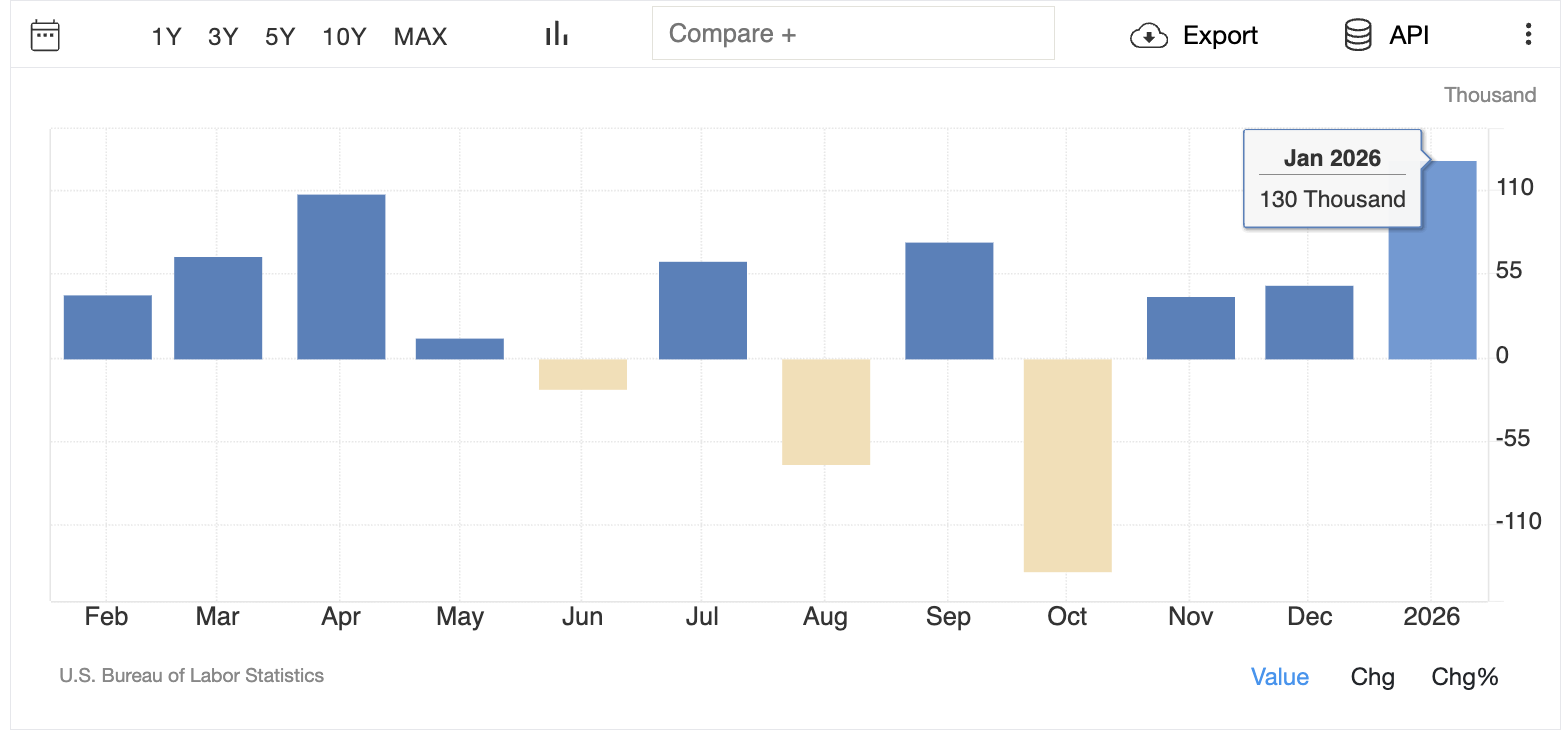
The January report was stronger than expected on the headline, but it came with important details that still colour today's debate.
BLS reported:
Nonfarm payrolls rose by 130,000 in January 2026.
Average hourly earnings rose 0.4% m/m to $37.17, and were up 3.7% y/y.
The average workweek edged up to 34.3 hours.
Prior months were revised lower (November to +41,000 and December to +48,000).
BLS reported that severe winter weather in January 2026 negatively impacted the household survey response rate. However, they noted that there was no noticeable impact on national payroll employment, hours, or earnings.
This year, it's particularly important for traders to focus on revisions, as they carry more significance than usual. If February's report includes meaningful revisions to January, the market can react twice: once to the headline and again to the revision line.
The Fed's next policy meeting is 17–18 March, and the market baseline remains a hold. The markets are pricing roughly a 97% chance of no change at that meeting, according to CME FedWatch probabilities.
So today's question is not, "Will the Fed cut in March?" The real question is, "Does this report keep the Fed in wait-and-see mode, or does it pull forward the next realistic cut window?"
The Fed will care about three parts of the report:
Payroll growth: Is hiring still ongoing, or is it beginning to slow down?
Unemployment rate: Is slack building, or is the labour market still tight?
Wages and hours: Are pay gains and the workweek still firm enough to keep services inflation sticky?
The best way to frame "whispers" into NFP is to compare indicators that capture different parts of the labor market.
| Indicator | Latest read | What it suggests going into NFP |
|---|---|---|
| ADP private payrolls (February) | +63,000 | Private hiring looks modest, but ADP and NFP can diverge sharply month to month. |
| Initial jobless claims | 212,000 (week ending Feb 21) | Layoffs remain contained, which supports the “low-fire” narrative. |
| Continuing claims | 1.83 million (week ending Feb 14) | Still elevated enough to imply unemployed workers are taking longer to find jobs. |
| ISM Services employment index | 51.8 (February) | Services hiring is expanding modestly, which matters because services dominate the economy. |
| ISM Manufacturing employment index | 48.8 (February) | Manufacturing hiring remains in contraction territory, even as the PMI is above 50. |
| JOLTS job openings (December) | Just over 6.5M | Labor demand has cooled materially from prior years, which is consistent with slower payroll growth. |
The combined message is consistent with a labor market that is neither collapsing nor re-accelerating cleanly.
When the headline hits, many traders overreact to one number. A cleaner process is to read it in this order:
Payrolls headline
Unemployment rate and participation rate
Average hourly earnings (m/m first, then y/y).
Average workweek.
Patterns across healthcare, government, and construction can significantly shape the narrative.
The BLS releases The Employment Situation for February today, Friday, March 6, 2026, at 8:30 a.m. ET. The report includes nonfarm payrolls, the unemployment rate, and wage measures such as average hourly earnings.
Economists broadly expect modest job growth, with many forecasts clustering around 50,000 payrolls, although the forecast range is wide.
Because markets largely expect the Fed to hold rates steady at the March meeting, the jobs report is a key swing input.
In conclusion, the February jobs report is a critical release because it comes as the Federal Reserve is in a wait-and-see mode, and markets are still assessing the pace of labor-market cooling.
The clear expectation is for modest payroll growth, a steady unemployment rate of 4.3%, and wage growth that remains contained at around 0.3% MoM.
Disclaimer: This material is for general information purposes only and is not intended as (and should not be considered to be) financial, investment or other advice on which reliance should be placed. No opinion given in the material constitutes a recommendation by EBC or the author that any particular investment, security, transaction or investment strategy is suitable for any specific person.