Published on: 2026-04-24
Updated on: 2026-04-24
Have you ever noticed how a major news event can result in a quiet market, while a minor data release causes a sudden, sharp shift in price? It can feel illogical if you’re only looking at the headline.
Most of the time, the market is not ignoring the news. It is reacting to something slightly different: how sure people feel about what comes next.
When investors share a stable story about growth, inflation, and interest rates, reactions tend to be more orderly. When that story starts to wobble, the same headline can land very differently. Traders disagree more, liquidity thins out, and small surprises can travel further than they normally would.
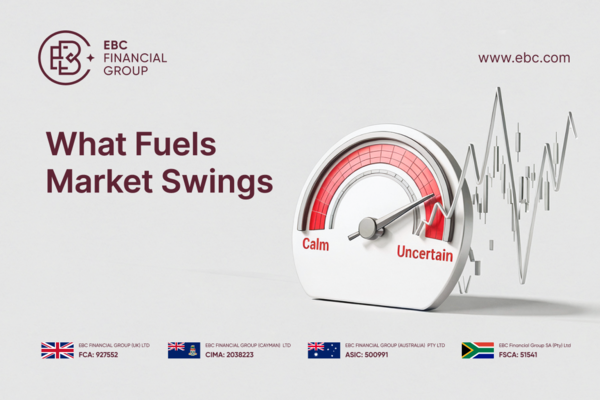
This uncertainty is what really drives market swings.
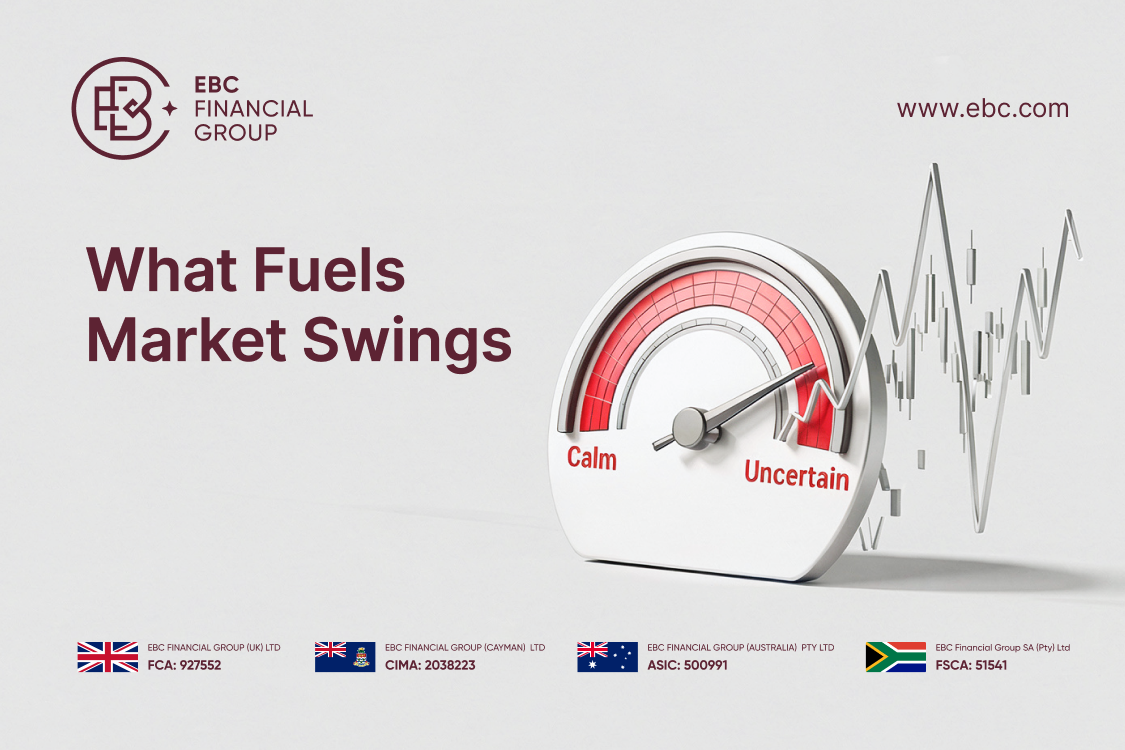
Sometimes the market does the opposite of what you expect. A big headline lands and nothing much happens. Then a routine data release comes along and the chart jerks higher or lower.
This happens because markets usually read the story behind the headline, not the headline itself. If most participants agree on what matters and what comes next, surprising news can be absorbed without chaos. But when the story is fragile, reactions get louder because the market is unsure which path to price.
Volatility does not mean the market is acting irrationally. It just means the market is struggling to find agreement when it is difficult to do so.
*The trader version of this is covered in Episode 2 of EBC’s Brazil podcast. Watch here.
Volatility is the size of price swings, not the direction. A calm market can drift for days. A volatile market can whip up and down sharply within the same session, even if it ends near where it started.
Risk and uncertainty are different things, and the distinction matters more than most people realise.
Risk is when you can roughly map the outcomes. You might not know which one will happen, but you can name the range.
Uncertainty is when people disagree on outcomes entirely, or cannot agree on what the outcome even depends on. That is when reactions become jumpier.
In uncertain periods, traders do not just change their views. They change their behaviour. They may reduce exposure, tighten limits, step back, and wait for clarity. When enough people do that at once, markets can turn quickly.
When uncertainty is high, a small piece of news can trigger a larger move. This is not because the news is huge but because the market is already tense. Four forces tend to appear together.
Disagreement widens. Two people can read the same number and see different futures. One sees resilience. Another sees overheating. A third sees policy risk. When disagreement widens, price often has totravel further to find a level that feels acceptable to enough participants.
The story changes faster than the data. A strong jobs report can be treated as “bad” if it suggests rate cuts will be delayed. A weak number can be treated as “good” if it makes a policy easier to implement. That is why the same headline can produce opposite reactions in different weeks. The story the market is trading has changed.
Liquidity thins out. In uncertain periods, fewer people want to take the other side. Market participants step back, and order books thin out. That means each trade can push the price further than usual. This is one reason markets can feel jumpy even when the news itself feels small.
Forced moves kick in. Stop losses get hit. Risk limits force cuts. Margin pressure rises. A small push turns into a bigger shove because positions are being reduced, not because everyone suddenly changed their mind. Once this loop starts, the market can become more reactive. Volatility can feed on itself.
A typical uncertain day starts with a market that looks calm on the surface but feels tense underneath. A key event is coming—a data release, central bank appearance, or headline risk that has lingered for days. Price may not have moved much yet, but the market is already leaning.
In the hour before the event, the tone changes and movements become choppier. The US 10-year Treasury yield flicks up and down instead of drifting. The Dollar Index firms, eases, then firms again. Oil may do the same. Nothing dramatic has happened, but the market is no longer relaxed.
Then the number lands.
The headline looks fine to most people. It is not a shock. But the market reacts sharply anyway, because it's not really to the headline. It is what traders think changes about the path from here.
If yields jump and the dollar firms, the market may lean towards tighter conditions, even if the data point itself is small. If yields fall and the dollar softens, it may be leaning towards easier conditions. Either way, early clues often show up in the scoreboards, not only in the headline.
After the initial move, things can get messy. Liquidity thins quickly. Stops get triggered. Traders leaning the wrong way cut fast. The move can extend, not because the headline was huge, but because the market was already tense and positioned. It can feel bigger than the news because confidence in the story was fragile.
Episode 2 of our Brazil podcast picks up here. We discuss what traders are thinking in the hour before a major event, and how interpretation shapes the reaction more than the headline does. Watch here.
Look at these as gauges instead of predictors.
10Y: US 10-year Treasury yield, a simple read on where rate expectations are leaning.
DXY: US Dollar Index, a broad measure of dollar strength against major currencies.
MOVE: ICE BofA MOVE Index, a gauge of bond market volatility and interest rate uncertainty.
VIX: a widely followed measure of expected equity volatility. It is equity-focused, but it can also reflect broader risk mood.
Headlines still matter, but you have to interpret them.
These instruments are widely referenced by market participants as contextual gauges. They do not predict future price movements.
Headline |
What the market is really asking |
What to glance at |
Common Trap |
Hot Inflation |
Does this push rate cuts further away?
|
10Y, DXY
|
Treating the headline as the whole story |
Weak Jobs |
Is this changing the growth outlook or the rate path? |
10Y, DXY |
Assuming “bad” always means markets fall |
Central Bank Speech |
Is the message shifting expectations? |
10Y, DXY, MOVE |
Fixating on one phrase |
Geopolitical Shock |
Is this fear-driven or inflation-driven? |
Oil, 10Y, DXY |
Forcing the safe haven story |
Oil Spike |
Is inflation worry returning? |
Oil, 10Y, DXY |
Ignoring second-order effects |
These are not strict rules. They are reminders of what the market usually focuses on when uncertainty is high.
Volatility is not just about information. It is also about how people behave.
When markets get fast and noisy, many traders fall into the same patterns. Moving because everyone else is moving. Holding a losing position because taking the loss feels unbearable, while banking a small winner early just to feel relief. Treating the newest headline as though it rewrites everything, even when it only changes a detail. Noticing the parts of the story that confirm their view and ignoring the one that does not. Getting anchored to a level they bought at and treating it like a destination.
None of this requires bad intentions. It is just how people behave under pressure. The problem is what happens when enough of them do it at once. Price swings widen, and the market becomes harder to read. The mechanics may help explain how big moves happen under certain conditions. The harder part is what volatility does to the person watching the screen.
You do not need to predict direction to follow what is happening. It helps to know whether the market feels calm or tense before an event, as that shapes how far a surprise travels.
A few instruments are used as rough gauges. The VIX measures expected equity volatility. The MOVE Index does the same for bonds and serves as a proxy for interest rate uncertainty. The US 10-year Treasury yield gives a simple read on how the market leans on rates. The Dollar Index tracks the dollar against major currencies. Oil, whether Brent or WTI, can quickly revive inflation concerns, feeding back into rates and the dollar.
None of these tells you where the price will go. What they can suggest is whether the environment looks settled.
In practice, people look for signs like yields swinging more than usual, the dollar firming quickly, oil spiking on headlines, the VIX moving sharply, intraday reversals erasing earlier moves, or “good news” being sold immediately. If two or three appear together, the market may be less settled and reactions more abrupt.
Trading the headline without checking what the market expected beforehand, since the move often depends on the gap between what happened and what was priced in. Confusing speed with direction, treating a sharp move as a new trend when it might be a trigger and a thin book. Skipping the second question: not only “what happened?” but “what does this change about rates, growth, or risk appetite?” Changing the plan mid-trade because the chart moves fast, which turns small mistakes into costly ones. Watching one instrument only when uncertain markets often require a wider context.
Volatile periods come with two costs that can catch people out. Wide swings increase the chance of being pushed out at the wrong moment, even when the underlying view is right. Fast markets can lead to worse fills and more slippage because prices move between decision and execution when liquidity is thin. Many traders focus less on catching every move and more on avoiding big, avoidable mistakes.
Trying to predict every move is exhausting and counterproductive. It makes people reactive rather than prepared.
A better habit is to start each week by writing down three short scenarios, just a line or two each. What does the market believe right now? What could make it more optimistic? What could make it more cautious? Then ask yourself honestly: what would make me change my mind?
This is not forecasting. It builds context before the noise starts, so when a headline lands, the first reaction is not to treat it as a fresh universe. Many big mistakes in volatile markets happen not from bad analysis but because people react to the tenth piece of information as if it were the first.
Big price swings are a sign of uncertainty and different opinions showing up in the market. The market is trying to find agreement, and sometimes that process is noisy and messy.
Your advantage is not in guessing the next move, but in making fewer decisions you regret. If you can spot when confidence is low, market reactions may stop feeling like surprises.
Why do some traders stay composed when a volatile session catches everyone else off guard? Episode 2 of our Brazil podcast gets into that. Watch here.
* The linked podcast episode is produced by EBC Financial Group for educational purposes and may include discussions of market concepts. It does not constitute investment advice or a recommendation to trade.