Published on: 2026-04-24
Updated on: 2026-04-24
Pricing power is one of the clearest signs of business quality because it shows whether a company can raise prices without losing customers. In an economy shaped by sticky inflation, wage pressure, energy volatility, and selective consumer spending, that ability has become a practical test of corporate strength.
The 2026 market backdrop makes pricing power especially important. U.S. CPI rose 3.3% year over year in March 2026, while February PCE inflation stood at 2.8% and core PCE at 3.0%, still above the Federal Reserve’s 2% longer-run inflation goal. For investors, the issue is not only whether inflation rises. It is which companies can defend profits when costs do.
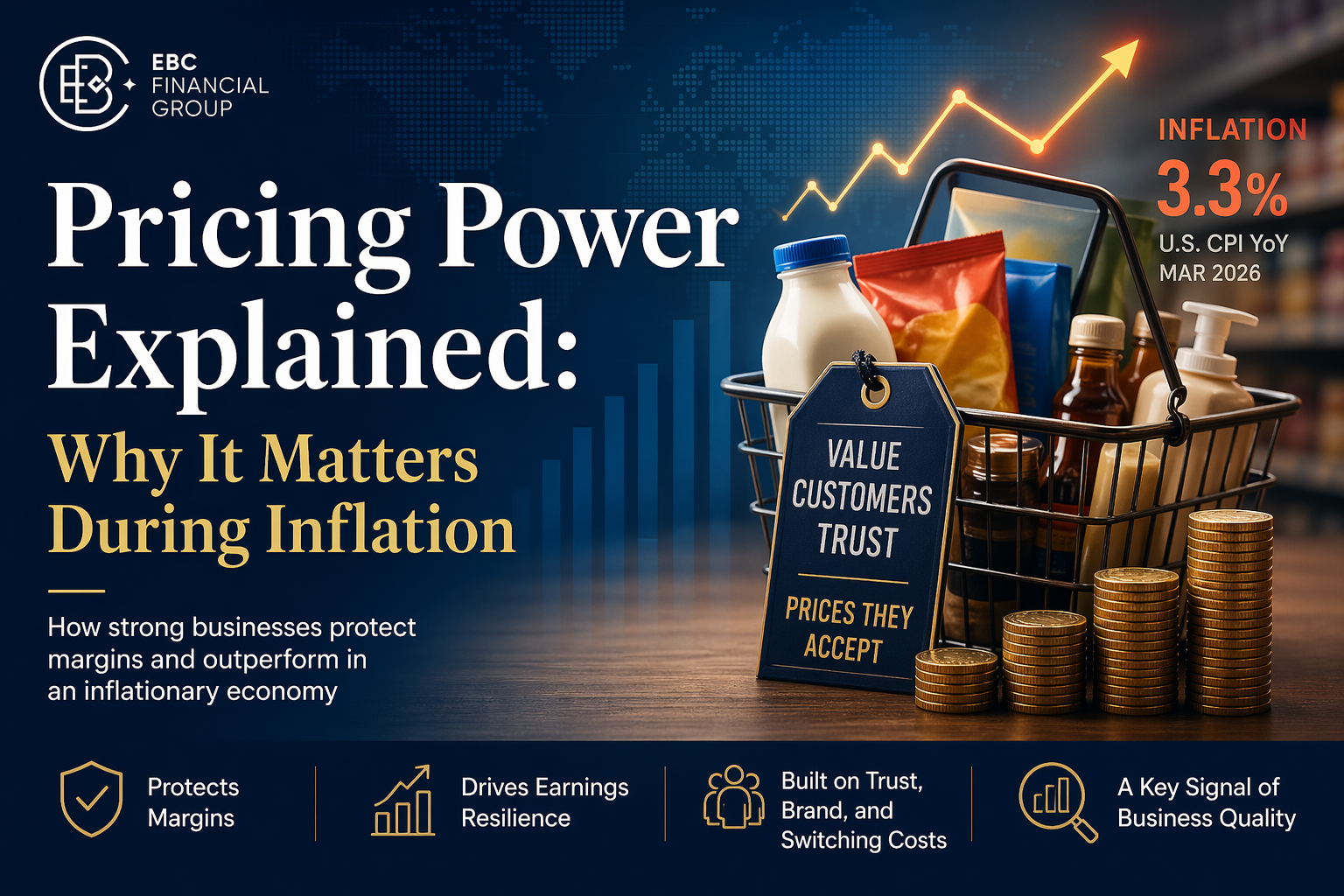
Pricing power means a company can raise prices while keeping demand, margins, and market share broadly intact.
Inflation separates stronger businesses from weaker ones because rising costs must either be passed on or absorbed.
Strong brands, essential products, high switching costs, and scarce supply often create pricing power.
Weak pricing power usually leads to margin compression when labour, freight, raw material, or energy costs rise.
Investors use pricing power to assess earnings resilience, cash-flow stability, and long-term business quality.
Pricing power is the ability to increase prices without causing a major decline in customer demand. It reflects how much value customers attach to a product or service.
A company with strong pricing power does not compete only on price. Customers buy because of trust, habit, quality, convenience, necessity, status, or deep integration into daily life. That gives the company room to protect profitability when costs rise.
A company with weak pricing power has less control. Its product may look similar to competitors’ products. Customers can switch easily. If the company raises prices, demand falls. If it does not raise prices, profits shrink.
This is closely linked to price elasticity. If demand barely changes after a price increase, the product has low price sensitivity. If customers quickly reduce purchases or switch to alternatives, the company has limited pricing power.
Inflation raises the cost of running a business. Wages rise. Packaging costs rise. Energy prices rise. Suppliers charge more. Borrowing costs may remain high.
At that point, every company faces the same question: can it raise prices enough to protect margins?
Businesses with pricing power can pass a meaningful share of higher costs to customers. Businesses without it absorb more of the pressure. This is why inflation often widens the gap between high-quality companies and fragile competitors.
Margins show how much profit a company keeps after covering costs. Pricing power protects margins by allowing revenue to rise alongside expenses.
The strong company does not escape inflation completely, but it protects most of its profitability. The weak company suffers twice: costs rise while revenue falls. This is the core reason pricing power matters in investment analysis.
Consumer staples often show pricing power because many products are low-cost, frequently purchased, and habit-forming. A small increase in the price of a beverage, snack, or household product may not significantly change consumer behaviour.
Luxury goods rely on scarcity, heritage, and status. For high-income consumers, higher prices can sometimes reinforce exclusivity rather than reduce demand.
Technology ecosystems can also hold pricing power when customers depend on software, devices, cloud services, or subscriptions that are difficult to replace. Switching costs make customers less likely to leave after a price increase.
Healthcare and specialist industrials may have pricing power when products are essential, patented, regulated, or mission-critical.
The common thread is not a sector alone. It is customer dependence. The harder it is to switch, the stronger the pricing power.
Consider three different businesses facing the same cost shock.
A global soft-drink brand may raise prices modestly because customers recognise the product, retailers need it on shelves, and the purchase remains affordable. A luxury handbag maker may lift prices because scarcity and brand prestige support demand from wealthier buyers. A subscription software provider may raise renewal prices because customers depend on its tools and switching would disrupt operations.
A commodity retailer has less flexibility. If it raises prices too aggressively, shoppers can immediately compare alternatives. This is why pricing power is not simply about being large. It is about being difficult to replace.
Investors should look for pricing power in company results, not just in brand reputation.
The strongest signals are stable gross margins during inflation, revenue growth not driven solely by higher volumes, low customer churn, repeat purchases, premium pricing relative to competitors, and market share stability after price increases.
Management commentary also matters. Companies with real pricing power often discuss price increases, product mix, renewal rates, and margin resilience with confidence. Companies without it tend to mention discounting, promotional pressure, weak traffic, or cost absorption.
Valuation reflects this difference. Businesses with durable pricing power often trade at higher earnings multiples because investors trust their future cash flows. They are not immune to downturns, but their earnings are usually less fragile.
Pricing power is valuable, but it is not unlimited.
Consumers eventually resist excessive price increases. Shoppers may trade down to private-label products. Corporate customers may renegotiate contracts. Regulators may question aggressive pricing in concentrated industries. Competitors may discount to regain market share.
Investors should therefore separate durable pricing power from temporary price hikes. A company may raise prices for one year because inflation gives it cover. A stronger business can defend demand, margins, and market share across several cycles.
Pricing power means a company can raise prices without losing too many customers. It shows that customers still value the product even when it becomes more expensive.
Inflation raises business costs. Companies with pricing power can pass some of those costs to customers and protect margins. Companies without it often suffer weaker profits because they cannot raise prices without hurting demand.
Strong pricing power is common in businesses with trusted brands, loyal customers, essential products, high switching costs, limited competition, or scarce supply. Consumer staples, luxury goods, software platforms, healthcare, and specialist industrials can all show these traits.
Investors can study gross margins, operating margins, revenue growth, volume trends, customer retention, market share, and management commentary. Stable margins during inflation are one of the strongest signs.
Yes. Pricing power can weaken if competition rises, brand value fades, consumers trade down, or technology changes customer behaviour. It should be monitored through each cycle.
Pricing power is not just a business concept. It is a practical way to assess whether a company can defend its profits as the economic environment becomes more challenging.
The best businesses do not raise prices simply because they want to. They raise prices because customers continue to see value. For investors, that resilience can point to stronger margins, steadier cash flows, and higher-quality long-term earnings.