Published on: 2026-01-28
The Plaza Accord remains a reminder that foreign exchange (FX) markets are not always left to “free float.” When governments decide an exchange rate has become economically and politically intolerable, they can coordinate policy and intervention to force a realignment.
In an era of recurring “strong dollar” cycles, widening trade deficits, and renewed currency rhetoric, the Plaza Accord has become shorthand for a radical solution that markets still fear or hope for, depending on positioning.
Signed at New York’s Plaza Hotel on September 22, 1985, the agreement followed a surge in the US dollar and the emergence of US trade imbalances as a domestic political risk. In the five years leading up to 1985, the dollar climbed 44 per cent against other major currencies, while the US trade deficit hit $122 billion in 1985.
That combination created the conditions for a rare event in modern macro: explicit, multinational currency coordination.
The Plaza Accord engineered an “orderly” dollar downshift after a 44 per cent run-up into 1985 that had eroded US price competitiveness and inflamed protectionist pressure.
The post-accord adjustment was large: in 1985-87, the dollar fell about 40 per cent on a major-currency basis, reversing a multi-year overvaluation.
The deal was never just about spot intervention. It paired coordination with a policy mix aimed at rebalancing demand, because credibility, not volume, moves FX regimes.
The political objective was to defuse trade conflict. The US trade deficit had reached roughly 3 per cent of GDP, a level that raised the probability of legislative retaliation.
“Plaza Accord 2.0” keeps resurfacing, but replication is structurally harder in a China-centric trade system and a far larger, faster FX market.
The Plaza Accord was a joint commitment by the Group of Five (G5) (United States, Japan, West Germany, France, United Kingdom) to push the dollar lower against major counterparts, particularly Japan and Germany, through coordinated messaging, policy alignment, and foreign exchange (FX) intervention.
The statement’s core premise was that “some further orderly appreciation” of non-dollar currencies was desirable, an unusually direct signal for a group of finance ministries and central banks.

What it was not: A one-day “sell dollars” operation that mechanically forced a new equilibrium. The durable effect stemmed from changes in expectations about the policy reaction function. In practice, Plaza worked because it convinced markets that the US and its key partners would not defend an overvalued dollar, and that interest-rate and fiscal settings would evolve in a dollar-negative direction consistent with rebalancing.
That distinction matters today because most modern “Plaza Accord 2.0” commentary implicitly assumes that a press conference and a few billion in intervention can overpower global capital flows. History suggests the opposite. Coordination moves FX when it changes the expected policy path, not when it tries to overpower daily turnover.
By 1985, the dollar’s strength had become a macroeconomic and political problem. A surging currency tightens financial conditions, cheapens imports, and squeezes tradable-sector margins. It also shifts the distributional balance inside an economy: consumers benefit from cheaper imports, while manufacturers and exporters lose pricing power.
The US trade balance was the visible pressure point. In 1985, the US trade deficit reached $122 billion, a record that heightened the risk of protectionist legislation. This was not abstract. A trade deficit that large, combined with a strong currency, produces a narrative of “unfair” competitiveness that quickly becomes bipartisan.
Plaza was designed to change that trajectory by restoring competitiveness through the exchange rate, while encouraging surplus economies to support domestic demand. The aim was macro rebalancing without a trade war.
So how did Plaza push the US dollar lower? Currency coordination has three channels, and Plaza used all three.
 1) Signalling and expectations.
When multiple authorities publicly align on a desired direction, they compress uncertainty about “how far is too far.” The Plaza language about orderly non-dollar appreciation was a direct attempt to re-anchor expectations.
If exchange-rate objectives conflict with monetary policy, the FX market normally wins. Plaza succeeded because it coincided with a broader policy shift in the US approach to the dollar and international coordination, not because intervention alone is omnipotent.
Even “sterilised” intervention can matter at inflexion points if it hits thin liquidity, forces risk managers to cut exposure, or triggers momentum and trend-following systems. But this works best when it is consistent with the macro narrative and the rate path.
This framework explains why the Louvre Accord followed. Once the dollar fell far enough, authorities sought to halt further declines and stabilise currencies around prevailing levels.
The post-Plaza adjustment was swift by macro standards. Frankel’s retrospective captures the scale: the dollar had climbed 44 per cent into 1985 and then fell about 40 per cent from 1985 to 1987. By early 1987, participants judged the depreciation sufficient and pivoted toward stabilisation via the Louvre Accord.
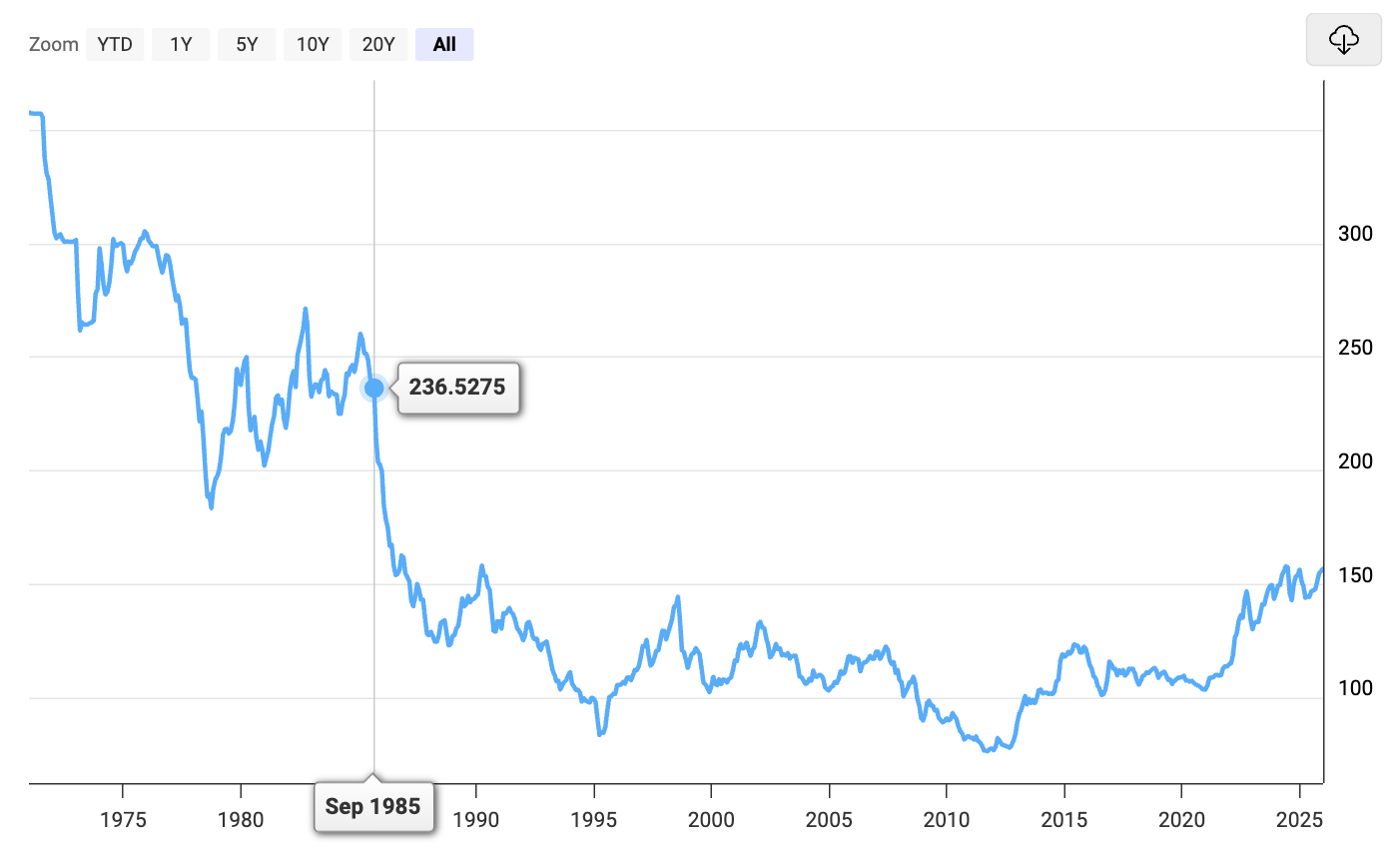
The yen move became the defining transmission mechanism for Asia. USD/JPY fell from roughly ¥242 per US Dollar around the time of the agreement to about ¥153 in 1986, and near ¥120 by 1988. For Japan’s exporters, that was not a marginal shift. It was a regime change.
| Metric | Pre-Plaza / peak | Post-Plaza outcome | Why it mattered |
|---|---|---|---|
| US dollar vs major currencies | +44% rise into 1985 | ~40% decline in 1985 to 1987 | Restored relative price competitiveness and eased pressure for trade barriers. |
| US trade deficit | $122B (1985) | Improved with lag | Trade balance dynamics lag FX; pricing effects hit first, volumes later. |
| USD/JPY (JPY per USD) | ~¥242 (around Sept 1985) | ~¥153 (1986); ~¥120 (1988) | Yen appreciation tightened financial conditions for Japan’s export engine. |
| Policy regime | Dollar strength tolerated | Stabilisation via Louvre Accord (1987) | Authorities shifted from depreciation to guarding against overshoot and volatility. |
The Plaza Accord is often placed at the start of a causal chain: yen appreciation, policy easing to offset export pain, asset inflation, bubble, and then long stagnation. That narrative is directionally plausible, but it is frequently oversimplified.
Two points are essential for readers trying to understand relevance rather than mythology.
First, the yen shock was real. A rapid currency appreciation compresses profits, reduces the local-currency value of foreign revenues, and puts pressure on employment in tradables. Japan’s response was to cushion the blow, a typical policy reaction when an export-led model faces a sudden loss of competitiveness.
Second, blaming Plaza alone ignores domestic policy and financial factors. Japan’s stagnation reflects broader policy choices, including monetary tightening and balance-sheet repair, not just the Accord.
In sum, Plaza accelerated a turning point. It drove rapid yen appreciation, encouraged easier domestic policy, and increased the chance of an asset bubble, but did not alone create it.
'Plaza Accord 2.0' trends when the dollar becomes very strong, especially when it tightens global financial conditions or destabilises emerging markets. Recent commentary has connected the concept to abrupt Asian currency moves and speculation about coordinated dollar weakening.
At the same time, a parallel term has gained visibility: the “Mar-a-Lago Accord.” It is not a formal agreement. It is a label analysts use to describe a hypothetical blueprint for deliberate dollar weakening aimed at shrinking the US trade deficit, borrowing the Plaza Accord playbook as historical precedent.
These debates persist because the underlying macro tension persists. The US runs large external deficits, the dollar is the dominant reserve and invoicing currency, and rate differentials can produce long stretches of dollar strength that squeeze global liquidity.
When that strength becomes politically costly, policymakers face a choice: accept the adjustment through domestic demand, or try to import adjustment through the exchange rate.
In 1985, managing the key exchange rates among the US, Japan, and Europe reached most of the relevant trade systems. Today, any attempt to realign without China’s participation risks being economically incomplete and politically incoherent.
Plaza was coordinating among allies. Modern currency coordination would sit within a more adversarial framework, where exchange-rate moves are interpreted as strategic tools rather than just macro stabilisation.
FX markets are deeper, faster, and more leveraged. Intervention still matters at the margin, but the burden of proof is higher. The market demands a consistent policy mix, not only a communiqué.
Major central banks are more insulated from finance ministries than they were in the mid-1980s. Publicly committing to currency targets can collide with inflation mandates and credibility.
This is why serious institutional voices tend to treat “Plaza Accord 2.0” as a useful analogy, not a near-term base case, even when the dollar is historically strong.
Plaza matters because it clarifies what must be true for a durable FX regime shift to occur.
A strong-dollar cycle must become politically costly: When trade deficits and industrial policy become central political issues, the probability of explicit currency rhetoric rises.
The policy mix must be aligned: If the US is tightening policy while partners are easing, coordinated “dollar down” talk rarely survives contact with yield differentials.
Watch the messaging, not only the flows: Plaza moved markets by changing expectations about official tolerance for dollar strength. Modern equivalents first appear in G7 language, finance ministry framing, and shifts in “market-determined rates” rhetoric.
The tell is usually in the second step: The Louvre Accord is the template. Once policymakers succeed, they often pivot quickly to preventing overshoot and volatility.
The Plaza Accord was a 1985 agreement among the US, Japan, West Germany, France, and the UK to weaken an overvalued US dollar. It combined coordinated public guidance with FX intervention and policy alignment to support a controlled decline in the dollar.
The US Dollar had surged by about 44 per cent by 1985, damaging export competitiveness and amplifying the US trade deficit, which reached $122 billion that year. The imbalance created political pressure for protectionism, so authorities chose to realign the currency to defuse the trade conflict.
On exchange rates, yes. In 1985-87, the dollar fell about 40 per cent on a major-currency basis. In trade, adjustment lagged because import prices rose immediately while volumes responded later. The deficit problem eased over time, but outcomes differed by partner.
The yen strengthened sharply, with USD/JPY moving from roughly ¥242 per US Dollar (Sept. 1985) toward ~¥153 in 1986 and near ~¥120 by 1988. That shift tightened conditions for exporters and influenced Japan’s later policy choices, often linked to the bubble-era backdrop.
The Louvre Accord (February 1987) aimed to stabilise exchange rates after the dollar had already depreciated substantially. It marked a regime shift from encouraging a weaker dollar to preventing further decline and volatility, reflecting the risk of overshoot after a successful realignment.
The Plaza Accord was a rare case in which the world’s largest economies treated an exchange rate as a shared macroeconomic risk and acted jointly to correct it. Its success came from scale and credibility: a strong-dollar problem became politically acute, the G5 aligned messaging, and markets believed policy would follow.
The dollar’s 44 per cent rise in 1985 and its roughly 40 per cent decline over 1985-87 capture the magnitude of that regime change.
Its relevance today is not nostalgia. It is diagnostic. When investors hear “Plaza Accord 2.0,” they should look past the headline and test for the real prerequisites: political pressure, aligned policy paths, credible signalling, and a trade system that can be coordinated. Without those, Plaza remains history. With them, it becomes a reminder that FX regimes can still be rewritten.
Disclaimer: This material is for general information purposes only and is not intended as (and should not be considered to be) financial, investment, or other advice on which reliance should be placed. No opinion given in the material constitutes a recommendation by EBC or the author that any particular investment, security, transaction, or investment strategy is suitable for any specific person.