Published on: 2026-01-26
Updated on: 2026-01-26
Talk of a "dollar collapse" spreads fast when the greenback dips for a few months, when inflation headlines spike, or when politics turns messy. The term 'collapse' has a specific meaning in markets, distinct from a typical down cycle.
Thus, let us treat this like a trader would. We will define what a dollar collapse would look like, then we will check the complex data that matters most: the dollar's broad exchange-rate index, inflation, global reserve shares, and real-world payment use.
No. The data does not support a collapse claim.
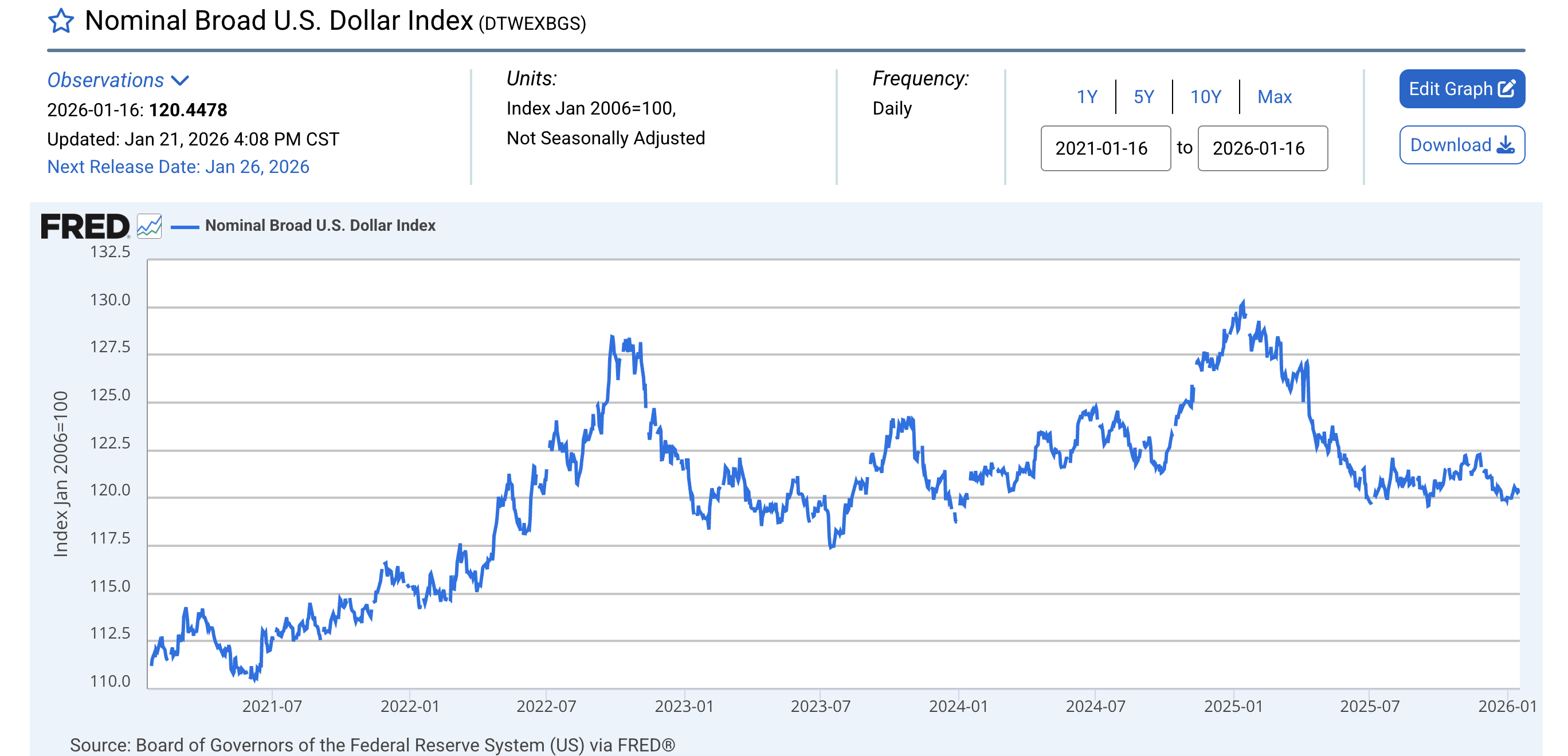
The broad trade-weighted US dollar index (the Federal Reserve's Nominal Broad Dollar Index) was 120.4478 on January 16, 2026. That is about 20% above its January 2006 base level of 100, which is not what a collapsing currency looks like.
Yes, the dollar has weakened over the past year. The index was 129.6284 on January 16, 2025, indicating a YoY decline of about 7% by mid-January 2026. This is a significant move, but it remains within the normal fluctuations of historical foreign exchange rates.
At the same time, US inflation has cooled compared with its 2022 peak. CPI inflation was 2.7% year on year in December 2025, and headline PCE inflation was 2.8% year on year in November 2025. Those numbers are above the Fed's 2% goal, but they are not "currency break" territory.
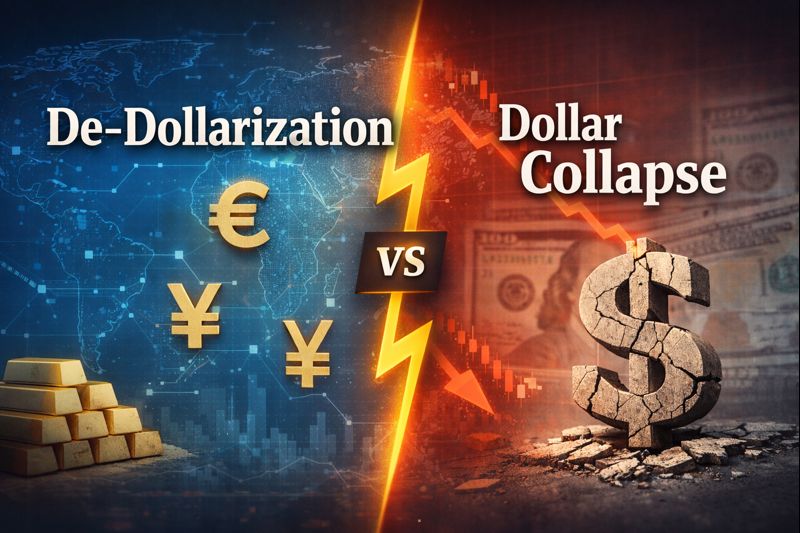
When people say "the dollar is collapsing," they usually mean one of three things:
Exchange-rate collapse: The value of the dollar declines significantly against most currencies for an extended period, not just against one pair like EUR/USD.
Purchasing-power collapse: Inflation has remained high for several years, while wages have struggled to keep pace.
Global role collapse: The world ceases to use the dollar on a large scale for reserves, trade invoicing, and payments.
Those three are linked, but they are not the same. You can have dollar weakness without losing reserve-currency status. It is possible to experience higher inflation without a sudden crash in foreign exchange rates.
Thus, the better question is: Is the dollar falling against almost everything, and are global users rushing away from it at the same time? If the answer is no, then "collapse" is usually the wrong word.
The cleanest way to avoid cherry-picking is to use the Fed's broad trade-weighted index. Here is what it shows around the same mid-January window across recent years:
| Measure (Nominal Broad Dollar Index) | Value | What it means |
|---|---|---|
| Jan 16, 2024 | 120.9213 | Dollar was strong vs 2006 base |
| Jan 16, 2025 | 129.6284 | Dollar strengthened further |
| Jan 16, 2026 | 120.4478 | Dollar gave back most of 2025’s gains |
| 1-year change (Jan 2025 → Jan 2026) | -7.1% | Normal-sized FX down cycle |
| Since 2006 base (100) | +20.4% | Still elevated on a long lens |
A collapse is a rapid decline that accelerates, often associated with runaway inflation, capital flight, or a policy mishap. A 7% broad pullback after a strong year is not that.
If the public is concerned about the dollar collapsing, they are really referring to the rising cost of living. Inflation matters because a currency can "fail" at home even if it does not crash on the FX screen.
Here is where the official inflation gauges stand:
CPI (December 2025): 2.7% year on year
PCE price index (November 2025): 2.8% year on year
That is not comfortable for households, and it matters for Fed policy. But it is also a long way from the kind of inflation that forces a currency crisis in advanced economies.
One reason the dollar often holds up, even when headlines turn negative, is yield. Global capital continues to seek out liquid markets that offer competitive returns.
As of January 22, 2026:
10-year Treasury yield: 4.26%
2-year Treasury yield: 3.61%
10-year minus 2-year spread: about +0.65% (a positive slope)
High yields do not guarantee a strong dollar, but they reduce the odds of a sudden, disorderly dump.
For a true collapse story, you would usually expect either a loss of buyer confidence or inflation that forces yields higher for the wrong reasons.
The IMF's COFER data is the best starting point for reserve composition. The key message is not "the dollar is gone." The key message is "the dollar remains dominant, but the world is diversifying at the margin."
| COFER metric | Q2 2025 | Q3 2025 |
|---|---|---|
| USD share | 57.08% | 56.92% |
| Euro share | 20.24% | 20.33% |
| RMB share | 1.99% | 1.93% |
| Total FX reserves | $12.94T | $13.0T |
In the IMF's Q3 2025 COFER update:
Total reserves rose to $13.0 trillion.
The US dollar share edged down to 56.92% (from 57.08% in Q2 2025).
That is a slow glide, not a collapse.
The Federal Reserve's 2025 review of the dollar's global role shows that the dollar remains significantly dominant, despite a gradual decline since its peak in the early 2000s.
Reserve composition is slow-moving. Payment data is faster and more practical. On SWIFT, the dollar remains the top currency used in global payments by value.
In SWIFT's RMB Tracker (December 2025 edition, reporting November 2025):
USD share of global payments by value: 46.77%
EUR share: 23.83%
CNY share: 2.94%
When you exclude payments within the Eurozone, the dollar's share rises further (the same report shows USD at 57.03% for "international payments" excluding Eurozone internal flows).
That is not a system in the middle of abandoning the dollar.
Here is a simple checklist you can use to avoid other doom-and-gloom headlines.
| Stress signal | What "collapse" would look like | What the data shows now |
|---|---|---|
| Broad FX value | Multi-year plunge across a broad basket | Broad index is still ~20% above 2006, despite a 1-year pullback |
| Inflation | Persistent high inflation and rising expectations | CPI 2.7% YoY (Dec 2025); PCE 2.8% YoY (Nov 2025) |
| Reserve role | Rapid drop in reserve share and forced selling | USD share 56.92% in Q3 2025 (small quarterly move) |
| Payment use | Dollar loses top position in global payments | USD still leads SWIFT payments by value |
| Funding stress | Failed auctions, broken Treasury market plumbing | Yields are elevated, but the market is functioning; 10Y 4.26% |
In short, the dollar is in a normal down cycle as the world continues to diversify its currency mix slowly.
A calm view does not mean there are no risks. It means we distinguish between gradual erosion and sudden rupture.
US debt levels are high, and the market focuses on direction rather than on levels.
US public debt outstanding was $38.46 trillion as of January 16, 2026 (TreasuryDirect).
The Congressional Budget Office estimated the deficit for fiscal year 2025 to reach $1.8 trillion.
Heavy issuance does not automatically crush the dollar, but it can raise the risk premium if buyers demand higher yields amid policy uncertainty.
The US still runs a large external gap:
The BEA reported a $226.4 billion current-account deficit in Q3 2025.
Significant current-account deficits can be sustained over an extended period if international investors consistently reinvest their capital into US assets.
The danger arises when faith diminishes, even as funding needs remain substantial.
If inflation remains persistently above the target and policy seems constrained, the dollar may lose its "store of value" status. For now, inflation is above target but not out of control.
Stablecoins, regional payment systems, and bilateral trade settlement can chip away at the dollar's share over time.
That is a slow story, not an overnight one, especially while the dollar remains the top SWIFT payment currency by value.
Based on the latest broad exchange-rate index and global usage data, no. The dollar is softer than it was a year ago, but the key pillars of global use remain intact.
Many people are reacting to prices at home. Inflation has cooled, but the price level remains high compared to a few years ago, so the pain is real even when the FX market is orderly.
In a gradual sense, yes. Reserve shares have declined over the years as central banks added smaller currencies. But the dollar remains the largest reserve currency by a wide margin.
A lasting surge in inflation expectations, a disorderly fall in the broad dollar index, and clear signs of stress in Treasury funding would be more serious than a normal FX pullback.
In conclusion, the dollar is not "collapsing" based on the most relevant datasets available in late January 2026.
The stronger, trader-relevant claim is that the dollar is in a contested phase where policy expectations, credibility risk, and global diversification can create sharp swings.
Disclaimer: This material is for general information purposes only and is not intended as (and should not be considered to be) financial, investment or other advice on which reliance should be placed. No opinion given in the material constitutes a recommendation by EBC or the author that any particular investment, security, transaction or investment strategy is suitable for any specific person.