Published on: 2026-02-13
Updated on: 2026-02-13
Currently, the exchange rate between CHF and USD is about $1.30, a level typically observed only when markets are unsettled, prompting individuals to seek safer investments. The Swiss franc is not moving like a "high-yield" currency right now.
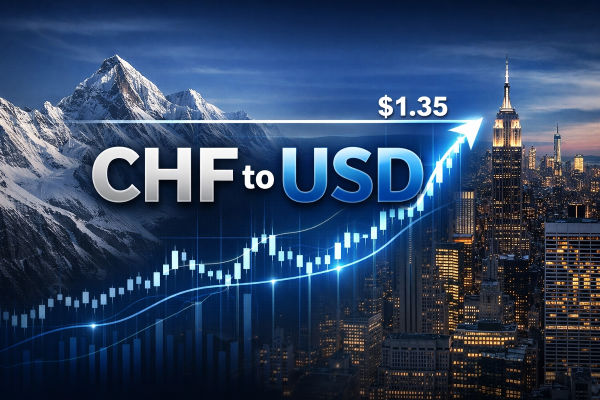
Switzerland's policy rate remains at 0%, yet the franc continues to attract buyers. This discrepancy is the key point. A push to $1.35 would be another big step. It is not an all-time high, but it would put CHF/USD within striking distance of the 2011 peak near $1.38.
However, the real question is not only whether the franc can break $1.35, but whether the Swiss National Bank (SNB) would allow the move to persist if it threatened Swiss inflation and exporters.
| Metric | Latest / Reference |
|---|---|
| Recent CHF/USD level (Feb 12 close) | $1.2998 |
| 2026 year-to-date move (CHF vs USD) | +3.02% |
| 2026 high (daily) | $1.3106 (Jan 27) |
| 2026 low (daily) | $1.2447 (Jan 15) |
| Reference “modern-era” extreme | $1.3800 (2011) |
| Distance from ~$1.30 to $1.35 | about +3.9% |
| What $1.35 implies in the flipped quote | about $0.7407 in USD/CHF (inverted) |
$1.35 is close enough to feel realistic in a strong trend, but far enough away that you usually need a macro catalyst (or several smaller catalysts stacking in the same direction).
Normally, a currency with a higher policy rate has an advantage because investors earn more carry. That is not happening here.
The Swiss National Bank maintained the policy rate at 0% and reiterated its willingness to intervene in foreign exchange markets if necessary.
The Federal Reserve, by contrast, has kept the fed funds target range at 3.50% to 3.75%.
Even with that wide rate gap, the franc has still been one of the strongest performers, which tells you something important: flows are dominating carry. In plain English, people are choosing insurance over interest income.
Investor concerns often arise from policy uncertainty, geopolitical risks, equity volatility, or a chaotic growth outlook. The recent strength of the franc is also linked to the dollar's overall weakness and increased demand for safe havens.
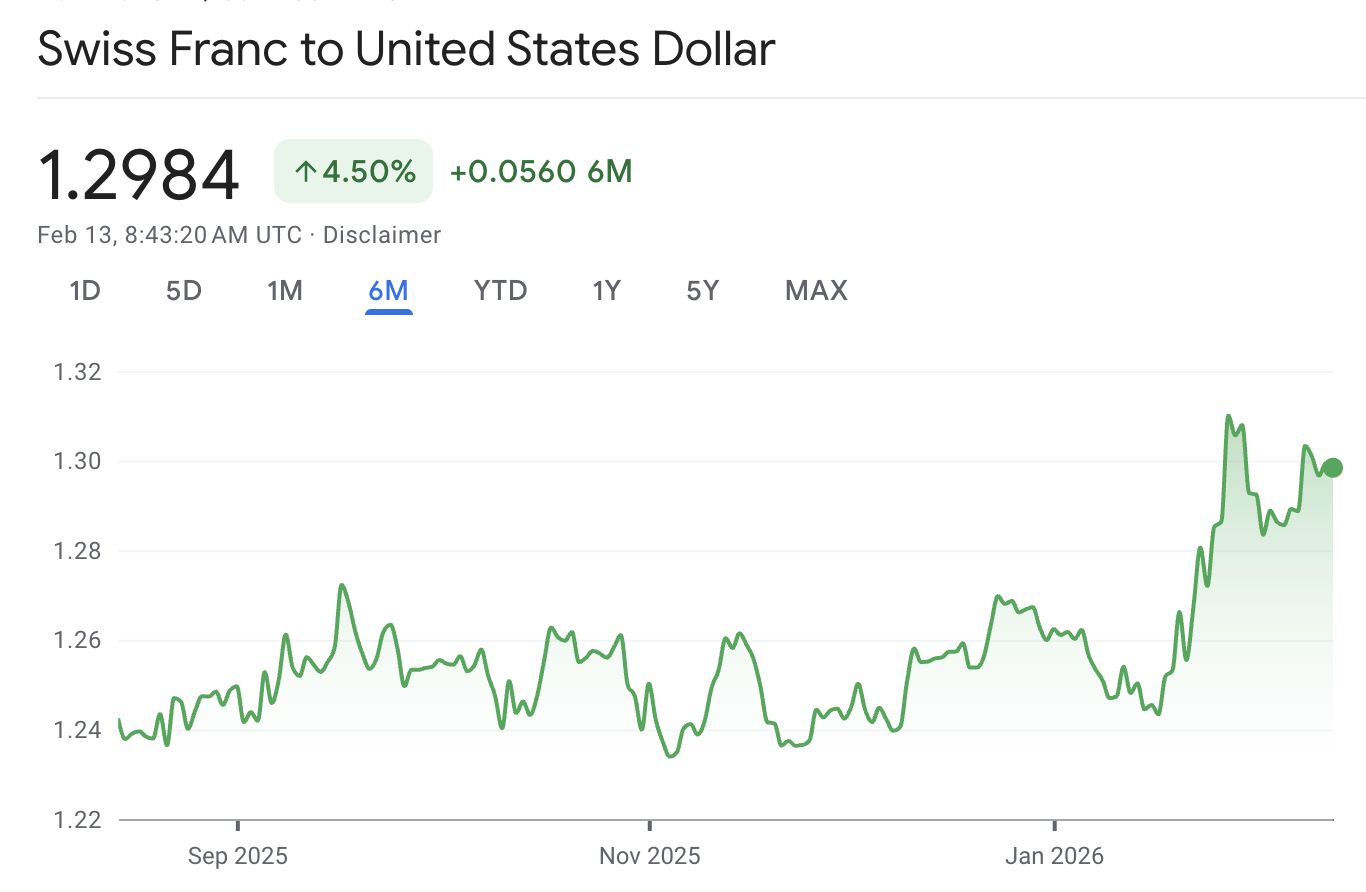
Market narratives regarding the unpredictability of US policy have strengthened the franc, as capital typically flows toward stability during times of uncertainty.
The franc is a "reliable" haven during the recent wave of global risk concerns, and the currency rose strongly through 2025 and stayed firm into 2026.
The Federal Reserve kept the fed funds target range at 3.50% to 3.75% on January 28, 2026, indicating it would remain guided by incoming data.
The SNB, by contrast, cut its policy rate to 0% in June 2025, which keeps Switzerland near the floor of global policy rates.
On paper, that interest-rate gap should support the dollar, but safe-haven flows can overwhelm interest-rate logic when investors prioritise capital preservation.
Switzerland and the United States released a joint statement reaffirming their commitment not to manipulate exchange rates for competitive advantage, in accordance with IMF rules. They also acknowledged that monetary policy should prioritize appropriate economic conditions and price stability.
This statement helps reduce political risk surrounding the Swiss National Bank's (SNB) actions to manage market volatility. This is important because the SNB has historically faced criticism for its extensive intervention in the currency market.
Because many traders track this move through the flipped quote (USD/CHF), the clean way to read it is:
USD/CHF falling = CHF/USD rising
A USD/CHF "strong buy" signal typically aligns with CHF/USD stalling or pulling back
A USD/CHF "strong sell" signal typically aligns with CHF/USD pressing higher
Recent technical readings for USD/CHF indicate strong buy signals, which often arise when the market is stretched, increasing the risk of mean reversion, even if the broader CHF trend remains intact.
The data presented below is initially in USD/CHF and has been inverted to display the equivalent in CHF/USD.
| Indicator | USD/CHF value | CHF/USD equivalent (inverted) | What it suggests for CHF/USD |
|---|---|---|---|
| Spot (reference time) | $0.7715 | $1.2962 | CHF still strong, but near a crowded zone |
| 5-day SMA | $0.7703 | $1.2982 | Short-term support sits just under spot |
| 10-day SMA | $0.7698 | $1.2990 | Buyers likely defend dips toward ~$1.30 |
| 20-day SMA | $0.7695 | $1.2995 | Trend support remains nearby |
| 50-day SMA | $0.7695 | $1.2995 | Medium-term trend is tight and persistent |
| 100-day SMA | $0.7688 | $1.3007 | Breaks above ~$1.30 can accelerate quickly |
| 200-day SMA | $0.7728 | $1.2940 | Longer-term mean sits below current levels |
| RSI (14) | 59.858 | (directional mirror) | Momentum is positive, not extreme yet |
| ATR (14) | 0.0008 | (smaller daily swings) | Volatility is contained, trend can grind |
Resistance (Upside Hurdles)
$1.3106: 2026 high daily.
$1.35: psychological target and "headline level."
$1.38: the 2011 extreme that still matters as a long-term reference.
Support (Where Dips Usually Get Tested)
$1.30: the current magnet level (round number plus moving-average cluster)
$1.285 to $1.29: early-February pricing band.
$1.2447: 2026 low, the level that would signal a much bigger reversal.
This is our practical way to think about CHF/USD without guessing.
| Scenario | What changes in the real world | What price action would likely look like | Levels to watch |
|---|---|---|---|
| Breakout toward $1.35 | US data cools, rate-cut expectations firm up, and risk appetite stays shaky | Higher highs and shallow pullbacks, with dips bought quickly | Break and hold above $1.31, then grind toward $1.35 |
| Range trading near $1.30 | Data is mixed, and policymakers talk down CHF strength without acting | Choppy two-way moves with repeated failures near the highs | $1.285–$1.31 becomes the main box |
| Pullback and trend reset | US inflation surprises higher or yields rebound sharply, and haven demand fades | Faster drop than the climb, with support levels breaking one by one | First risk line is $1.285, then $1.245 |
The following risks emerge when the transition is too rapid, overly one-sided, or excessively painful for the Swiss industry.
The SNB can signal that monetary conditions have become too tight and use FX operations as part of its toolkit.
The SNB can cut rates again if it believes price stability is threatened, even if rates are already at 0%.
A stabilisation in the US policy outlook can reduce safe-haven demand and support the dollar.
A sudden shift towards risk-taking can decrease demand for safe havens and boost higher-yielding currencies at the expense of the Swiss Franc.
The SNB's next monetary policy assessment is scheduled for March 19, 2026, with a press release and news conference.
The Fed's March meeting is scheduled for the 17th and 18th in 2026, and it marks a crucial point for US interest rate expectations.
This timing creates a tight window where traders can see the Fed message first and then trade into the SNB decision one day later.
CHF/USD is near its strongest levels in more than a decade, but the widely referenced 2011 peak was around $1.38. A move to $1.35 would be close to that historical extreme, which is why traders treat it as a major psychological level.
For CHF/USD to climb, it typically requires a stable weakening of the dollar and increased demand for safe-haven assets. Softer US inflation and stronger expectations for Fed cuts can add fuel.
Safe-haven flows can outweigh rate differentials when investors prioritize stability over yield. Switzerland's policy rate remains 0%, but demand for protection and portfolio hedging can keep the CHF bid, especially when confidence in the dollar weakens.
Yes. The SNB can influence monetary conditions by adjusting the policy rate and may intervene in foreign exchange markets if necessary to uphold its mandate of price stability.
In conclusion, CHF/USD is strong because the world is pricing uncertainty, and the franc is one of the few currencies that still attracts capital when investors feel uneasy.
A move to $1.35 is plausible, but it would likely require either a fresh wave of global risk aversion or a clear turn towards earlier Fed cuts, and it would also test the SNB's tolerance for a tighter monetary environment.
Disclaimer: This material is for general information purposes only and is not intended as (and should not be considered to be) financial, investment or other advice on which reliance should be placed. No opinion given in the material constitutes a recommendation by EBC or the author that any particular investment, security, transaction or investment strategy is suitable for any specific person.