Published on: 2026-06-15
Updated on: 2026-06-15
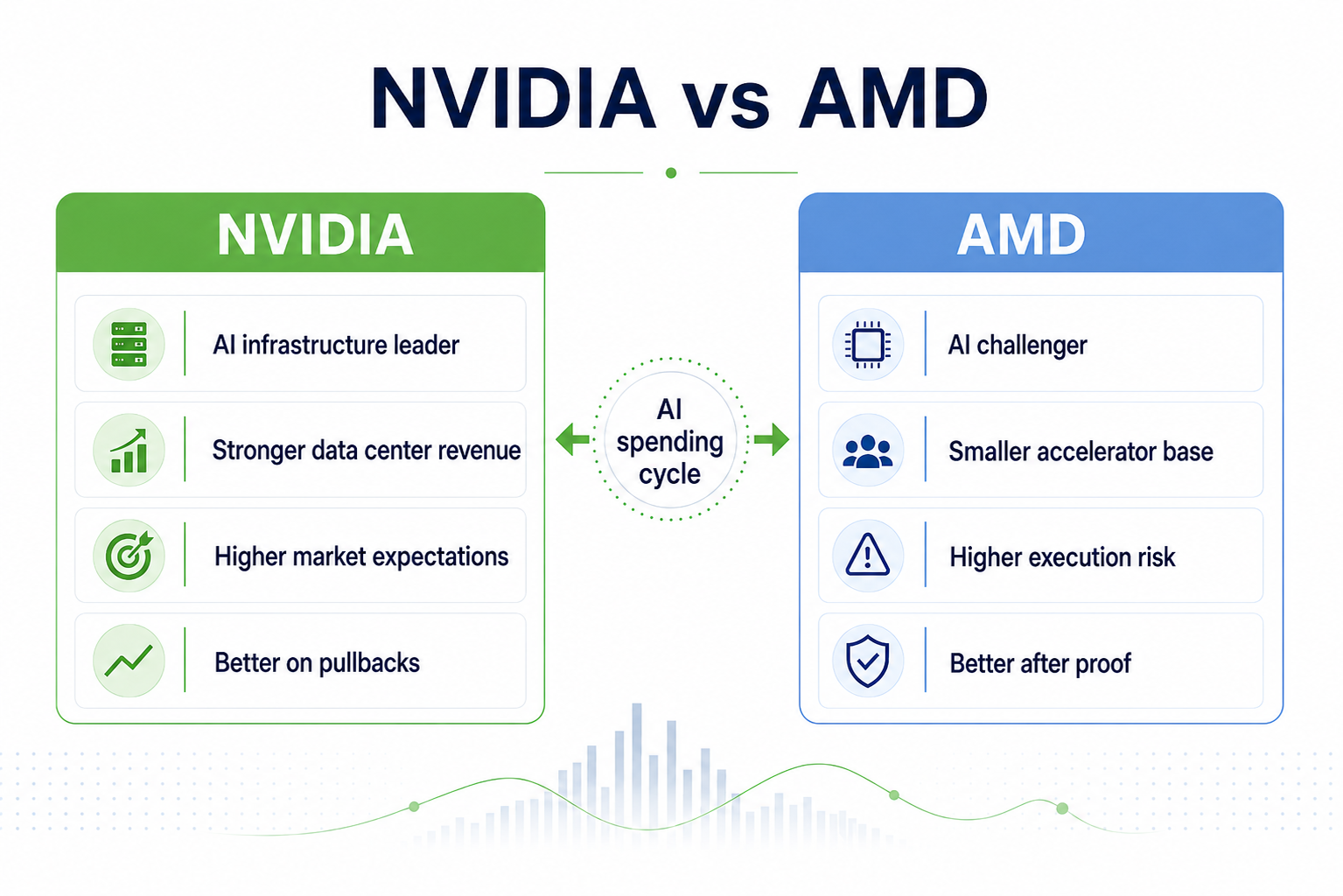
NVIDIA remains the stronger default AI chip entry after the pullbacks, as its growth has already been demonstrated in earnings. AMD offers the bigger catch-up trade only if accelerator adoption expands faster than the market has already priced in.
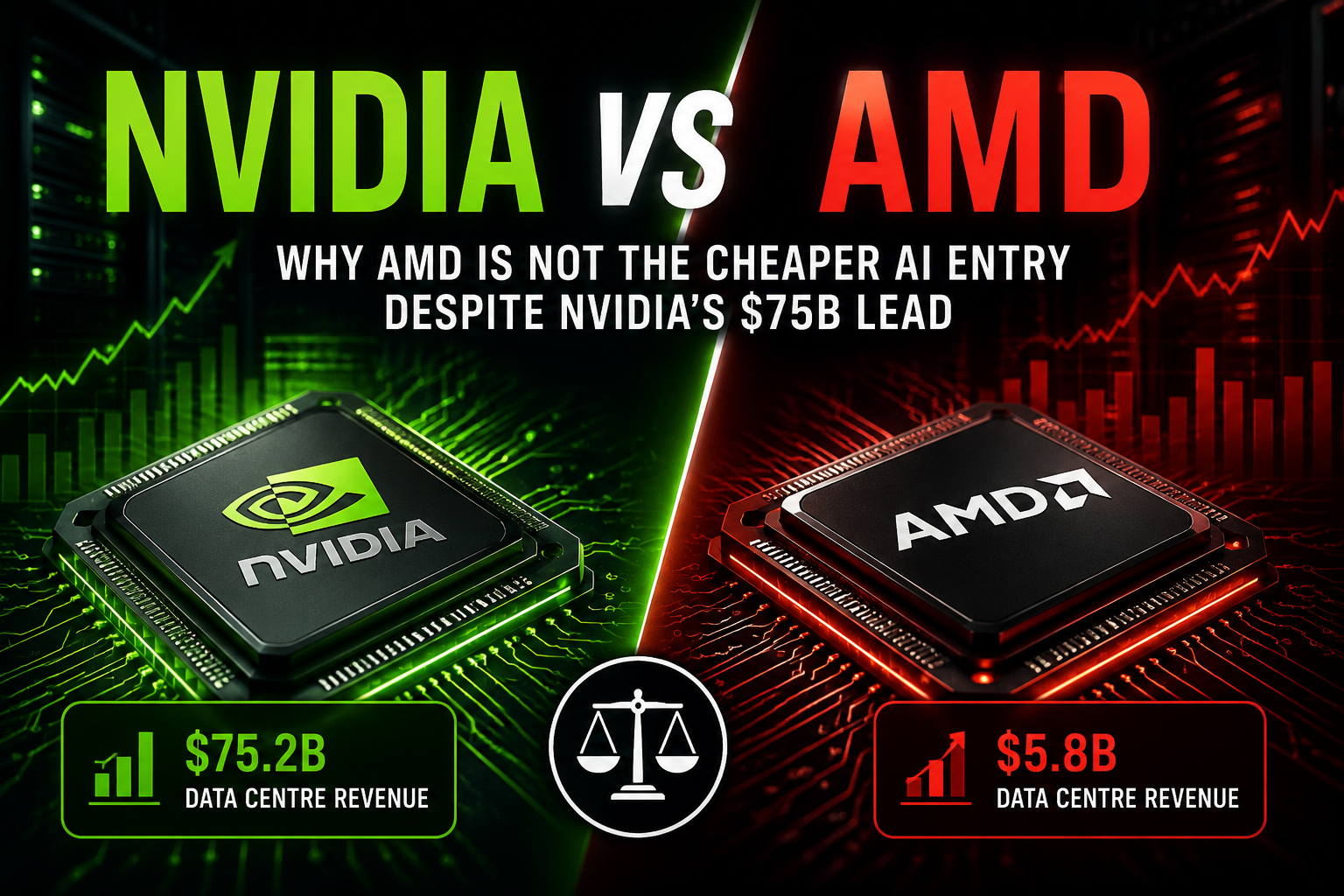
NVIDIA’s $75.2 billion Data Centre quarter gives it a stronger earnings-backed AI thesis, with AI infrastructure revenue already visible at scale.
AMD’s $5.8 billion Data Centre revenue leaves more catch-up potential, but Instinct, MI450, and Helios still need to become repeatable revenue drivers.
Valuation weakens the simple AMD bargain argument: Nvidia trades near 31x trailing earnings, while AMD trades near 168x.
NVIDIA’s risk is expectations; AMD’s risk is execution. One must defend dominance, while the other must still prove adoption.
The next decisive signal is Data Centre guidance. NVIDIA must protect margins, while AMD must show that accelerator demand exceeds second-supplier interest.
NVIDIA’s latest earnings explain why it remains the benchmark for AI chip stocks. Revenue reached $81.6 billion in fiscal Q1 2027, up 85% from a year earlier. Data Centre revenue reached $75.2 billion, up 92% year over year, making AI infrastructure the core of the company’s earnings engine.
AMD’s growth is real, but the base is much smaller. First-quarter 2026 revenue reached $10.3 billion, with Data Centre revenue rising 57% year over year to $5.8 billion. That gives AMD room to surprise, but it also means the investment case still depends on future accelerator adoption becoming large enough to reshape the company’s revenue mix.
The entry-point debate starts with one fact: Nvidia is not only larger, but also showing far more AI revenue proof than AMD, while AMD trades on the possibility that its smaller base can scale faster.
The most important row is Data Centre revenue. NVIDIA’s AI lead is already evident in reported results, while AMD’s opportunity still hinges on translating product ambition into durable accelerator revenue. The valuation row makes the entry-point question sharper: AMD may be smaller, but it is not automatically cheaper.
This is the first major divide. NVIDIA investors are paying for visible AI earnings. AMD investors are paying for the chance that visible AI earnings arrive later.
NVIDIA’s latest earnings explain why it remains the benchmark for AI chip stocks. Revenue reached $81.6 billion in fiscal Q1 2027, up 85% from a year earlier. Data Centre revenue reached $75.2 billion, up 92% year over year, making AI infrastructure the core of the company’s earnings engine.
That scale changes the entry-point debate. NVIDIA is not trading only on a future AI story. It is already monetising demand through accelerators, networking, systems, software, and full-stack infrastructure. Its position across hyperscalers, cloud platforms, AI labs, and enterprise buyers gives investors a level of earnings visibility AMD cannot yet match.
AMD’s growth is real, but the base is much smaller. First-quarter 2026 revenue reached $10.3 billion, with Data Centre revenue rising 57% year over year to $5.8 billion. That gives AMD room to surprise, but it also means the investment case still depends on future accelerator adoption becoming large enough to reshape the company’s revenue mix.
This is the first major divide. NVIDIA investors are paying for visible AI earnings. AMD investors are paying for the chance that visible AI earnings arrive later.
The easiest mistake is assuming AMD is cheaper because it is smaller. A smaller market value does not mean better value. The entry point depends on what investors pay for current earnings, future growth, and the probability that the growth will arrive.
NVIDIA is much larger, but investors are paying a lower earnings multiple for existing AI revenue. AMD is smaller, but its valuation already assumes meaningful future AI success. That difference is why AMD needs more than a promising roadmap. It needs a visible accelerator adoption strong enough to justify the premium.
For investors, this changes the question. The choice is not simply between Nvidia’s dominance and AMD’s upside. It is between paying for earnings already in the numbers and paying for earnings that still have to be delivered. That is why Nvidia remains the cleaner default entry after pullbacks, while AMD requires stronger proof before its upside becomes compelling.
AMD’s first advantage is its EPYC server CPU footprint. Those relationships already place the company inside hyperscaler and enterprise data-centre procurement channels. That matters because AMD does not need to start from scratch to find new customers. It needs to sell more into accounts it already serves.
Instinct is the more important test. If AMD gains traction in inference, cost-sensitive AI workloads, or customers seeking a second supplier, the stock can rerate quickly. A few large customer wins would move AMD’s revenue base far more than they would move Nvidia’s.
Helios and MI450 raise the stakes. They show AMD wants to compete at the rack level, not just sell individual chips. That is the right direction, but it also forces AMD to prove it can narrow Nvidia’s advantage in software, networking, deployment, and total system economics.
That is why AMD is not simply a cheaper Nvidia. It is a higher-upside trade with a higher proof burden. NVIDIA rewards pullbacks. AMD rewards confirmation.
The debate between NVIDIA and AMD will ultimately be settled by earnings, not hype. If you want to trade NVIDIA and other top US stocks as the AI story evolves, EBC gives you direct access to the market.
NVIDIA remains the stronger AI stock in terms of business quality because its AI revenue is already reflected in reported earnings. AMD offers greater upside, but that upside depends on future accelerator adoption becoming large enough to materially affect revenue, margins, and investor confidence.
Not necessarily, but the entry price matters more after a major rally. NVIDIA remains stronger on earnings quality, but buyers should focus on pullbacks, Data Centre guidance, gross margin, and Blackwell-to-Rubin demand rather than assuming AI leadership alone guarantees upside.
AMD is smaller than Nvidia, but it is not automatically cheaper. NVIDIA trades at a much lower trailing earnings multiple, while AMD’s valuation reflects expectations for future AI market-share gains. AMD only becomes attractive if growth arrives faster than the market has priced in.
AMD can become a better trade if the adoption of Instinct, MI450, and Helios accelerates among major cloud and enterprise customers. It does not need to beat Nvidia across every workload. It needs sufficient adoption to make AI accelerators a larger, more profitable part of its business.
The biggest risk is that AMD remains a secondary AI supplier while the stock trades like a future category leader. If accelerator adoption improves but fails to produce sustained Data Center revenue and margin expansion, the valuation could become harder to defend.
NVIDIA remains the stronger default AI chip entry point when valuations reset, but the Data Centre growth story remains intact. Its advantage is not just leadership but evidence: AI demand is already reflected in revenue, margins, customer adoption, and platform depth.
AMD becomes a better trade only when proof catches up with expectation. The next decisive signal is whether demand for Instinct, MI450, and Helios can move from customer interest to sustained Data Centre revenue growth. Until then, AMD is not simply the cheaper stock. The better entry is the stock where investors are paying less for what still has to go right.