Published on: 2026-07-30
The Federal Reserve left its target range at 3.50% to 3.75%, but three officials voted to raise it and long-dated Treasury yields closed at 2007 highs. The cost of long-term capital rose even though policy did not move.
The Federal Reserve held its benchmark target range at 3.50% to 3.75% on 29 July 2026, yet three policymakers voted to raise it and the long end of the Treasury curve sold off.
The Federal Open Market Committee approved the hold by 9 votes to 3. Cleveland’s Beth Hammack, Minneapolis’ Neel Kashkari and Dallas’ Lorie Logan each preferred a quarter-point increase. None dissented for a cut.
Borrowing costs then moved in opposite directions. Treasury data show the 30-year yield closing at 5.20%, up 11 basis points, while the two-year fell to 4.22%.
The FOMC held the federal funds target range at 3.50% to 3.75% by a 9-to-3 vote, its fifth consecutive hold.
Beth Hammack, Neel Kashkari and Lorie Logan each dissented in favour of a quarter-point increase, the first time since September 2016 that three policymakers have dissented on the same side.
The curve steepened. The 30-year Treasury yield closed at 5.20%, its highest since 2007, while the two-year eased to 4.22%.
Equities fell on several fronts at once: no relief from the Fed, weakness in semiconductor and AI-linked shares, and a 7.9% jump in front-month Brent to $90.74.
Market pricing implies a mid-50s percentage chance of a September increase and roughly 80% odds of at least one hike by year-end.
With two-year Treasuries above 4%, cash and short duration compete directly with risk assets for capital.
This was the fifth consecutive hold and, by Warsh’s own description, his second FOMC meeting as chairman. The Board voted unanimously to keep the interest rate on reserve balances at 3.65% and the primary credit rate at 3.75%.
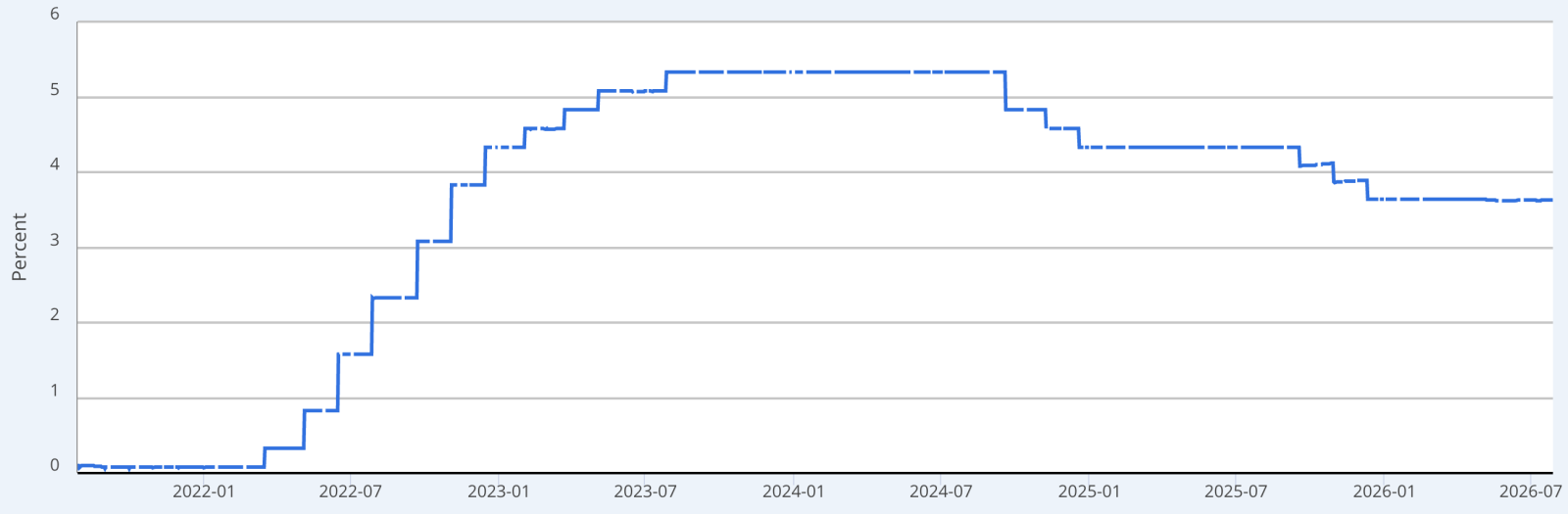
The pause has run since the December 2025 cut that set the current range:
| Year end | Fed funds target range | Net change |
|---|---|---|
| 2022 | 4.25% to 4.50% | +425 bps |
| 2023 | 5.25% to 5.50% | +100 bps |
| 2024 | 4.25% to 4.50% | -100 bps |
| 2025 | 3.50% to 3.75% | -75 bps |
| 2026 to date | 3.50% to 3.75% | No change |
The statement described economic activity as expanding at a solid pace despite elevated uncertainty tied partly to the conflict in the Middle East, and said job gains have kept pace with the workforce. It called inflation elevated relative to the 2% goal, partly reflecting supply shocks in sectors including energy.
Three dissenters sharing the same view is unusual. It is the first time since September 2016 that three policymakers have broken from the committee on the same side.
Warsh has moved away from forward guidance. He said the statement was intended to convey the facts rather than forecast, and acknowledged that thinner guidance may be contributing to sharper market reactions to data. He called the internal disagreement a good family fight and rejected any suggestion of a soft or implicit target above 2%.
The shape of the curve tells the clearer story. Treasury closing data show the two-year yield, which tracks near-term policy expectations, falling to 4.22% from 4.26%. The 30-year rose to 5.20% from 5.09%, its highest since 2007, and the 10-year reached 4.67%.
Short-dated debt priced in patience. The long end moved the other way. Inflation concern is one plausible driver, though higher oil prices, a rising term premium and Treasury issuance could each account for part of the move.
The effect on valuations holds regardless of attribution. A higher long-term discount rate reduces the present value of distant cash flows with no change to the overnight rate.
The 10-year Treasury yield influences mortgage pricing, corporate bond spreads and commercial lending. Freddie Mac put the average 30-year fixed mortgage rate at 6.58% on 23 July, the highest in nearly a year, though below the 6.74% recorded a year earlier.
Wall Street closed sharply lower:
| Index | Close | Change |
|---|---|---|
| Dow Jones Industrial Average | 51,594.14 | -2.19% |
| S&P 500 | 7,316.15 | -1.52% |
| Nasdaq Composite | 24,442.94 | -1.74% |
The Dow’s 1,153.18-point drop was the steepest since April 2025. The Nasdaq Composite ended roughly 9.8% below its record, while the narrower Nasdaq-100 entered correction territory about 11% from its peak.
Attributing that to the Fed alone would misread the session. Semiconductor and AI-linked shares were significant contributors, extending a sell-off from the previous session.
Energy prices then jumped after President Donald Trump promised a forceful response to an intercepted Iranian missile attack on American forces. Front-month Brent settled 7.9% higher at $90.74 a barrel, while West Texas Intermediate settled 6.6% higher at $84.46.
The Fed declined to offset those pressures. A dovish signal might have cushioned the selling; three hawkish dissents and no guidance did the opposite. Higher oil compounds it, raising input costs while narrowing the Fed’s room to ease, precisely the supply shock the statement referenced.
With the policy rate at 3.50% to 3.75% and two-year Treasuries yielding 4.22%, short-dated government debt offers a return most portfolios must beat. That reframes the hold. It does not automatically mean investors should stay invested and wait for cuts.
Every equity position, corporate bond and leveraged trade must justify itself against a liquid alternative paying above 4%. For long-duration growth shares priced on earnings several years out, that hurdle rose again on Wednesday.
Post-meeting CME FedWatch readings put the probability of a September increase in the mid-50s, easing from higher levels earlier in the week, with roughly an 80% chance of at least one increase by year-end. These are market-implied probabilities, not Fed commitments.
The June projections showed a central tendency of 3.6% to 4.1% for the end-2026 rate, with a 3.8% median. Participants were divided: eight projected no change, nine projected one or more increases and one a cut. Projections are forecasts, not policy.
Dates before the next decision:
12 August: July CPI
27 to 29 August: Jackson Hole symposium, where Warsh is widely expected though the Kansas City Fed has not confirmed speakers
11 September: August CPI
15 to 16 September: next FOMC meeting
June CPI fell 0.4% on the month and rose 3.5% from a year earlier, an unexpected decline. The Fed formally targets PCE inflation rather than CPI, though Warsh noted inflation has run above target for more than five years.
Strong data may now raise the risk of a hike rather than support equities. Weak data threatens earnings. Higher oil pressures bonds and non-energy shares at once. Softer core inflation remains the clearest path to relief.
No. The FOMC voted 9 to 3 to hold the target range at 3.50% to 3.75%, a fifth consecutive hold. Three regional presidents dissented in favour of a quarter-point increase. No voting member sought a cut.
Several factors combined: hawkish dissents that kept an increase in play, weakness in semiconductor and AI-linked shares, and a jump in oil prices after escalation between the United States and Iran.
The 30-year closed at 5.20%, its highest since 2007, while the two-year fell. Inflation concern, higher oil, term premium and Treasury supply are each plausible contributors rather than any single identifiable cause.
Market pricing implies roughly a mid-50s percentage probability, with about an 80% chance of at least one increase by year-end. The Fed has made no commitment. July and August CPI data arrive first.
Mortgage pricing tracks the 10-year Treasury yield rather than the federal funds rate. With the 10-year at 4.67%, a meaningful fall from 6.58% would likely require long-term yields to decline first.