Published on: 2026-07-10
Updated on: 2026-07-10
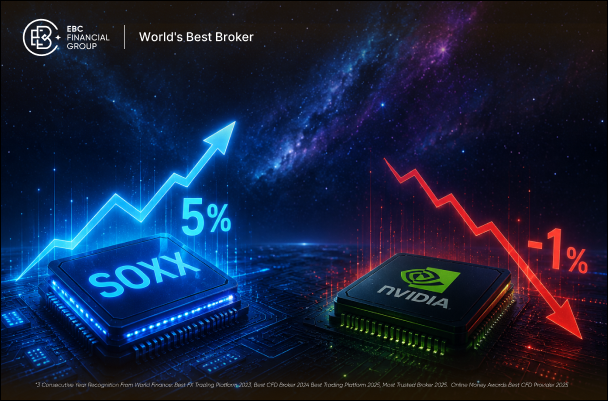
SOXX printed an intraday gain of as much as 5.9% but held only 3.5% into the close, while Nvidia finished down about 1%.[1][2]
Micron and AMD were the session’s largest positive contributors to the index.[3][4]
At current weights, AMD and Micron each carry more index influence than Nvidia on a standalone basis.[5]
Participation broadened across memory, storage, equipment and networking.
Confirmation over several more sessions is needed before treating it as a durable change in leadership.
The iShares Semiconductor ETF (SOXX) traded up as much as 5.9% intraday on Thursday, July 9, before paring the move to a 3.5% close, while Nvidia slipped 0.7% over the same session.[1][2] Advances in Micron, Advanced Micro Devices and the equipment complex more than absorbed Nvidia’s decline within the cap-weighted fund.
The session stood out for its internals: leadership sat in memory, storage, equipment and alternative compute rather than in the sector’s dominant accelerator name.
SOXX gapped open at $589.50, tagged an intraday high of $594.99 and settled at $581.70 against the prior close of $562.03. That high marked a 5.9% advance, but the fund surrendered more than two-fifths of the gain by the bell to finish up 3.5%. Nvidia closed at $202.78, down 0.7% from $204.12.[1][2]
| Asset | Closing price or level | Closing move | Intraday detail |
|---|---|---|---|
| SOXX | $581.70 | +3.5% | High of $594.99, or +5.9% |
| Nvidia | $202.78 | -0.7% | Held down about 1% all session |
| Micron | $991.64 | +4.5% | Faded from a higher intraday print |
| AMD | $546.72 | +5.7% | Top contributor by index weight |
| SanDisk | Not stated | +7.6% | Storage and memory leadership |
| Nasdaq Composite | 26,206.89 | +1.3% | Broad technology risk-on |
AMD carried roughly 8.35% of the fund and Micron 8.07%, both ahead of Nvidia at 7.79%, with Broadcom near 6.93%.[5] Because SOXX is cap-weighted and its two heaviest sleeves now outrank Nvidia, gains of 4% to 6% in those positions comfortably swamped the drag from a sub-1% move in the accelerator name.
The notable feature was the move’s composition. SOXX did not require its highest-profile constituent to lead, because several comparably weighted holdings rose in concert, lifting the index through breadth rather than through a single mega-cap.
Micron carried the cleanest idiosyncratic catalyst. The company disclosed up to $3 billion of investment in the U.S. semiconductor supply chain, including $500 million of financing for GlobalWafers under a ten-year wafer-supply agreement, and lifted its broader domestic commitment above $250 billion through 2035.[6]
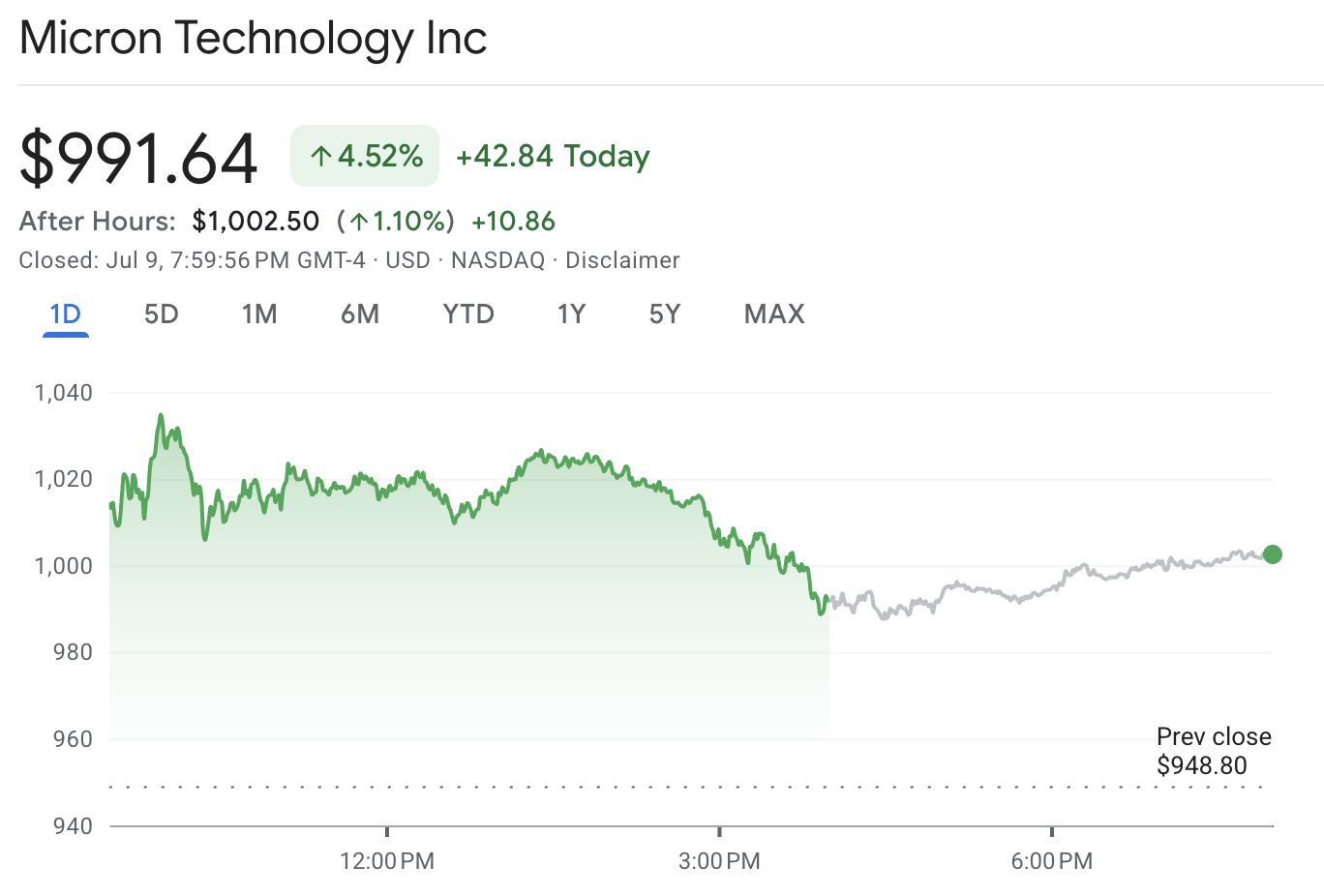
The news reinforced an intact HBM and DRAM demand thesis rather than establishing a new one. Micron’s most recent quarter set records, with management flagging DRAM and NAND demand running ahead of supply; data-centre revenue cleared $25 billion and data-centre SSD revenue more than doubled sequentially.[6]
The stock had also derated sharply in the preceding chip sell-off, leaving a low base from which to rebound once risk appetite returned.[1] SK Hynix reinforced the memory bid, with heavy demand for its U.S. share sale signalling that institutional appetite for HBM exposure had not faded.
AMD’s advance reflected a different setup. It had lagged on the way down, which left more slack for a snap-back as positioning rebuilt in higher-beta chip names. Its data-centre CPUs and accelerators also gave allocators a route to add compute exposure without concentrating further into a single supplier.
Company price data showed AMD closing 5.7% higher at $546.72.[4] The move said nothing about AMD displacing Nvidia on the merits; it said investors were willing to diversify AI-compute exposure across more than one vendor.
No adverse Nvidia headline surfaced during the session. The only confirmed fact is the 0.7% decline itself; profit-taking, crowded positioning and rotation into more heavily discounted names are plausible readings, not verified drivers.[2]
Nvidia had outperformed Micron, AMD and much of the equipment group through parts of the preceding drawdown. That relative resilience left it less oversold, and therefore with less to reclaim on a bounce. When risk appetite returned, buyers gravitated to the constituents that had fallen furthest.
The lack of a fresh company-specific catalyst likely capped incremental demand as well. A sub-1% down day carries no signal about Nvidia’s standing in AI accelerators. It simply demonstrates that a diversified chip fund can rise with its marquee holding acting as a drag rather than a driver.
The gains reached most parts of the sector. Memory and storage rose through Micron, SanDisk, and Western Digital; AMD led alternative compute; and Marvell and Astera Labs covered networking and data-centre connectivity.
Equipment makers advanced too, as buyers returned to suppliers of fabrication, test and packaging capacity. The point was breadth: the AI-infrastructure trade showed up across the supply chain, not just in the GPU designers.
Several forces likely combined. Micron supplied a real catalyst; the recent sell-off invited bargain-hunting, rotation favoured less crowded names; and short covering probably amplified the sharpest moves. The broader logic is that AI capital spending reaches well beyond GPUs, lifting memory, storage, networking and equipment as data-centre capacity grows.
Wider participation makes a rally less dependent on any single stock. It does not, on its own, make the rally last.
West Texas Intermediate crude eased about 2% to $72.08 as fears of Middle Eastern supply disruption receded, and Treasury yields drifted lower as risk sentiment steadied.
Softer energy prices trimmed near-term inflation risk, while lower yields relieved some of the discount-rate pressure that weighs on long-duration, high-multiple technology equities. The Nasdaq Composite added 1.3% to 26,206.89.
That SOXX outran the index by a wide margin argues that chip-specific positioning and catalysts, not the macro tape alone, drove the session. The broad market set a constructive backdrop, but Micron’s news, AMD’s oversold setup and the recent sector drawdown dictated where the strongest bids landed.
The session carried credible evidence of broadening. SOXX rose while Nvidia fell, AMD and Micron outperformed the index, and participation reached storage, equipment and connectivity. Robust demand for the SK Hynix offering reinforced the memory leg of the trade.
The relief-rally case is at least as strong. SOXX was rebounding off three sessions of losses exceeding 5%, and it handed back a large share of its intraday gain into the close.[1] That price action is textbook for bargain-hunting and short covering rather than fresh conviction buying.
No single industry development can account for every constituent’s gain. Micron had a discrete catalyst; the balance of the move looks like positioning, improved sentiment and mean reversion from oversold levels.
The session showed semiconductor participation broadening. It did not establish that leadership had shifted away from Nvidia for good, or that the correction was over.
The first tell is whether SOXX defends the July 8 close near $562 and retains the bulk of the rebound. Sustained outperformance from Micron, AMD, storage and equipment over several sessions would firm up the broadening thesis.
Nvidia’s tape is a second test. Stabilisation alongside firm breadth elsewhere would point to genuinely de-concentrating participation; a quick reassertion of Nvidia leadership as the rest of the group fades would recast July 9 as a tactical, positioning-driven bounce.
TSMC reports second-quarter results on July 16 at 2:00 p.m. Taiwan time.[7] Its commentary on advanced-node demand, gross margin, packaging capacity and capital expenditure will gauge whether AI spending is holding across the chain. SK Hynix’s trading debut, HBM capacity guidance and memory-pricing prints offer further reads.
Broadening rally: Micron, AMD and other chip names extend their outperformance while Nvidia stabilises, consistent with participation de-concentrating across the sector.
Relief rebound: SOXX retraces most of the move within several sessions, implying that short covering and bargain-hunting, not fresh demand, powered the rally.
Leadership shift: Memory and alternative-compute names outperform Nvidia over several weeks, pointing to a rotation of the AI trade beyond its prior leader.
SOXX’s near-6% intraday swing showed the semiconductor complex can advance without Nvidia at the front. Micron, AMD and names across storage, equipment and networking drew enough buying to override Nvidia’s decline.
The breadth was credible, but the move followed a severe drawdown and lost momentum into the close. The next several sessions, TSMC’s print and further memory-demand signals will decide whether this marked durable broadening or one more oversold bounce.
Nasdaq, SOXX historical prices and market activity.
Nvidia Investor Relations, stock information and price data.
Nasdaq and Investors Business Daily, July 9 semiconductor and storage-stock performance.
AMD Investor Relations, July 9 price history. https://ir.amd.com/stock-data/price-history
iShares by BlackRock, SOXX holdings and fund information.
https://www.ishares.com/us/products/239705/ishares-phlx-semiconductor-etf/
Micron Technology, “Micron Announces Up to $3 Billion Strategic Investment to Strengthen U.S. Semiconductor Ecosystem,” July 9, 2026.
Micron Technology, fiscal third-quarter 2026 results and investor presentation.
TSMC Investor Relations, 2026 financial calendar and second-quarter earnings conference.