Published on: 2026-06-22
GLW stock has rerated around AI optical infrastructure, not a simple rebound in legacy glass demand.
Nvidia gives the thesis its strongest validation, with Corning set to expand U.S. optical connectivity manufacturing capacity by 10x.
Amazon and Meta broaden the demand base, turning Corning’s AI exposure into a hyperscaler pattern rather than a one-customer story.
Optical Communications is now visible in reported earnings, with Q1 2026 sales up 36% and segment net income up 93%.
The next test is execution, including capacity timing, margin durability, cash generation and customer concentration.
GLW stock has surged because the market is no longer pricing Corning as a conventional glass-and-materials company. The rally reflects a sharper thesis: Nvidia, Amazon and Meta are securing long-term optical supply from Corning as AI data-center buildouts put new value on fiber, cable, connectivity systems and photonics.
Corning last closed at $194.92 on June 18, up 11.13% in the latest regular session, before U.S. trading paused for the Juneteenth holiday and weekend. The move extended a rally of more than 120% in 2026 and roughly 275% over the past year, pushing GLW into record territory.
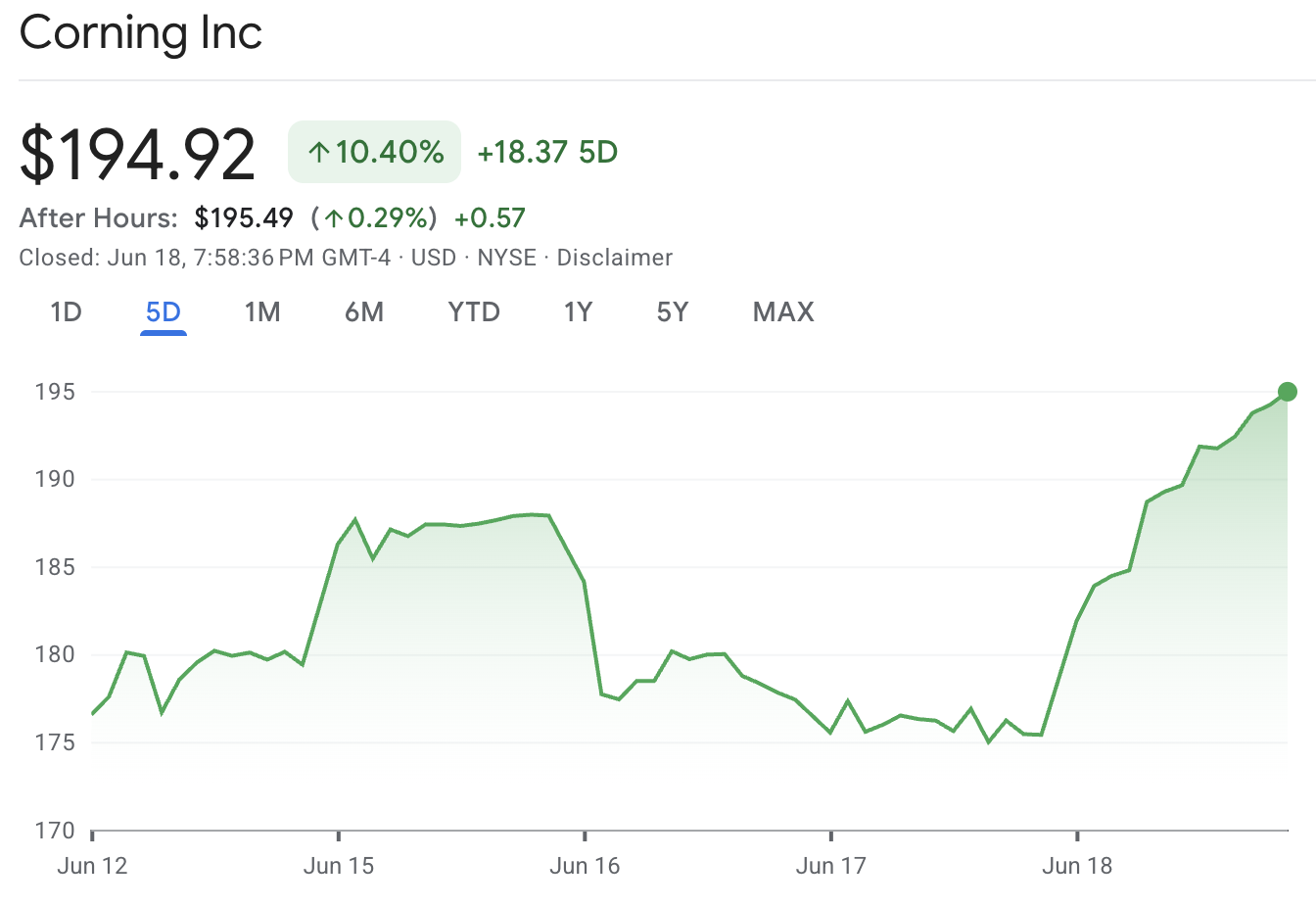 The price action is no longer being driven by a recovery in display glass. It is being driven by a market decision to revalue Corning around the infrastructure that moves data inside AI compute networks.
The market is not simply rewarding Corning for having an AI label. It is reclassifying the company.
For years, GLW was judged through display technologies, smartphone cover glass, specialty materials and industrial end markets. Those businesses still matter, but they no longer explain the stock’s latest move. The premium now sits in Optical Communications, where Corning sells the physical components that help high-density compute systems move data at scale.
That changes the earnings debate. A cyclical glass stock is valued on recovery timing and margin normalization. An AI infrastructure supplier is valued on capacity, contract duration and the ability to convert large customer commitments into recurring earnings.
The difference is visible in the customer list. Nvidia, Amazon and Meta are not marginal buyers. They are among the largest spenders in AI infrastructure, and each has moved to lock in Corning’s optical products through long-term arrangements.
Nvidia is the most important name in the current GLW narrative because the May partnership links Corning directly to the center of the AI hardware cycle.
Under the agreement, Corning will expand U.S. optical connectivity manufacturing capacity by 10x and increase U.S. fiber production capacity by more than 50%. The plan includes three new advanced manufacturing facilities in North Carolina and Texas and more than 3,000 jobs.
The equity structure gives the partnership more weight than a routine supply agreement. Nvidia received a warrant to purchase up to 15 million Corning shares at $180 per share and a pre-funded warrant to purchase up to 3 million additional shares, with an aggregate purchase price of $500 million. If the traditional warrant is exercised in full, Nvidia’s total potential equity exposure would rise meaningfully.
For Corning, the signal is clear. Nvidia is not only buying optical components. It is aligning with domestic manufacturing capacity needed for the next phase of AI infrastructure.
For GLW investors, the question shifts from whether Corning has AI exposure to whether that exposure can support a higher earnings base over several years.
Amazon’s June agreement added the second major hyperscaler anchor. The company signed a multiyear, multibillion-dollar agreement with Corning for optical fiber, cable and connectivity solutions tied to expanding U.S. data-center infrastructure.
The agreement is expected to create 1,000 advanced manufacturing jobs at Corning facilities in North Carolina.
Meta provides the earlier proof point. Corning’s multiyear agreement with Meta is valued at up to $6 billion and supports the buildout of advanced U.S. data centers through optical fiber, cable and connectivity products.
Corning has also disclosed that two additional hyperscale customers entered large, long-term agreements similar in size and duration to the Meta arrangement. That detail is central to the investment case because it reduces the risk that GLW’s rerating depends on one buyer or one contract.
For investors, the customer pattern improves the quality of the story. Short-cycle demand can lift a quarter. Multiyear agreements across several hyperscalers can support factory utilization, revenue visibility and margin planning.
Corning’s first-quarter numbers gave the rally financial backing. Core sales rose 18% year over year to $4.35 billion, while core EPS rose 30% to $0.70. Management guided Q2 core sales to about $4.6 billion and core EPS of $0.73 to $0.77.
The strongest contribution came from Optical Communications. Segment sales rose 36% to $1.85 billion, while segment net income rose 93% to $387 million. That profit growth is the clearest evidence behind the rerating. The segment is not merely adding revenue. It is contributing stronger earnings leverage.
| Metric | Q1 2026 Result | Year-over-year change | What it shows |
|---|---|---|---|
| Core sales | $4.35 billion | +18% | Group growth accelerated |
| Core EPS | $0.70 | +30% | Earnings grew faster than sales |
| Optical Communications sales | $1.85 billion | +36% | AI-related demand is showing up in results |
| Optical Communications net income | $387 million | +93% | Segment leverage strengthened |
| Q2 core sales outlook | About $4.6 billion | About +14% | Management expects momentum to continue |
The scale of profit growth explains why GLW is no longer being discussed only as a diversified materials company. A segment growing earnings far faster than revenue can justify a different valuation conversation, provided the margin performance holds as capacity expands.
Corning’s upgraded Springboard plan gives the market a longer-term framework. It also raises the burden of proof.

The company expects to reach a $20 billion annualized sales run rate by the end of 2026. It has outlined a high-confidence plan for $35 billion by the end of 2030, alongside an internal Springboard target of $40 billion. Management also aims to build its Photonics Market-Access Platform into a $10 billion revenue stream by 2030.
These are company targets, not guaranteed outcomes. The market can reward the roadmap only if Corning turns contracts, factory expansion and photonics demand into sustained sales, margins and cash flow.
Capacity timing is the first test. Expanding optical connectivity manufacturing by 10x requires labor, supply discipline, capital control and close alignment with hyperscaler project schedules.
Margins are the second test. Optical Communications delivered strong operating leverage in Q1, but new facilities can pressure profitability during ramp-up periods.
Customer concentration is the third test. Nvidia, Amazon and Meta improve visibility, but they are powerful buyers. Their technical requirements, spending cycles and project timing can shape Corning’s growth path.
Valuation is the final test. GLW is already priced for a stronger growth profile. The shares now need evidence that optical demand can become a durable earnings engine rather than a temporary AI spending surge.
Corning’s strongest story is no longer glass recovery. It is optical infrastructure.
Nvidia gives the thesis industrial validation. Amazon and Meta show demand spreading across the largest AI and cloud platforms. Q1 results show Optical Communications already converting that demand into sales and profit growth.
The stock’s rerating has happened. The delivery phase is next. Corning must bring capacity online, protect margins and prove that hyperscaler contracts can turn into recurring earnings power.
If it executes, GLW’s rally may prove more durable than a one-session AI trade. It would reflect a broader market recognition that the next stage of AI infrastructure is not only about producing more compute, but about moving data efficiently enough to make that compute useful.