Published on: 2026-05-06
Updated on: 2026-05-06
AMD’s post-earnings surge was not just a reaction to a stronger Q1 report or a headline earnings beat. The stock closed at $355.26 on May 5, 2026, then traded at $414.00 after hours, up 16.53% from the close, as investors reassessed AMD’s role in the next phase of AI infrastructure spending. (1)
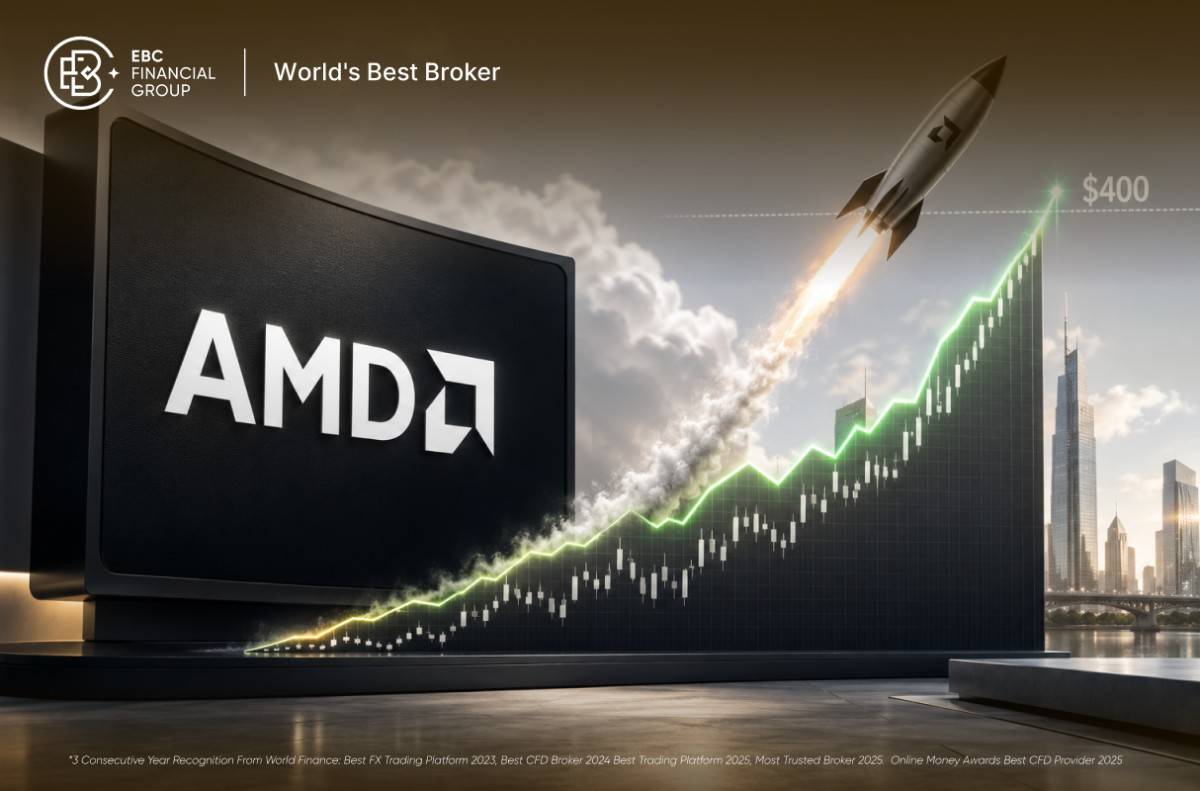
The earnings beat explains part of the move; the larger reaction reflects a possible reset in how investors value AMD’s AI data-center pipeline across EPYC server CPUs, Instinct GPUs, MI450 Series accelerators, Helios rack-scale systems, and large cloud deployments.
AMD beat Q1 expectations, with revenue of $10.253 billion and non-GAAP EPS of $1.37, above consensus estimates of about $9.9 billion in revenue and $1.29 in adjusted EPS. (2)(3)
Data Center revenue rose 57% year over year to $5.8 billion, driven by EPYC processor demand and the continued ramp of AMD Instinct GPU shipments.
AMD’s Q2 revenue guidance of $11.2 billion was above Wall Street expectations of about $10.54 billion, giving investors a stronger forward signal.
The most important forward-looking detail was management’s comment that MI450 Series and Helios customer engagement is strengthening, with customer forecasts exceeding AMD’s initial expectations.
The risk is valuation. After the after-hours jump, AMD traded above the average analyst price target of $279.50 and the listed high target of $400, although those targets may change after analysts refresh post-earnings models.
AMD stock is rising because investors are repricing the company’s AI data-center trajectory, not simply rewarding one clean earnings beat.
| Metric | AMD Q1 2026 result | Consensus / expectation | Read-through |
|---|---|---|---|
| Revenue | $10.253 billion | About $9.9 billion | Clear beat |
| Non-GAAP EPS | $1.37 | About $1.29 | Clear beat |
| Data Center revenue | $5.775 billion | FactSet consensus around $5.64 billion | Data Center beat |
| Q2 revenue guidance | $11.2 billion midpoint | About $10.54 billion | Stronger forward signal |
| Q2 non-GAAP gross margin guide | About 56% | N/A | Margin support if achieved |
The Q1 numbers were strong. AMD reported first-quarter 2026 revenue of $10.253 billion, up 38% year over year. GAAP net income rose 95% to $1.383 billion, while non-GAAP net income increased 45% to $2.265 billion. Non-GAAP diluted EPS came in at $1.37, up 43% from the prior year.
But the size of the after-hours move suggests investors were looking beyond Q1. A beat on revenue and EPS explains part of the reaction. The larger move came from the possibility that AMD’s forward growth profile has changed.
That is the central thesis: AMD is being repriced as a potential AI infrastructure winner for 2026 and 2027.
AMD’s Data Center segment generated $5.775 billion in Q1 revenue, up 57% year over year. It was also larger than the company’s Client and Gaming segment. AMD said Data Center growth was driven by strong demand for EPYC server processors and by the continued ramp in Instinct GPU shipments.
| Segment | Q1 2026 revenue | Year-over-year change | Main driver |
|---|---|---|---|
| Data Center | $5.775 billion | Up 57% | EPYC demand and Instinct GPU shipment ramp |
| Client and Gaming | $3.605 billion | Up 23% | Ryzen, Radeon, market-share gains |
| Embedded | $873 million | Up 6% | Better demand across several end markets |
This is why the rally differs from a typical semiconductor earnings move. AMD is no longer being valued mainly as a PC, gaming, or server CPU share-gain story. The market is increasingly treating Data Center as the valuation engine.
The Data Center segment also gives AMD a broader AI angle than a pure GPU story. AMD’s release ties growth to both EPYC CPUs and Instinct GPUs, which matters because agentic AI and inference workloads require more than accelerators. They also need CPUs, memory, networking, software, and rack-level system design.
The limitation is that AMD does not disclose the exact Data Center split between EPYC CPUs and Instinct GPUs in this release.
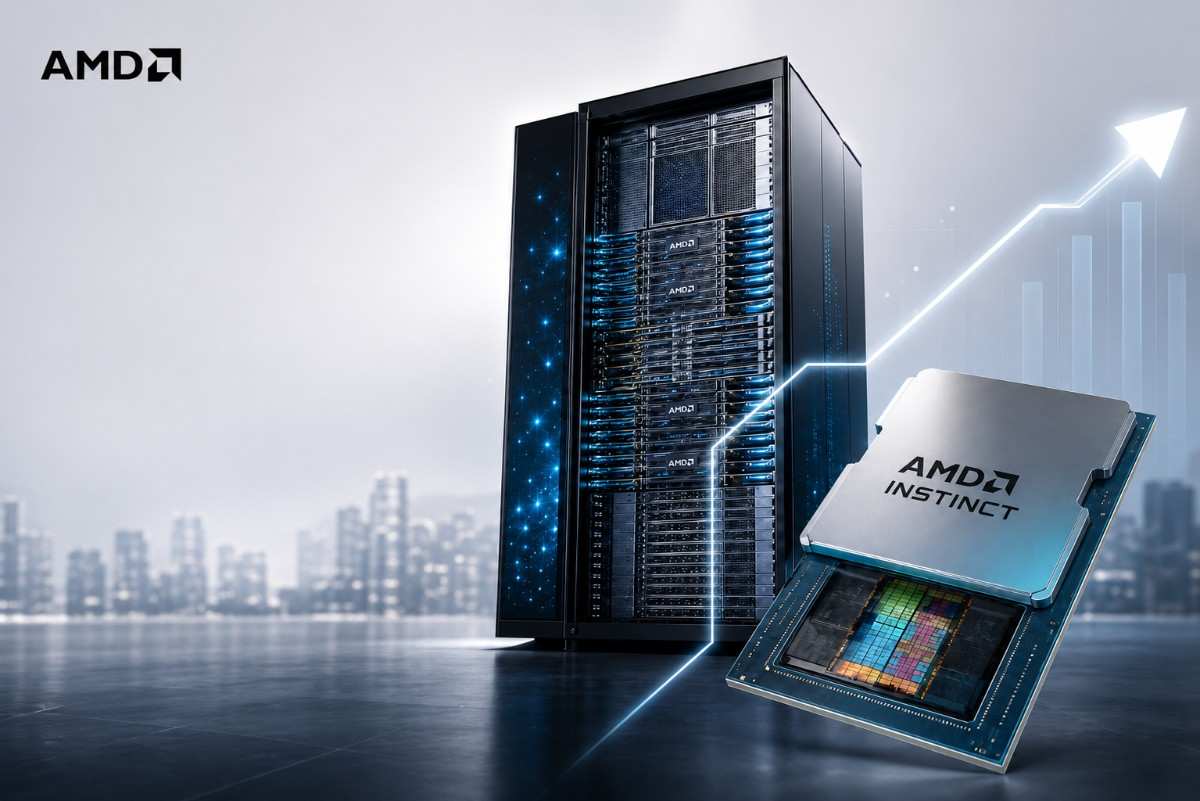
The most important forward-looking language in AMD’s release was Lisa Su’s comment that customer engagement around the MI450 Series and Helios is strengthening, with leading customer forecasts exceeding AMD’s initial expectations and a growing pipeline of large-scale deployments, which is improving visibility into AMD’s growth trajectory.
That shifts the debate from participation to execution.
Before this report, investors were wondering whether AMD could meaningfully participate in AI infrastructure. After this report, the harder question is whether AMD can scale fast enough to justify a higher valuation.
AMD’s Helios platform is designed as an open, rack-scale AI system built around MI450 Series GPUs. The investment case now depends on whether that customer engagement converts into shipments, recognized revenue, and margin-accretive growth.
AMD’s AI infrastructure story now has several large-customer proof points.
| Partner / initiative | AMD product exposure | Why it matters |
|---|---|---|
| Meta | Instinct GPUs, custom MI450-based GPU, 6th Gen EPYC CPUs, Helios | Up to 6GW AI infrastructure agreement |
| OpenAI | AMD Instinct MI450 Series GPUs and rack-scale AI systems | 6GW multi-year partnership, first 1GW in 2H 2026 |
| TCS / India | Helios rack-scale AI architecture | 200MW AI-ready deployment blueprint |
| Samsung | HBM4 supply for MI455X GPUs and DRAM for EPYC CPUs | Memory supply and next-generation compute |
| NAVER Cloud / Upstage | Instinct GPUs and EPYC CPUs | Sovereign AI infrastructure in Korea |
Meta and AMD announced a multi-year agreement to deploy up to 6GW of AMD Instinct GPUs, with shipments of the first gigawatt expected to begin in the second half of 2026, using a custom MI450-based GPU and the Helios architecture. (4)
OpenAI and AMD also announced a 6GW strategic partnership, beginning with a 1GW deployment of AMD Instinct MI450 GPUs in the second half of 2026. (5)
These partnerships do not guarantee revenue timing, margins, or smooth execution. But they make AMD’s AI pipeline harder to dismiss.
The market’s reaction also reflects a shift in AI workloads.
Training large models remains GPU-heavy. But inference, agents, reasoning systems, and multi-step AI workflows can increase demand for broader infrastructure. These workloads need accelerators, but they also need CPUs to coordinate tasks, manage environments, run orchestration layers, and support memory- and networking-heavy systems.
That is why AMD’s wording around “inferencing and agentic AI” is important. Lisa Su linked those workloads to demand for both high-performance CPUs and accelerators.
This gives AMD a more credible full-stack narrative:
Instinct GPUs for acceleration
MI450 Series for next-generation AI compute
Helios for rack-scale deployment
EPYC CPUs for server and orchestration workloads
ROCm software for AI developer support
Pensando networking for data-center infrastructure
That does not make AMD equal to Nvidia. NVIDIA is still widely viewed as having the stronger AI software ecosystem and a broader installed base of accelerators. But AMD’s pitch is no longer just “cheaper GPUs.” It is becoming a broader AI infrastructure story built around CPUs, GPUs, software, networking, memory, and partnerships, as well as rack-level design.
AMD is benefiting from a market where AI infrastructure spending remains aggressive.
Investors are not only reacting to AMD’s report. They are connecting it to a broader AI capital-spending cycle that includes hyperscalers, sovereign AI projects, custom silicon, memory, advanced packaging, networking, and power-hungry data centers.
That backdrop matters because AMD does not need to dominate the entire AI accelerator market for the thesis to work. It needs to capture enough incremental demand to turn the Data Center into a larger and more durable earnings engine.

After the after-hours move, AMD was no longer priced like a company that merely beat Q1 earnings. It was priced as if investors expected the company to execute a multi-year ramp in AI infrastructure.
StockAnalysis data showed AMD at $414.00 after hours, while the average analyst price target was $279.50 and the listed high target was $400. Those targets may be revised after analysts update their models, but the comparison still shows how much expectation was pulled forward by the rally.
That does not automatically make AMD overvalued. It does mean the stock is demanding proof.
The market is now asking AMD to show that:
Data Center growth can remain strong in H2 2026
Instinct GPU shipments can scale without major delays
MI450 and Helios demand can convert into revenue
The gross margin can hold near guidance
Partnerships can become repeatable revenue, not only announcements
AMD can compete without relying only on lower pricing
Note: After-hours prices can change before the next regular session, and analyst targets may be revised after post-earnings model updates. The point is not that AMD is automatically overvalued, but that the rally has pulled forward higher expectations.
The biggest risk is that expectations outrun execution.
AMD’s own cautionary statement points to the risks that matter most now: competition, product timing, customer concentration, export rules, tariffs, third-party manufacturing, memory supply, substrate availability, manufacturing yields, software support, supply-chain logistics, and stock-price volatility.
For AMD, those risks are not boilerplate. They are central to the investment case.
The thesis weakens if MI450 timing slips, Helios deployments are slower than expected, Data Center growth decelerates in the second half, gross margin disappoints, or AMD fails to provide clearer evidence that AI GPU revenue is scaling.
The next catalysts are execution-based, not hype-based:
Q2 revenue versus the $11.2 billion midpoint
Data Center revenue in H2 2026
Instinct GPU shipment commentary
MI450 Series customer updates
Helios deployment milestones
Gross margin versus the 56% Q2 outlook
Meta, OpenAI, TCS, and sovereign AI timing
Competitive updates from Nvidia and other AI accelerator suppliers
This is not a simple earnings-beat rally. It is the market testing whether AMD belongs in the top tier of AI infrastructure winners.
The Q1 beat gave investors a reason to react. Data Center growth gave them a reason to believe. Q2 guidance gave them a reason to look forward. MI450 and Helios commentary gave them a reason to rethink AMD’s role in the 2026–2027 AI infrastructure cycle.
The larger the repricing, the less room AMD has for delays, margin pressure, or vague shipment commentary.
After the move above $400 in after-hours trading, AMD does not just need to participate in AI infrastructure. It needs to prove it can scale that opportunity profitably, on time, and with enough shipment visibility to justify the market’s new expectations.
(1) https://stockanalysis.com/stocks/amd/forecast/