Published on: 2026-06-16
Updated on: 2026-06-16
The Vedanta demerger has turned one share into five listed prices, and the market quickly picked its favourite. VAML opened as the clear crown jewel after the June 15 listings, but its 5% fall by the close showed buyers were not willing to chase the split at any price.
The opening pointed to a roughly 20.6% sum-of-the-parts gap; by the close, the combined value had narrowed to about ₹896.5 per original Vedanta share.
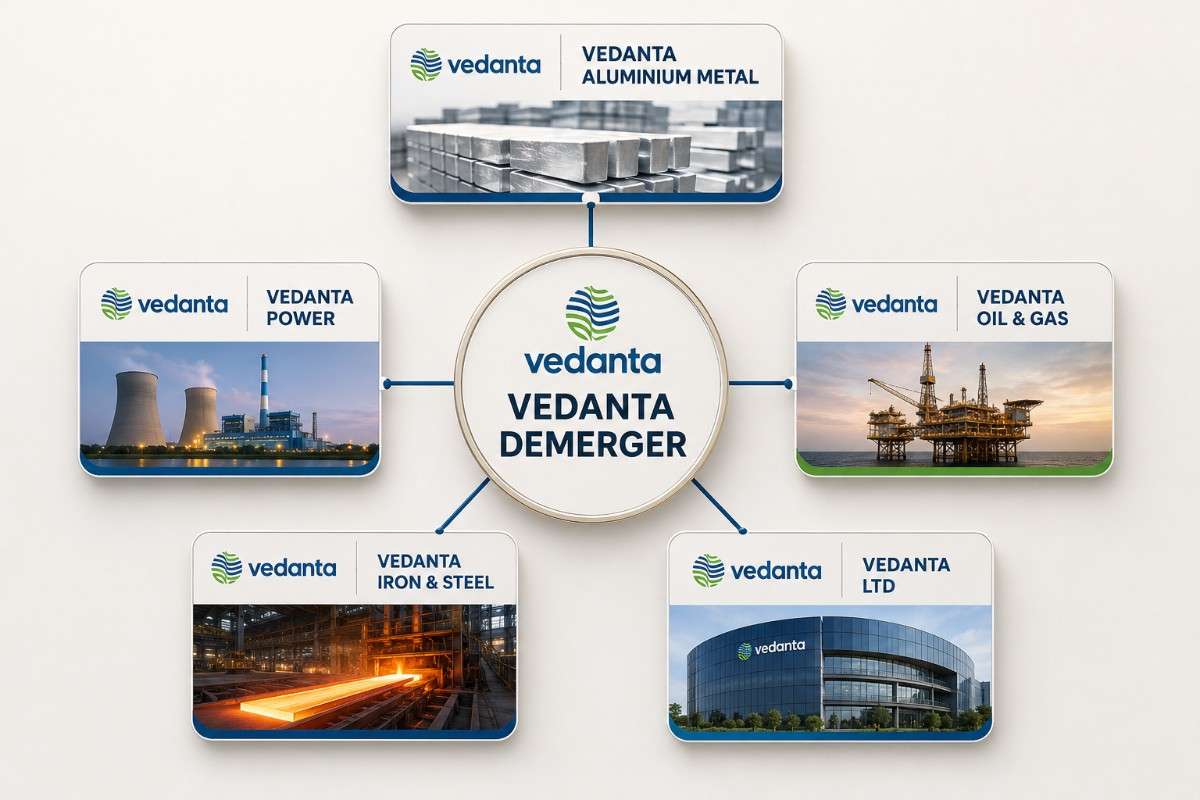
Four Vedanta spin-offs began trading on June 15, giving the market its first chance to price aluminium, power, oil and gas, and steel separately.
Eligible shareholders received one share in each new company for every one Vedanta share held on the May 1 record date.
VAML opened at ₹522 on NSE and ₹527 on BSE, then closed at ₹495.90 on NSE after a 5% fall, making Vedanta Aluminium Metal both the clearest value signal and the first test of post-listing demand.
The five-stock structure topped ₹930 per original Vedanta share after the open, but closed near ₹896.5, showing the valuation lift narrowed during the first session.
The first 10 trading sessions are subject to Trade-to-Trade rules, so the cleaner signal comes after delivery-only restrictions end and real liquidity builds.
Each new Vedanta stock now moves on a different signal: aluminium, power demand, Brent crude, steel margins or residual Vedanta debt.
| Stock | What Moves It | Market Read |
|---|---|---|
| Vedanta Aluminium Metal | Aluminium margins | Biggest value pool |
| Vedanta Power | Power demand and tariffs | Stable, demand-backed |
| Vedanta Oil & Gas | Brent crude and output | Higher risk, higher swing |
| Vedanta Iron & Steel | Steel demand and margins | Smallest, cyclical |
| Vedanta Ltd | Zinc, copper, debt and dividends | Still the balance-sheet story |
VAML is the name to watch. The split did not create five equal opportunities; it gave aluminium the valuation lift and left power, oil and steel to prove their own case.
VAML leads the Vedanta demerger because aluminium gives the split its cleanest profit engine. Scale, lower-cost targets, and demand from electrification, infrastructure, packaging, and transmission give the stock a clearer case than the smaller listings.
Vedanta Aluminium produced 2.46 million tonnes of aluminium in FY26. Vedanta’s wider FY26 numbers also gave the new structure a strong base, with revenue of ₹1,74,075 crore, EBITDA of ₹55,976 crore and PAT of ₹25,096 crore. A demerged stock with scale, earnings history and commodity leverage is easier for the market to price.
VAML’s cost target is the real lever. The company aims to cut hot metal cost from $1,752 per tonne in FY26 to $1,550–1,600 per tonne, a planned reduction of 9–12%. If that happens, aluminium earnings become more powerful when prices rise and less exposed when prices fall.
The catch is valuation. Aluminium fell to $3,375.65 per tonne on June 15, down 4.72% on the day, yet still 34.04% higher than a year earlier. A valuation lift built in a strong aluminium cycle leaves little room for weaker margins.
The first session already tested that valuation. VAML closed at ₹495.90, down 5% from its ₹522 NSE listing price, while Vedanta Oil & Gas also fell 5%, and Vedanta Iron & Steel was the only demerged entity to close higher. The message was not bearish, but it was disciplined: the market liked aluminium, not at any price.
VAML won the first round. Keeping the gap will be harder.
For every one Vedanta share held on the record date, eligible shareholders received one share each in Vedanta Aluminium Metal, Vedanta Power, Vedanta Oil & Gas and Vedanta Iron & Steel. Vedanta Ltd remains listed with zinc, copper and other residual assets.
The split separated Vedanta into five listed stories: aluminium, power, oil and gas, iron and steel, and residual Vedanta. Each stock now has to earn its own valuation.
Vedanta Power has demand on its side. India met a record peak electricity demand of 256.1 GW on April 25, 2026, giving the stock a real growth argument beyond listing excitement.
Demand alone will not drive the stock. Power value depends on plant load factors, coal costs, tariffs, power purchase agreements and merchant sales. Vedanta Power can rise with electricity demand, though a lasting rerating needs visible cash flow.
Vedanta Oil & Gas is the swing stock. Brent exposure gives it upside when crude rebounds and punishes the stock quickly when oil weakens. Brent fell to below $83 per barrel on June 15 as hopes of a US-Iran deal eased pressure around energy supply routes.
Vedanta Iron & Steel has the better demand backdrop among the smaller listings. Indian steel demand is forecast to grow by 7.4% in 2026 and 9.2% in 2027, well above projected global steel demand growth of 0.3% in 2026.
Power, oil and steel are still in the race. Cash flow, margins, and volume will determine whether they achieve higher valuations.
The opening print was stronger than the close. Early price discovery pushed the combined value of Vedanta Ltd and the four demerged entities to about ₹933 per original Vedanta share, or roughly 20.6% above Vedanta’s pre-demerger close of ₹773.6. Closing prices brought that figure down to about ₹896.5, still above the old price, but no longer as euphoric as the morning trade.
That gap formed under restricted trading conditions. The four new stocks entered the Trade-to-Trade segment for the first 10 sessions, during which every transaction requires delivery and same-day speculation is prohibited. Once normal liquidity builds, the market will get a cleaner read on whether the demerger rerating is durable.
From here, the gap needs earnings support.
| Stock | What Helps | What Hurts |
|---|---|---|
| VAML | Lower costs | Aluminium premium fades |
| Vedanta Power | Higher utilisation | Fuel costs rise |
| Vedanta Oil & Gas | Better output | Brent weakens |
| Vedanta Iron & Steel | Stronger steel demand | Margins compress |
| Vedanta Ltd | Lower debt | Dividend pressure |
The valuation lift now has five separate jobs: VAML must defend margins, Power must lift utilisation, Oil & Gas must show output, Steel must protect margins, and Vedanta Ltd must keep debt under control.
Management’s ambition is far larger than the first-day gap. Vedanta Chairman Anil Agarwal has described each major vertical as a potential $100 billion opportunity, while also outlining a longer-term plan to lift group revenue from about $23–24 billion to $50 billion. The market will not price that aspiration without margin proof, output growth and debt discipline.
The first risk is paying for the split twice. The market has already rewarded Vedanta with a higher combined value, so the next gains need better earnings, not just a cleaner structure.
Commodity weakness would hit each new stock more directly than before. Aluminium pressure would test VAML, Brent weakness would weigh on Vedanta Oil & Gas, fuel and tariff pressures would weigh on Vedanta Power, and weaker steel margins would hit Vedanta Iron & Steel.
The old Vedanta blended those risks inside one stock. The new structure exposes them faster.
Debt and dividends remain the key pressure points for residual Vedanta Ltd. Vedanta entered FY26 with Net Debt to EBITDA down to 0.95x from 1.22x a year earlier, giving the split a stronger base than a restructuring built only on market excitement.
If cash flows are pulled too aggressively toward distributions or group-level obligations, the market may question whether the demerger has truly improved capital discipline.
The Vedanta demerger split the group into five listed businesses: residual Vedanta Ltd plus separate aluminium, power, oil and gas, and iron and steel companies. The market can now value each business on its own earnings, risks and commodity cycle.
The five post-demerger stocks are Vedanta Ltd, Vedanta Aluminium Metal, Vedanta Power, Vedanta Oil & Gas and Vedanta Iron & Steel. Vedanta Ltd remains the existing listed company, while the other four are newly listed demerged entities.
VAML share price matters because aluminium carries the clearest value case in the split. Its scale, cost targets and commodity exposure make it the stock most likely to drive the demerger’s rerating, while also carrying the highest expectations to defend.
Yes. The rerating can fade if aluminium margins weaken, Oil & Gas output disappoints, power costs rise, steel margins compress, or Vedanta Ltd faces renewed pressure on debt and dividends. The split improves transparency, but it does not remove commodity or balance-sheet risk.
The share allotment itself is generally not treated as an immediate taxable gain. For future capital gains, the original Vedanta acquisition cost must be apportioned among Vedanta Ltd and the four demerged stocks in accordance with the official cost allocation.
The next test begins after the 10-session Trade-to-Trade window ends. If volume builds and VAML holds above its first-session close, the split will look stronger than an opening-day reaction.
If the combined value continues to narrow, the message will be just as clear. The demerger has drawn attention, but each stock now has to defend its own price.
Agarwal’s $100 billion ambition gives the story scale. The market’s first close gave it discipline. Vedanta has won the headline; the harder test is keeping the valuation lift.