Published on: 2026-07-09
Two international ETFs can hold similar assets and still deliver different returns to a U.S.-based investor. The difference often comes from currency translation, not the stocks, bonds or fund manager.
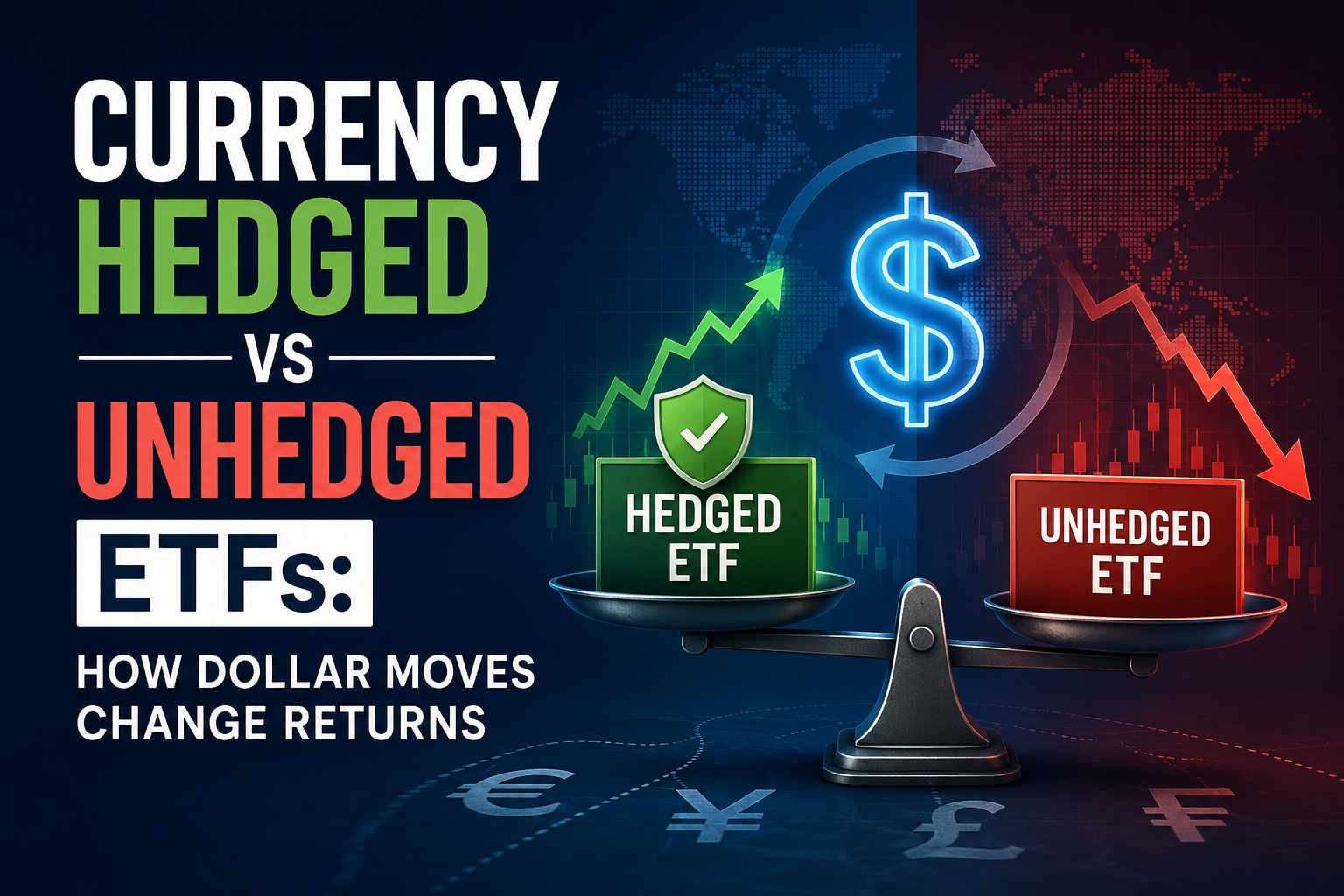
When the U.S. dollar strengthens, unhedged foreign ETF returns can face a drag. When the dollar weakens, that same currency exposure can become a return boost. This is where the real difference between a currency hedged ETF vs unhedged ETF shows up: not only in what the fund owns, but in how foreign returns arrive back in dollars.
Hedged and unhedged ETFs can behave differently even when they hold similar underlying assets.
A stronger U.S. dollar may reduce returns on unhedged foreign ETFs in USD terms.
A weaker U.S. dollar may lift unhedged ETF returns through currency translation.
Currency hedging can reduce FX swings, but it can also change returns through hedge costs, interest-rate differentials, tracking differences and lost currency upside.
The better structure depends on dollar direction, asset class, hedge economics, holding period and whether the investor wants currency exposure.
The gap between a currency hedged ETF and an unhedged ETF is not just theoretical. It becomes visible when the dollar starts trending. A U.S.-based investor buying an unhedged international fund is taking on two exposures at once: the performance of the foreign asset in its local currency, and the translation of that value back into dollars.
Think of the return in two layers. The first is the local-market return, such as how European stocks, Japanese equities or foreign bonds performed in their own currency. The second is the currency move against the dollar.
A simple way to think about it is:
USD return = (1 + local asset return) × (1 + currency return) − 1
An unhedged ETF passes both layers through to the investor, while a hedged ETF attempts to reduce the second so returns track the local-market asset more closely. When the dollar moves sharply, the two can diverge in ways that surprise investors who assumed similar holdings meant similar returns.
A better way to see the difference is to hold the foreign asset return constant and change only the currency direction. A stronger dollar usually lowers the value of foreign-currency returns once translated back into USD. A weaker dollar does the opposite.
| Scenario | Foreign Asset Return | Currency Move vs USD | Hedged ETF Result | Unhedged ETF Result |
|---|---|---|---|---|
| Strong dollar | +8% local return | Foreign currency falls | Around +8%, adjusted for hedge effects and tracking | Below +8% due to FX drag |
| Weak dollar | +8% local return | Foreign currency rises | Around +8%, adjusted for hedge effects and tracking | Above +8% due to FX boost |
| Flat dollar | +8% local return | Little currency change | Around +8%, adjusted for hedge effects and tracking | Around +8%, limited FX effect |
In a strong-dollar environment, the hedged ETF may look better because the unhedged version faces currency drag: the market may rise, but a falling foreign currency leaves the U.S. investor with a lower USD return than the local performance suggests.
In a weak-dollar environment, the unhedged ETF may look better because foreign-currency appreciation adds to the dollar return.
When the dollar is broadly flat, asset performance, expenses, hedge economics and tracking difference matter more than the currency effect. None of this means one structure wins permanently. The same market exposure can simply produce different outcomes depending on the currency cycle.
Currency hedged ETFs may be useful when the dollar is strengthening and the investor wants foreign market exposure without taking a currency view, such as holding European equities without a separate bet on the euro.

By reducing the effect of foreign-currency weakness, the hedge can make the ETF behave more like the underlying local market, which may appeal to investors who care more about the asset than the exchange rate.
Hedged structures can also matter when currency volatility is high, since hedging removes one source of uncertainty. That can be especially relevant for shorter holding periods, tactical positions or periods of central bank divergence, such as the Fed and the Bank of Japan setting policy in opposite directions. Asset class matters too.
Bonds are the common example: fixed-income returns are often smaller than equity returns, so a large swing in the yen or euro can overwhelm a foreign bond portfolio.
Still, hedged does not automatically mean safer. It simply means the investor has chosen to reduce one specific risk while accepting its cost, carry effect and limitations.
Unhedged ETFs may be useful when the dollar is weakening or a foreign currency is strengthening, because currency appreciation can add to returns in dollar terms. A rising euro or yen, for example, can lift a European or Japanese equity ETF beyond its local-market gain once returns are translated into USD.
Unhedged exposure may also appeal to investors who want currency diversification, since a portfolio holding only dollar assets is heavily tied to the dollar, while an unhedged developed-market ETF spreads exposure across currencies like the euro, yen and pound. A longer time horizon can make some investors more comfortable with these swings.
Even so, unhedged ETFs are not automatically better long term: if the dollar strengthens for an extended period, the currency drag can last longer than expected. Hedge economics can also tip the decision, as expensive or unfavourable hedging may lead some investors to stay unhedged.
A currency hedge is usually built using forward contracts designed to offset movements between the foreign currency and the U.S. dollar. The goal is not to improve returns automatically, but to reduce the effect of exchange-rate changes on the ETF’s USD performance.
The cost or benefit of hedging is often linked to interest-rate differentials between the two currencies. The economics differ depending on which country has higher rates, which is why hedging can become more or less attractive as central banks adjust policy.
There are also tracking differences. Hedges need to be rolled, market prices move and implementation is not frictionless, so a hedged ETF may not perfectly match the local-market index after expenses and timing effects. A currency hedge reduces one risk, but it does not remove all risk. It changes the source of return and the cost structure, while market risk, credit risk and interest-rate risk remain.
Currency effects do not affect every international ETF in the same way. The importance of ETF currency risk depends on the size of the currency move relative to the return profile of the underlying assets.
| Asset Class | Why Currency Hedging Matters |
|---|---|
| International equities | Stock returns are often larger and more volatile than currency moves, so many equity investors may tolerate FX fluctuation. The decision depends on dollar cycle, region and holding period. |
| International bonds | Bond returns are usually smaller, so FX volatility can overwhelm income and price returns. Hedging may play a larger role here. |
| Emerging market ETFs | Currency risk can be larger and less predictable. Hedging may also be less available, more expensive or harder to implement cleanly. |
| Global dividend and income ETFs | Currency moves can affect both share-price and income translation, so FX can influence capital value and distributions. |
For equities, the decision often depends on region and portfolio role, since a Japanese, European or broad developed-market ETF can each carry a different currency profile. For bonds, it can be more consequential: if currency exposure creates larger swings than the bond allocation itself, the ETF may behave differently from what the investor expected.
Emerging market ETFs add another layer, where currency moves can reflect inflation or capital flows and clean hedging is not always available.
The first variable to watch is the dollar trend. A broad rise in the U.S. dollar can create a headwind for unhedged international ETF returns, while a weaker dollar can act as a tailwind. Interest-rate differentials matter too, because they influence hedge economics, and when central banks move in different directions the cost or benefit of hedging can change.
This is why hedged and unhedged ETF performance can diverge during periods of monetary policy divergence.
Investors should also compare the ETF’s expense ratio, tracking difference, hedging method, region and currency exposure. A broad international ETF may span the euro, yen, pound and Swiss franc, while a single-country ETF carries a far more concentrated profile.
For active traders, hedged and unhedged versions of a similar exposure can behave differently during sharp FX moves or central bank surprises. For longer-term investors, the structure should match the portfolio objective. The practical question is whether the investor wants foreign asset exposure alone, or foreign asset exposure plus currency exposure.
They may perform relatively better during a strengthening dollar because unhedged foreign returns can face currency drag. The result still depends on the size of the dollar move, hedge economics, expenses and underlying asset performance.
Unhedged ETFs may benefit when the dollar weakens because foreign-currency gains can add to USD returns. That same exposure can work against the investor when the dollar strengthens again.
No. Currency hedging targets FX risk only. Market risk, interest-rate risk, credit risk, liquidity risk, fund expenses and tracking differences still remain.
There is no fixed answer. Some prefer unhedged exposure for currency diversification, while others prefer hedged exposure to focus more closely on the underlying asset. The right fit depends on time horizon, asset class, hedge economics and whether currency exposure is wanted.
The comparison is often framed too simply. Hedged ETFs are not automatically safer, and unhedged ETFs are not automatically better long term.
A hedged ETF gives closer exposure to the foreign asset itself, adjusted for hedge effects, expenses and tracking differences. An unhedged ETF gives exposure to both the asset and the currency translation effect. That means every unhedged international ETF position carries a currency view, even when the investor does not intend one.
The better choice depends on the dollar cycle, hedge economics, asset class, holding period and whether the investor actually wants foreign-currency exposure. Understanding that trade-off turns the hedged-versus-unhedged decision from a guess into a deliberate portfolio choice.