Published on: 2026-05-20
Updated on: 2026-05-20
AI infrastructure stocks in 2026 need proof, not popularity: every name below has current evidence through revenue, orders, backlog, margins, guidance, or contracted power.
The constraint has moved outside the chip: Nvidia now links AI growth to data center capacity, energy availability, and customer capital, pushing power and cooling into the core trade.
Power and cooling are no longer side themes: Vertiv, Eaton, GE Vernova, and Constellation show AI demand reaching cooling systems, electrical gear, grid equipment, and firm power.
Backlog quality separates durable exposure from hype: Dell passes with $43 billion of AI server backlog, while Super Micro misses the core list on margin quality.
The next rotation depends on the limit: chips lead if compute stays scarce; power, cooling, and grid names gain if deployment speed becomes the choke point.
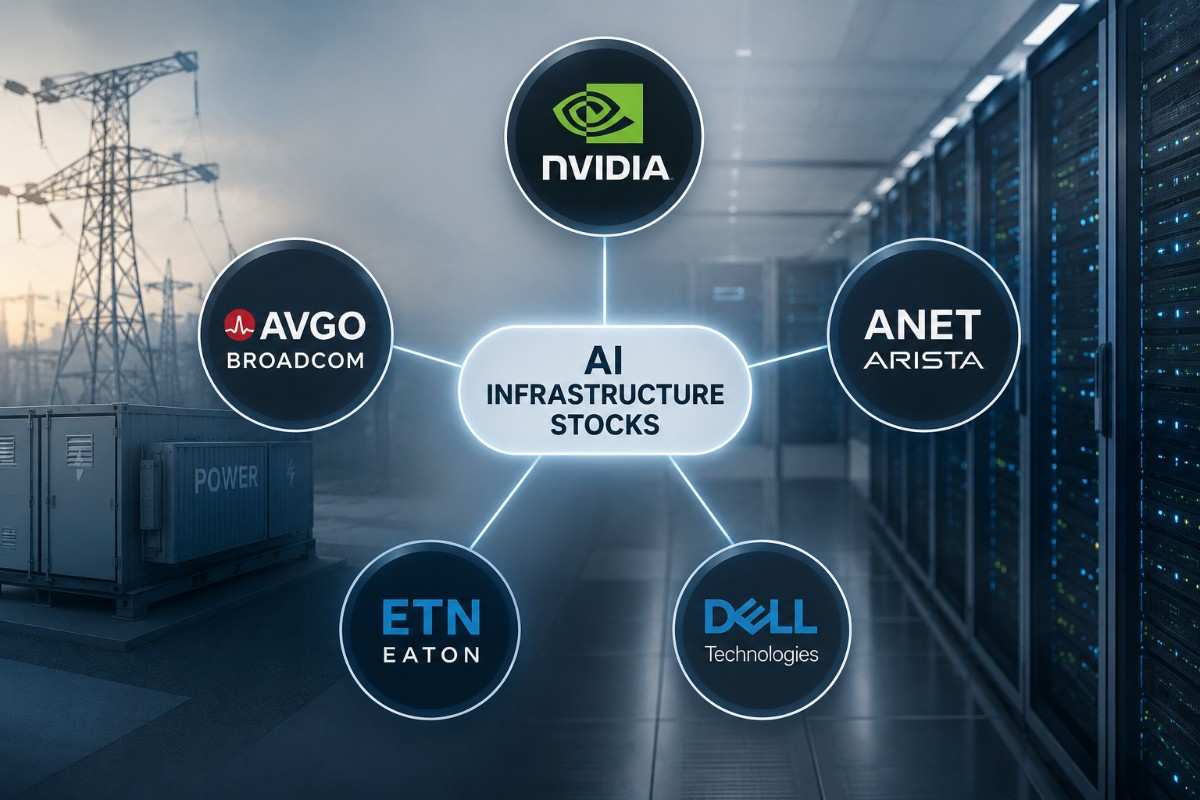
The market already knows Nvidia anchors the compute layer. The less obvious 2026 trade is whether the next winners are decided by what sits around the chip: data center capacity, power, cooling, networking, electrical systems, and firm electricity.
If compute stays scarce, chip and networking leaders keep the advantage. If deployment becomes the choke point, power, cooling, grid, server, and data center names move up the list. This article follows the constraint, not the AI label.
| Ticker | Data Center Limit | 2026 Proof | Main Risk |
|---|---|---|---|
| NVDA | AI compute | $193.7B Data Center revenue | Few large buyers |
| TSM | Advanced chipmaking | 66.2% Q1 gross margin | Taiwan risk, capex |
| AVGO | Custom chips, networking | AI revenue up 106% | Few large buyers |
| ANET | AI data movement | Revenue up 35.1% | Cloud order swings |
| VRT | Cooling, rack power | Sales up 30% | High valuation, delays |
| ETN | Electrical systems | Electrical backlog up 48% | Backlog conversion |
| GEV | Grid equipment | $2.4B data center orders | Wind weakness |
| DELL | AI servers | $43B AI backlog | Thin server margins |
| EQIX | Connected capacity | 60% of largest deals AI-linked | Rates, capex |
| CEG | Firm power | 380 MW data center deal | Regulation, pricing |
The list starts with the highest-margin AI layers, then moves toward the physical infrastructure companies that benefit if power, cooling, grid access, and deployment speed become the harder constraint.
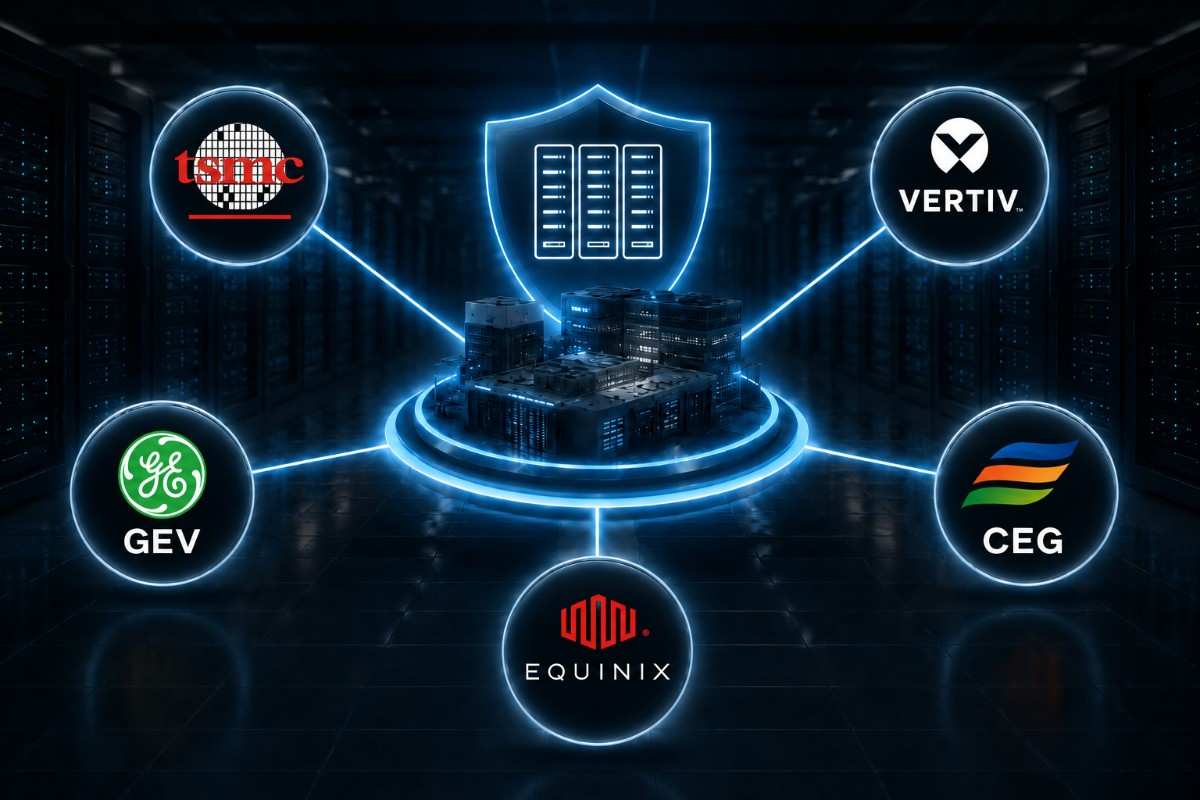
These 10 stocks are included because 2026 data shows AI demand reaching financial results: revenue, backlog, orders, margins, guidance, or contracted power. The screen rejects broad AI exposure when there is no clear link to data center capacity, power, cooling, networking, or deployment.
Limit: AI compute capacity.
2026 proof: Fiscal 2026 revenue reached $215.9 billion, with Data Center revenue of $193.7 billion. Nvidia’s filing also identifies data centers, energy availability, and customer capital as critical to AI infrastructure buildout.
Risk: Customer concentration, China restrictions, and deployment delays. Two direct customers accounted for 22% and 14% of fiscal 2026 revenue, respectively.
Verdict: Core pick. Nvidia remains the compute standard, but its own filing shows the next constraints sit outside the chip.
Limit: Leading-edge manufacturing and advanced packaging.
2026 proof: Q1 revenue reached $35.9 billion, gross margin was 66.2%, and Q2 guidance was $39.0 billion to $40.2 billion.
Risk: Taiwan concentration, overseas fab execution, and heavy capex.
Verdict: Foundry pick. TSMC shows AI pricing power still exists at the manufacturing layer.
Limit: Custom AI accelerators and high-speed networking.
2026 proof: Q1 fiscal 2026 AI revenue rose 106% to $8.4 billion, with Q2 AI semiconductor revenue guided to $10.7 billion.
Risk: A narrow group of hyperscale buyers can create sharp order cycles.
Verdict: Custom-chip pick. Broadcom benefits when large AI platforms optimize around cost, power, and workload-specific silicon.
Limit: Networking inside dense AI clusters.
2026 proof: Q1 revenue rose 35.1% to $2.709 billion. Its new optics platform can reduce the number of networking racks by up to 75% and floor space requirements by up to 44%.
Risk: Cloud customer concentration can amplify order swings.
Verdict: Networking pick. Arista benefits when AI clusters need faster data movement, lower latency, and denser architecture.
Limit: Heat, rack density, and power management.
2026 proof: Q1 net sales rose 30% to $2.65 billion, with 23% organic growth. Full-year guidance implies organic growth of 29% to 31%.
Risk: High valuation leaves less room for project delays or execution misses.
Verdict: Cooling pick. Vertiv has one of the clearest links between denser AI racks and current sales growth.
Limit: Power distribution must be in place before servers can operate.
2026 proof: Electrical Americas rolling 12-month orders rose 42%, while total Electrical backlog rose 48%.
Risk: Backlog must convert into revenue without supply-chain drag or acquisition pressure.
Verdict: Electrical pick. Eaton captures the infrastructure layer between grid access and usable AI compute.
Limit: Grid equipment, substations, and electrification systems.
2026 proof: GE Vernova’s Electrification segment booked $2.4 billion of data center equipment orders in Q1, more than all of the prior year.
Risk: Wind weakness and turbine delivery timing can dilute the grid story.
Verdict: Grid pick. AI power demand is already showing up in equipment orders.
Limit: Turning AI chips into deployable systems.
2026 proof: Dell closed more than $64 billion of AI-optimized server orders, shipped more than $25 billion, and entered fiscal 2027 with $43 billion of AI server backlog.
Risk: Server revenue can grow faster than earnings if component costs or pricing pressure compress margins.
Verdict: Backlog pick. Dell passes because $43 billion of AI server backlog shows demand has moved beyond pipeline talk, but the test is whether thin server margins can survive conversion into revenue.
Limit: Interconnection, enterprise AI access, and distributed capacity.
2026 proof: About 60% of Equinix’s largest Q1 deals were AI-related, and the company raised its full-year outlook.
Risk: Expansion is capital intensive, and REIT valuations remain sensitive to rates.
Verdict: Capacity pick. Equinix benefits if AI shifts toward distributed inference, private data access, and multi-cloud connectivity.
Limit: Reliable electricity for AI data centers.
2026 proof: Constellation and CyrusOne signed a 380 MW agreement to support a data center near the Freestone Energy Center in Texas. The mechanism is firm power. AI data centers need electricity that can run around the clock, and Constellation’s nuclear and gas-backed fleet gives it a different profile from intermittent renewable supply that must be paired with storage or backup generation.
Risk: Regulation, power pricing, and project execution can alter contract economics.
Verdict: Power pick. Constellation gives the list direct exposure to electricity as an AI capacity gate.
| Stock | Decision | Why It Missed | What to Watch |
|---|---|---|---|
| AMD | Watchlist | Strong Data Center growth, but less control over the primary AI compute standard than Nvidia. | MI450/Helios adoption and hyperscaler wins |
| SMCI | Excluded | AI revenue is clear, but 9.9% gross margin weakens growth quality. | Margin recovery and cash conversion |
| AMZN | Excluded | Major AI infrastructure buyer and operator, but too broad for a supplier-focused list. | AWS capex, Trainium adoption, data center power deals |
| SNOW | Excluded | AI-relevant software platform, not a direct power, cooling, hardware, or capacity constraint. | AI data revenue and enterprise adoption |
These exclusions keep the list focused. The article does not rank every company touched by AI. It isolates stocks with clearer exposure to physical infrastructure, capacity constraints, and deployment risk.
The ranking will change if the market starts paying a different part of the AI stack. Compute, chipmaking, and networking lead when training demand absorbs the most capital. Cooling, electrical gear, grid equipment, connected capacity, and firm power gain when deployment speed becomes the harder constraint.
| 2026 Signal | Stocks Most Exposed | Market Read |
|---|---|---|
| Data Center revenue keeps accelerating | NVDA, TSM, AVGO, ANET | Compute, chipmaking, and networking stay at the top of the AI margin trade |
| Deployment constraints increase | VRT, ETN, GEV, EQIX, CEG | Power, cooling, grid gear, and connected capacity gain relative weight |
| Customer concentration rises | NVDA, AVGO, DELL | AI demand remains strong, but revenue risk becomes more concentrated |
| Server pricing weakens | DELL | Backlog quality becomes more important than order size |
| Energy and grid limits dominate guidance | VRT, ETN, GEV, CEG | Physical infrastructure gains weight against pure chip exposure |
A stock can pass the infrastructure screen and still disappoint if the market already prices in flawless execution. The ranking is about exposure quality, not automatic upside.
If compute remains the tightest constraint, the semiconductor-heavy names keep the advantage. If the harder problem becomes powering, cooling, connecting, and operating AI capacity, the equipment and power names move closer to the center of the trade.
Stocks were selected using three tests:
Direct AI infrastructure exposure: compute, chipmaking, networking, cooling, electrical gear, servers, data centers, or power.
Current 2026 evidence: filings, earnings, orders, backlog, guidance, or contracts.
Financial conversion: proof that AI demand is reaching revenue, margins, backlog, cash flow, or deployed capacity.
Companies were excluded if their AI exposure was mainly software-led, popularity-driven, too far from the data center buildout, or weakened by poor margin quality.
AI data centers need power, cooling, and electrical systems before chips can operate at scale. Vertiv, Eaton, GE Vernova, and Constellation appear because 2026 results show AI demand reaching cooling equipment, electrical backlog, grid orders, and contracted power.
Super Micro has clear exposure to AI servers, but its 9.9% gross margin weakens the quality of that growth. The screen excludes companies where demand is visible but financial conversion is less convincing.
No. This is a quality screen based on 2026 evidence, not investment advice. Every stock carries the risks identified above. The list ranks exposure quality, not expected returns.
If data centers keep hitting limits in power, cooling, networking, and capacity, which group gets repriced first: chip leaders, equipment suppliers, or power providers?