Published on: 2026-07-09
Updated on: 2026-07-09
The EU AI Act 2026 changes how AI companies approach compliance, transparency, general-purpose AI, high-risk systems and model governance in Europe. The law does not ban AI, and it does not treat every AI tool the same way. Instead, it uses a risk-based approach that places more detailed requirements on systems that may affect safety, rights, jobs, education, credit access or public services [1].
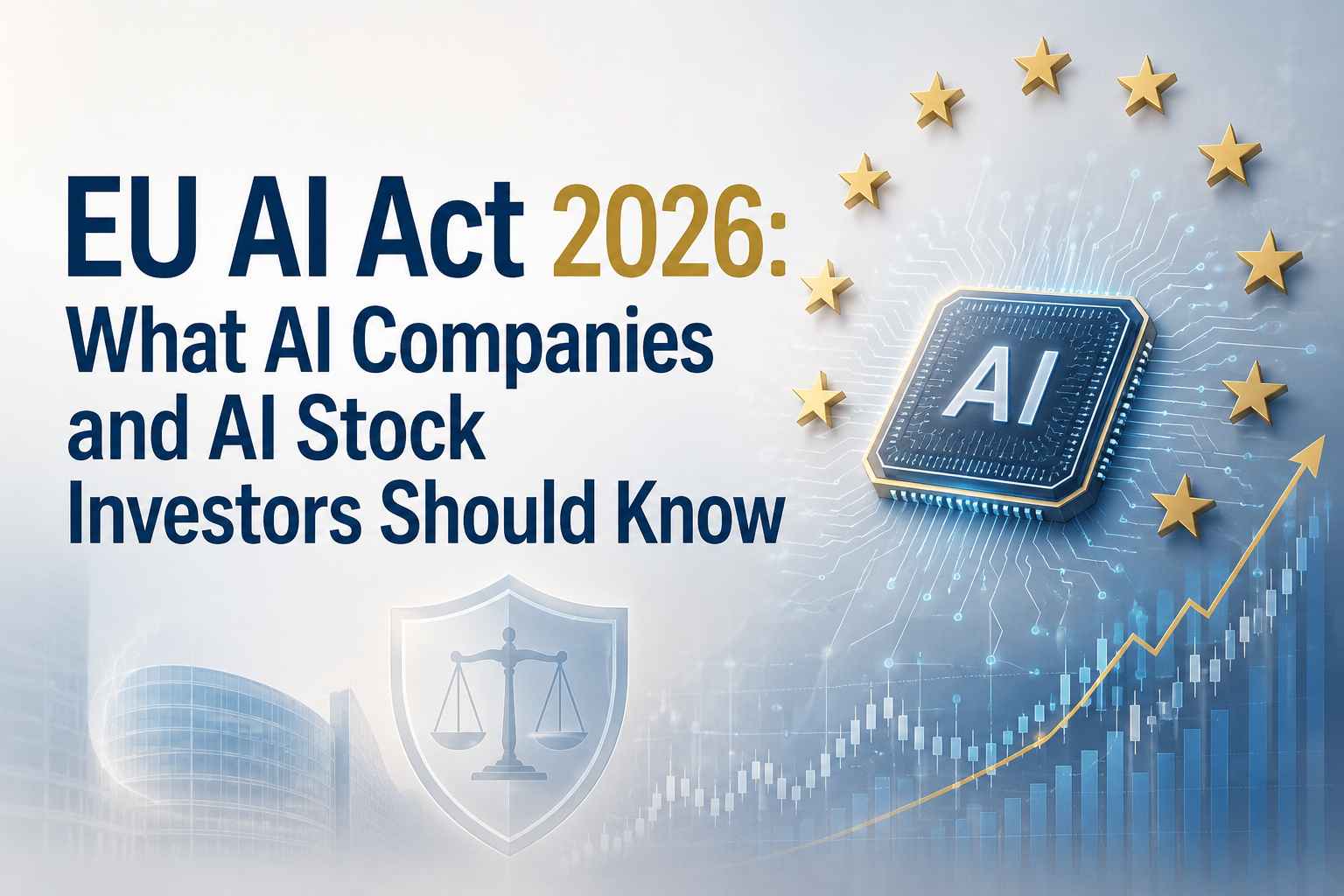
For AI companies and AI stock investors, the key issue is practical: how compliance, transparency and model governance may shape the cost and pace of scaling AI in Europe. The Act phases in over several years rather than switching on all at once, so it is a framework to prepare for, not a direct trading signal.
The EU AI Act rolls out in phases, with a major milestone on 2 August 2026 and further obligations arriving later [1][2].
It uses a risk-based structure rather than treating every AI tool the same way, with four broad risk levels [1].
AI companies may need to prepare for documentation, transparency, copyright, governance and risk-management requirements.
General-purpose AI (GPAI) and foundation model providers face specific obligations, with additional requirements for models judged to carry systemic risk [3].
For AI stock investors, the Act is relevant indirectly, through compliance costs, rollout timing, enterprise trust and margin visibility, not as a buy or sell signal.
The EU AI Act is a legal framework for AI systems and models placed on the EU market or used within the European Union, regardless of where the provider is based [1]. Its scope is defined by where a product is offered and used, not solely by where a company is headquartered, which is why it draws attention from AI developers worldwide.
Rather than regulating the technology in the abstract, the Act focuses more heavily on how AI is applied. Systems that could affect health, safety, fundamental rights, essential services or major life outcomes carry more detailed obligations, while lower-impact tools face lighter requirements [1].
The framework also assigns responsibilities across the supply chain, covering providers who develop AI, deployers who use it, and importers and distributors who bring it to market, with the heaviest obligations generally falling on providers. This layered design is central to understanding why the Act affects some businesses far more than others.
The Act did not switch on all at once. It follows a staggered timeline set out when the law took effect, which helps explain what companies should already have addressed and what still needs attention [2].
1 August 2024: The AI Act entered into force, starting the countdown for all later deadlines [1][2].
2 February 2025: Rules on prohibited AI practices and AI literacy obligations began to apply [1][2].
2 August 2025: Obligations for providers of general-purpose AI models began to apply [3].
2 August 2026: A major phase of the Act applies, and the Commission’s enforcement powers over GPAI providers enter into application [2][5].
2 August 2027 and later: Some general-purpose AI models already on the market before 2 August 2025 have until this date to comply [5].
The timeline for certain high-risk systems has been adjusted through the “Digital Omnibus” simplification package, which links parts of the high-risk regime to the readiness of supporting technical standards [6].
Under those adjustments, obligations for some use-based high-risk systems are scheduled for 2 December 2027, and certain AI embedded in products under specific EU harmonisation legislation moves to 2 August 2028 [6]. The practical point for readers is that 2026 is a meaningful milestone, but not a single hard cutoff, since different obligations arrive on different dates.
The Act’s structure rests on four broad categories of risk, each carrying a different level of obligation [1]. In plain terms:
Unacceptable risk: a limited set of banned uses considered a clear threat to rights or safety. These are prohibited from the EU market.
High risk: permitted, but tied to sensitive or consequential uses. These carry detailed governance, testing, documentation, human oversight and monitoring.
Transparency (limited) risk: systems people interact with, or that generate content. Here the main duty is disclosure, so users know they are dealing with AI or AI-generated content.
Minimal or no risk: the majority of everyday AI tools, which face light or no specific obligations.
Most AI systems in everyday use fall into the minimal-risk category and face few specific requirements. The framework is designed so that scrutiny scales with potential impact, which is why the same rulebook can apply to a spam filter and a credit-scoring tool while asking very different things of each [1].
For companies building or deploying AI in Europe, the Act translates into a set of internal practices rather than a single checkbox. Depending on the systems involved, businesses may need stronger technical documentation, clearer data governance, user-facing transparency, ongoing risk monitoring, cybersecurity measures, copyright processes and defined internal compliance workflows.
 These requirements could influence operating costs and product rollout timelines, particularly for companies selling AI into Europe or using it in sensitive sectors.
Preparing documentation, running conformity checks and building governance processes takes time and resources, which is one reason larger providers with established compliance teams may absorb the work differently than smaller firms. None of this makes AI unusable in Europe; it changes the groundwork required before certain systems reach the market.
General-purpose AI models, the large foundation models that can perform many tasks and be built into countless downstream products, receive dedicated treatment under the Act [3].
Providers of these models face baseline obligations that include maintaining technical documentation, giving information to downstream developers who integrate the model, establishing a policy to respect EU copyright law, and publishing a sufficiently detailed summary of the content used for training [3][5].
Models judged to carry systemic risk, broadly the most capable or most widely used, face additional obligations such as model evaluation, risk assessment and mitigation, serious-incident reporting and cybersecurity protections [3].
High-risk AI is where obligations become most demanding, and it is worth being precise about what that label means. High risk does not mean banned. It means a system is allowed but subject to stricter governance, testing, documentation, human oversight and ongoing monitoring [1][6].
The categories generally involve AI used in consequential contexts, for example employment and recruitment, education, access to credit and essential services, critical infrastructure, public administration, migration, and certain law-enforcement uses [6].
Commission guidance clarifies that a system’s classification depends on its intended purpose as reflected in how it is marketed and documented, not simply on how terms of service are worded [6]. For businesses operating in these areas, the practical effect is more upfront work to show that a system is safe, well-documented and properly overseen.
The AI Act is not a trading signal. It won’t tell anyone whether to own an AI stock, and it doesn’t reward or punish share prices on its own. What it does is nudge the inputs that sit underneath a valuation:
Cost. Legal review, safety testing, documentation and monitoring land in the operating expense line, and for high-risk systems that spending tends to be recurring rather than one-off.
Timing. If a product needs more review before it can ship in Europe, revenue can slide from one quarter into a later one, changing the shape of a growth curve even when the destination is the same.
Adoption. Enterprise buyers in regulated industries often want legal clarity before they commit, so a credible compliance story can be less a cost than a reason a customer signs at all.
The question is less whether regulation exists, since it applies to everyone selling into Europe, than who can absorb the work without denting margins. That tends to cut along size.
A large platform can spread a compliance team and its fixed costs across a big revenue base, so the drag barely registers per dollar earned. A smaller company faces broadly the same rules against far less revenue, so it can weigh more heavily on cash and slow the path to scale. Treated this way, the Act is one input into margin and growth assumptions, not a standalone catalyst.
The clearest impact is on foundation-model developers such as OpenAI, Google (Alphabet), Anthropic and Meta, as GPAI rules apply directly to them [3]. Cloud and enterprise platforms like Microsoft, Amazon (AWS), Salesforce and Oracle may also be affected because they distribute AI through APIs and copilots.
Fintech (e.g. PayPal, Block), HR tech (Workday, LinkedIn) and education platforms (Duolingo, Coursera) face more scrutiny where AI influences decisions like hiring, credit or assessment. Healthcare software providers such as Tempus or Siemens Healthineers may also sit closer to high-risk use cases.
On the other side, cybersecurity and governance tools like Palo Alto Networks, CrowdStrike and ServiceNow could benefit as demand grows for AI monitoring, compliance and audit systems. The overall impact varies by use case, so exposure is best assessed company by company.
Yes. The AI Act entered into force on 1 August 2024, but its obligations apply in phases [1][2]. Some prohibited practices and AI literacy rules began applying in February 2025, general-purpose AI obligations began applying in August 2025, and a major phase of the Act applies from 2 August 2026, with certain high-risk obligations arriving later [1][2][3].
No. The Act bans a limited set of unacceptable-risk practices, but most AI systems are allowed if they follow the relevant rules [1]. It uses a risk-based framework, with stricter requirements reserved for systems that carry higher potential impact.
Yes, if their AI systems or models are placed on the EU market or used in the EU [1]. The practical issue is market access and use within Europe, not only where a company is headquartered.
It may affect AI companies through compliance costs, rollout timing, enterprise trust, risk controls and margin expectations. It is not a standalone trading signal, but it is a relevant sector-risk factor for AI, cloud, software and fintech stocks.
The EU AI Act 2026 is best understood as neither a simple legal update nor a trading signal. It is a business framework that makes governance, documentation, transparency and risk controls part of how AI companies operate in Europe, phased in over several years so that different obligations land on different dates [1][2].
For the market, it adds one more factor to weigh when evaluating AI stocks: not only model performance and revenue growth, but also regulatory readiness and compliance capacity. The practical takeaway is straightforward. Treat the Act as part of the operating environment for AI in Europe, and watch how individual companies adapt to it rather than expecting a single, uniform market effect.
European Commission AI Act (Regulatory framework on Artificial Intelligence), Shaping Europe’s Digital Future.
https://digital-strategy.ec.europa.eu/en/policies/regulatory-framework-ai
European Commission - Navigating the AI Act (FAQ / timeline), Shaping Europe’s Digital Future.
https://digital-strategy.ec.europa.eu/en/faqs/navigating-ai-act
European Commission - General-purpose AI obligations under the AI Act, Shaping Europe’s Digital Future.
https://digital-strategy.ec.europa.eu/en/factpages/general-purpose-ai-obligations-under-ai-act
European Commission - The General-Purpose AI Code of Practice, Shaping Europe’s Digital Future.
https://digital-strategy.ec.europa.eu/en/policies/contents-code-gpai
European Commission - Guidelines for providers of general-purpose AI models, Shaping Europe’s Digital Future.
https://digital-strategy.ec.europa.eu/en/policies/guidelines-gpai-providers
European Commission - Guidelines for providers and deployers of AI high-risk systems, Shaping Europe’s Digital Future.
https://digital-strategy.ec.europa.eu/en/policies/guidelines-ai-high-risk-systems