Published on: 2026-05-07
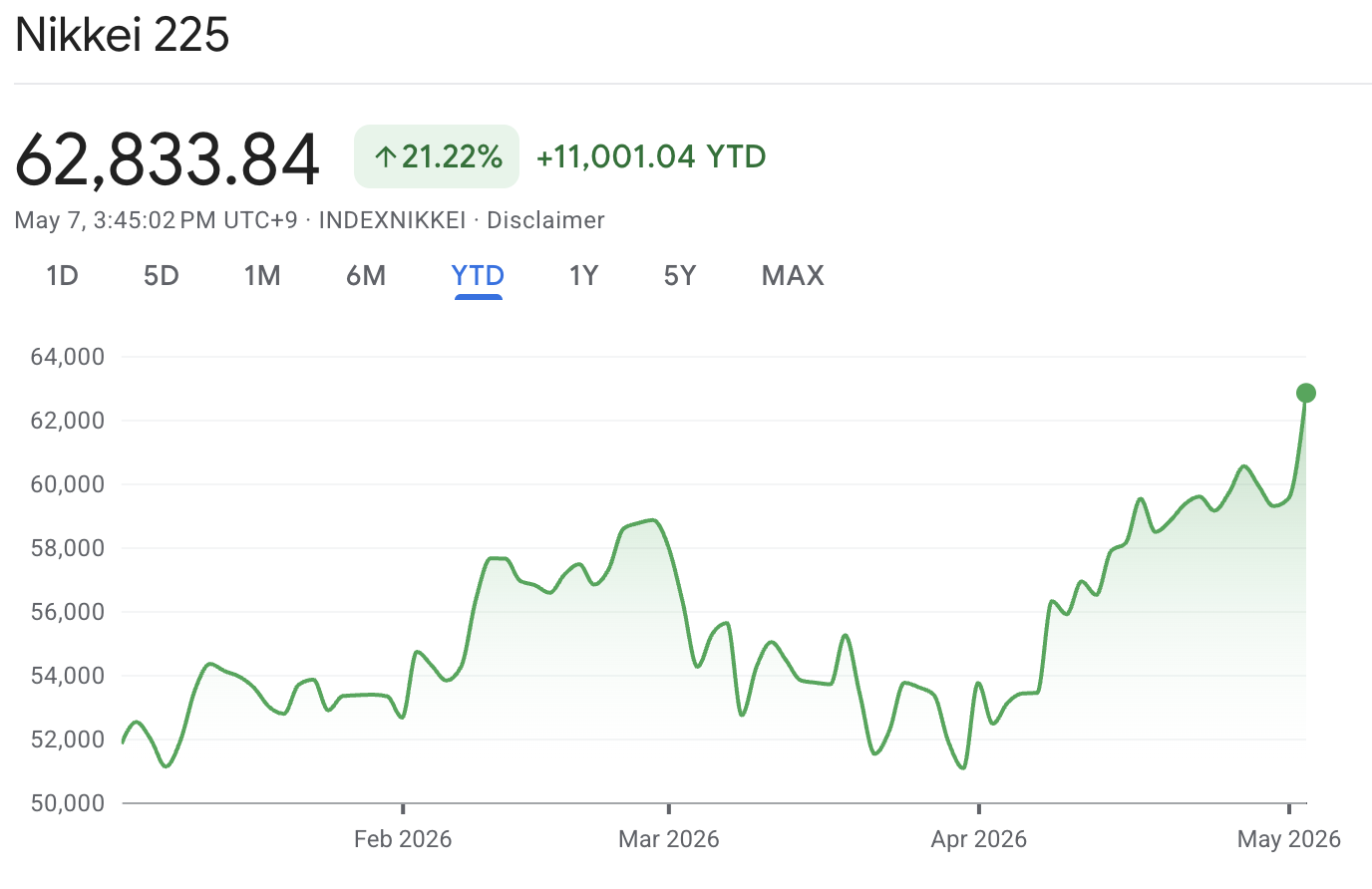
The Nikkei 225 posted its largest single-day point gain on record and one of its strongest percentage gains of the year today, rising 3,320.74 points, or 5.58%, to close at 62,833.84. The move came as Japan reopened after the Golden Week holiday break, pushing the benchmark into fresh all-time-high territory.

The rally was not a simple reopening bounce. It reflected a compressed post-holiday repricing, stronger global risk appetite, lower perceived stress around oil supply, and aggressive buying in Japan’s semiconductor and AI-linked shares.
The index briefly traded above 63,000, confirming a sharp momentum breakout after several days of delayed price discovery.
The Nikkei 225 closed at 62,833.84, gaining 3,320.74 points, or 5.58%.
The index briefly moved above 63,000, marking a fresh record zone.
Japan reopened after Golden Week, forcing the market to absorb several global sessions at once.
Semiconductor, chip-equipment, and AI-linked shares led the advance.
Improved global risk appetite supported high-beta Asian equities.
The speed of the rally raises short-term profit-taking risk near record highs.
Japan’s equity market had been closed for part of Golden Week while global risk assets moved higher. When Tokyo reopened, delayed orders hit a market already positioned for upside.
This created a compressed move. Instead of pricing global developments gradually over several sessions, Japanese equities absorbed them in one trading day. Index futures, foreign orders, and domestic institutional flows all moved in the same direction, amplifying the breakout.
The holiday effect was important, but it was not the full story. The Nikkei was already supported by strong technology demand, corporate reform expectations, and persistent foreign interest in Japanese equities.
| Indicator | Latest Signal | Market Read |
|---|---|---|
| Nikkei 225 close | 62,833.84 | Fresh all-time-high close after post-holiday rally |
| Daily point gain | +3,320.74 | Largest single-day point gain on record |
| Daily percentage move | +5.58% | One of the strongest percentage gains of the year |
| Intraday zone | Above 63,000 | Momentum buying accelerated after reopening |
| Main leadership | AI and semiconductor shares | Technology concentration amplified index gains |
| Key short-term risk | Profit-taking | A vertical rally may require consolidation |
The strongest buying came from Japan’s high-tech and semiconductor complex. Chip-equipment makers, testing-equipment firms, automation companies, and AI infrastructure names attracted fresh capital as global enthusiasm for artificial intelligence remained intact.
This has a powerful effect on the Nikkei because the index is price-weighted. High-priced technology shares can exert a larger influence on index direction than they would in a market-cap weighted benchmark. When Japan’s semiconductor leaders rally together, the Nikkei can move faster than the broader market.
Japan remains a key equity expression of the AI infrastructure cycle. Its listed companies supply chipmaking tools, precision components, testing systems, sensors, industrial robots, and automation equipment. As AI capital expenditure expands, these firms continue to sit close to the hardware layer of the trade.
The macro backdrop also helped. Asian equities advanced as markets priced in a lower probability of severe disruption in Middle East energy flows. For Japan, this is especially important because the country imports most of its energy.
Lower oil-risk premiums can support corporate margins, reduce pressure on the trade balance, and ease inflation concerns. The more important impact for the Nikkei was sentiment. A calmer energy backdrop allowed capital to rotate back into growth and technology shares.
The rally also followed strength in U.S. technology shares. Momentum in the Nasdaq and broader U.S. equity market provided a strong external signal for Asian technology exposure.
Japanese semiconductor stocks often react quickly to U.S. chip demand, AI spending expectations, and global hardware cycles. When U.S. technology sentiment improves, Tokyo’s chip-equipment sector tends to receive follow-through buying.
The constructive case for Japanese equities remains supported by three pillars: AI demand, corporate reform, and foreign capital inflows. Japan has benefited from stronger shareholder returns, improved governance standards, and a long-running shift toward more capital-efficient corporate behaviour.
AI exposure adds another layer. Japan is not only a domestic recovery story. It is also a global hardware and manufacturing story, linked to semiconductor equipment, automation, robotics, power systems, and precision industrial supply chains.
Currency conditions remain important. A weaker yen has helped exporters in recent years by lifting overseas earnings translation. However, extreme currency volatility can also raise policy risk. A stable yen would be the cleaner backdrop for the next stage of the rally.
The main risk is short-term exhaustion. A 5% to 6% index rally in one session can trigger profit-taking, especially when the move follows a holiday gap rather than a gradual accumulation phase.
Three risks stand out. A renewed rise in oil prices would pressure Japan’s energy-sensitive economy. Yen strength could weigh on exporters. A pullback in U.S. technology shares could hit Japan’s semiconductor leaders quickly because the rally remains heavily linked to AI sentiment.
Yen movement: A stronger yen can pressure exporters and reduce overseas earnings translation.
Semiconductor shares: Chip-equipment, testing, and automation names remain key sentiment gauges.
Oil and Middle East headlines: Japan’s energy import profile makes oil-risk premiums important.
U.S. tech momentum: Nasdaq strength continues to feed Japan’s AI-linked equity trade.
Profit-taking near 63,000: The Nikkei may need consolidation after such a sharp breakout.
The Nikkei 225 closed at a fresh all-time high after briefly trading above 63,000, posting its largest single-day point gain on record.
The rally was a post-holiday repricing amplified by AI enthusiasm, semiconductor strength, and improved global risk appetite. The index did not rise simply because Japan reopened. It surged because several bullish catalysts arrived at the same time.
The broader trend remains constructive, but the speed of the move leaves the market vulnerable to short-term consolidation. For now, Japan remains one of the clearest equity expressions of the global AI trade, with the Nikkei breaking into record territory as capital rotates back into high-beta Asian technology exposure.