Published on: 2026-07-31
Updated on: 2026-07-31
The KOSPI jumped as much as 17.07% on Friday after falling nearly 17% across the previous three sessions, with Samsung Electronics and SK Hynix reversing from the centre of the sell-off to lead the rebound. Wall Street’s chip rally brought foreign money back into Seoul, while position-closing likely amplified the move through Korea’s two largest semiconductor stocks.
Friday’s close and Monday’s session will show whether demand remains once the first wave of forced buying fades.
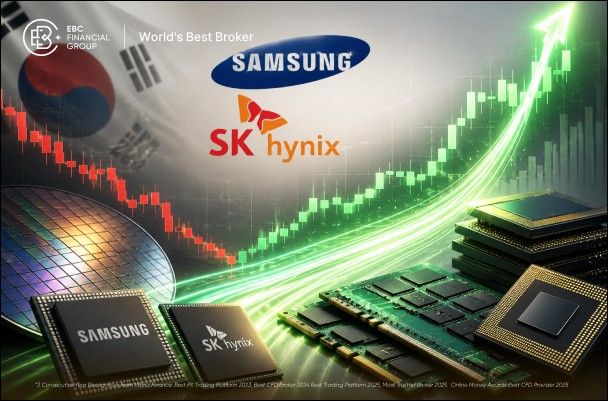
The KOSPI reached 6,548.64, up 17.07% from Thursday’s close, yet remained about 28% below its June record.
Samsung Electronics and SK Hynix gained more than 20% after U.S. semiconductor shares rose 8%, tying the reversal to renewed confidence in global AI demand.
Foreign net buying reached about ₩4.48 trillion during the morning, showing that overseas capital rather than domestic retail demand supplied much of the rebound.
China’s memory expansion and elevated chip expectations remain the two risks Friday’s surge has not resolved.
The KOSPI rebound began after the Philadelphia Semiconductor Index rose 8% and the Nasdaq gained 2.8%. Microsoft’s annual Azure revenue passed $100 billion with 41% growth, strengthening the case that heavy AI spending is still producing commercial demand rather than only higher infrastructure costs.
Korean memory shares reacted immediately because they sit inside the same AI supply chain. Samsung expects server DRAM, enterprise SSD and HBM demand to accelerate through the second half, while SK Hynix has started mass shipments of HBM4 and secured long-term agreements with about ten major customers.
Samsung Electronics and SK Hynix had fallen hardest during the crash, making them the fastest route back into Korean AI exposure when U.S. chip sentiment turned.
Foreign net purchases reached about ₩4.48 trillion during the morning as Samsung Electronics and SK Hynix gained more than 20%. Their combined index weight meant the same two stocks that drove the sell-off could lift the entire KOSPI once capital returned.
Rising prices also increased pressure on positions built around further declines, adding demand to the rebound. Korea’s widespread use of margin borrowing and leveraged semiconductor products had already intensified the earlier sell-off, leaving the market vulnerable to an equally sharp reversal.
At 9:06 a.m., the Korea Exchange activated a buy-side sidecar after KOSPI 200 futures rose at least 5% for one minute. Program buy orders paused for five minutes while regular trading continued, showing how quickly the reversal had spread through the market.
A record profit can still disappoint when the share price assumes an even stronger result.
SK Hynix reported ₩60.54 trillion in quarterly operating profit and a 76% margin, yet its shares fell because expectations had risen faster than the reported numbers. The sell-off reflected an expensive valuation meeting a result that was exceptional, but no longer surprising.
Samsung’s memory business delivered another record quarter, expanded HBM4 sales and shipped HBM4E samples to major customers. Demand remained strong even as share prices collapsed.
Friday’s rebound showed that the earlier selling had gone beyond weakness in the actual businesses. It did not remove the risk that future earnings may again struggle to justify elevated chip valuations.
CXMT can hurt standard DRAM pricing before it challenges Samsung Electronics or SK Hynix in advanced HBM.
The Chinese producer accounted for about 9% of global DRAM shipments in early 2026, with its share projected to reach 11% by 2028. More capacity would increase supply in conventional memory and place pressure on prices and margins across the industry.
Advanced HBM remains a harder market to enter. Restricted access to leading chipmaking tools, production bottlenecks and customer qualification still protect the Korean chipmakers’ lead in AI memory. CXMT therefore represents a near-term pricing threat in DRAM and a longer-term competitive threat in HBM.
Friday’s rebound restored confidence in demand, not immunity from Chinese expansion.
The 17.07% intraday rise recovered only part of the larger decline. Even at Friday’s high, the KOSPI remained about 28% below its June 22 closing record of 9,114.55, leaving most of the fall from the peak intact.
Four signals will show whether the rebound attracted lasting demand or mainly forced losing positions to close.
| Signal | Recovery case | Warning sign |
|---|---|---|
| Foreign flows | Buying continues Monday | Friday inflow reverses |
| Chip shares | Most gains hold | Late selling accelerates |
| Market breadth | Other sectors join | Rally remains chip-led |
| Korean won | Stable or stronger | Depreciation resumes |
Foreign buying is the clearest test. Demand that survives Friday’s profit-taking and continues on Monday would give the rebound greater credibility. A rapid reversal would show that much of the surge came from positions being closed rather than new capital staying in the market.
A buy-side sidecar pauses program buy orders for five minutes after KOSPI 200 futures rise at least 5% for one minute. Regular trading continues, so the measure is not a full market halt or a broad circuit breaker.
Not yet. Even at Friday’s intraday high, the KOSPI remained about 28% below its June 22 closing record. A rebound of this scale still needs follow-through before it qualifies as a durable recovery.
Not immediately. CXMT poses a nearer-term threat to conventional DRAM prices, while advanced HBM still requires difficult production yields, complex packaging and customer qualification. Chinese expansion can pressure Korean memory margins before CXMT reaches technological parity in HBM.
At Friday’s intraday high, the KOSPI recovered about 27% of the index-point loss between its June 22 record and Thursday’s close. The index still stood roughly 28% below the peak because a large percentage decline requires a much larger gain to reverse fully.
Friday delivered the reversal. Monday will show whether the demand behind it can survive a calmer market. The rebound becomes a recovery when demand persists without the volatility that created it.