Published on: 2026-09-14
Updated on: 2026-09-14
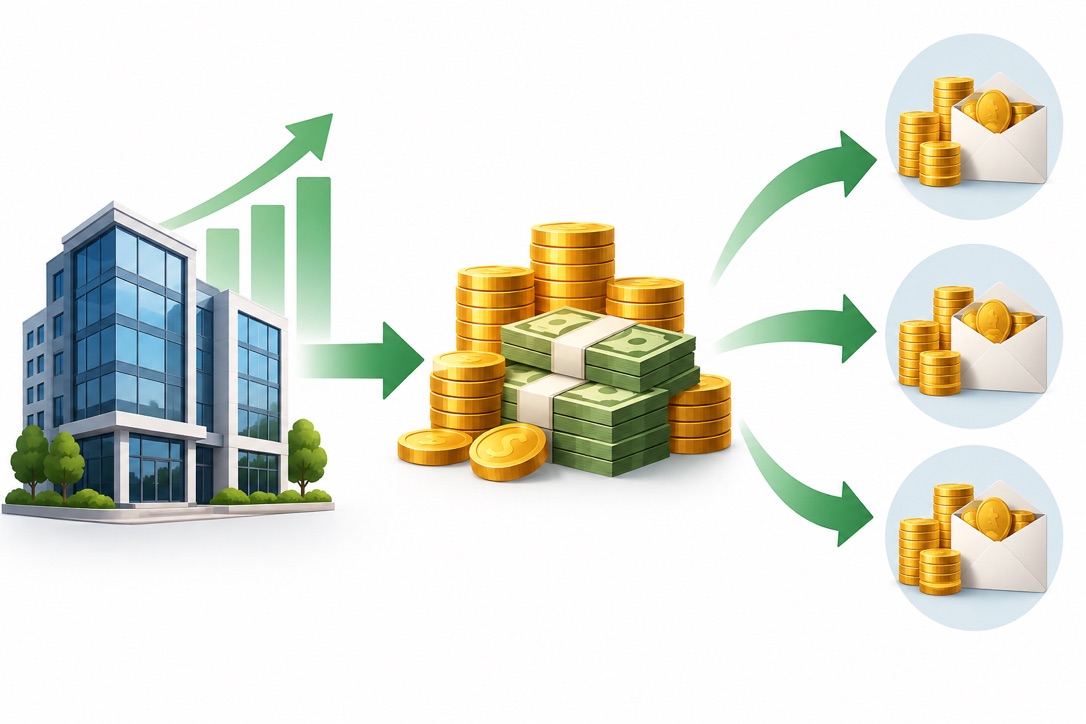
When a company pays a dividend, the cash appearing in a shareholder’s account has to come from somewhere. In most cases, it begins with money generated by the company’s ordinary business activities, although accumulated cash, asset sales and other sources can occasionally support distributions.
Understanding that journey helps investors judge whether a dividend reflects healthy cash generation or a payment that may become difficult to maintain.
Dividend payments are normally funded by cash generated through a company’s underlying business.
Accounting profit and available cash are not the same, so strong earnings do not automatically guarantee a dividend.
Free cash flow helps show how much financial capacity remains after a company funds its operations and capital spending.
Companies must balance dividends against debt repayment, expansion, acquisitions, share buybacks and other uses of capital.
Cash reserves or one-off transactions can support dividends temporarily, but recurring distributions are generally stronger when backed by recurring cash generation.
The starting point is the business itself.
Customers buy products or services, creating revenue for the company. A supermarket collects money from shoppers, a software company earns subscription fees, a manufacturer sells equipment and a bank generates income from lending and financial services.
Revenue, however, is only the beginning.
Companies also have expenses. They must pay employees, suppliers, landlords, lenders, governments and numerous other parties involved in running the business. Some money may also be required to purchase equipment, maintain factories or invest in future growth.
Whatever remains after these obligations contributes to the financial resources available to the company.
A portion of those resources may eventually be returned to shareholders through dividends.
This is why dividends should not be viewed as money generated separately from the company. The payment ultimately represents corporate resources being transferred from the business to its owners.
But revenue and reported profit alone cannot tell investors how much cash is actually available.
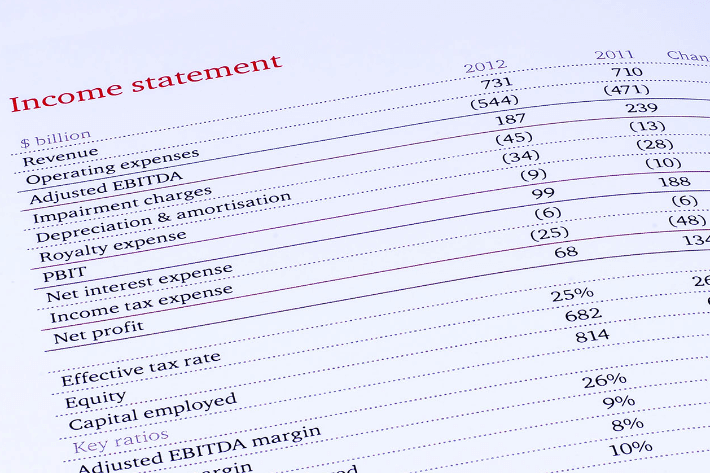
Companies usually report profit through their income statements, but accounting profit is different from cash sitting in a bank account.
Consider a business that sells $10 million worth of products during the year. If some customers have not yet paid their invoices, the company may record revenue before all of the corresponding cash has been collected.
Expenses can also create differences between profit and cash flow.
Depreciation, for example, reduces reported earnings without representing a fresh cash payment during that period. Meanwhile, increases in inventory or money owed by customers can absorb cash even when the company remains profitable on paper.
This creates an important distinction for dividend investors:
Companies report earnings, but dividends ultimately require cash.
A business could therefore report healthy net income while having relatively little cash available for distribution. Another company may temporarily report weaker earnings while still producing substantial cash from its operations.
For this reason, investors often look beyond net profit when evaluating the financial resources supporting dividends.
One of the most useful measures is free cash flow.
A simplified calculation is:
Operating cash flow − capital expenditure = free cash flow
Operating cash flow reflects cash generated through the company’s main business activities. Capital expenditure represents money spent on assets such as equipment, factories, technology or infrastructure.
Suppose a company produces the following results:
| Cash-flow item | Amount |
|---|---|
| Operating cash flow | $5 billion |
| Capital expenditure | $2 billion |
| Free cash flow | $3 billion |
The company has generated $3 billion after funding those capital investments.
If it subsequently distributes $1 billion in dividends, the payment appears comfortably below the free cash flow generated during the period.
Free cash flow should not be interpreted as a dedicated pool reserved for shareholders. Management still has several choices for using it.
A manufacturing company may build another factory. A telecom operator may upgrade its network. A retailer could open new stores. A company with heavy borrowings might prefer to reduce debt.
Dividends compete with all of those uses for the same corporate resources.
Even highly profitable companies rarely distribute every available dollar.
Businesses need financial flexibility. Economic conditions can deteriorate, equipment may need replacing and opportunities for expansion can emerge unexpectedly.
Companies can use available capital to:
invest in new products or facilities;
repay outstanding debt;
acquire other businesses;
repurchase their own shares;
build cash reserves;
meet future operating requirements;
pay dividends.
The decision therefore becomes one of capital allocation.
A company with attractive expansion opportunities may decide that reinvesting cash can create more value over time than distributing it immediately. Another business with mature operations and fewer opportunities for rapid expansion may return a greater proportion of its cash to shareholders.
Retained earnings are sometimes misunderstood in this discussion.
They represent accumulated profits that have remained within the company from an accounting perspective. They should not be treated as a cash account waiting to be paid out.
A business may have large retained earnings while holding much less cash because previous profits have already been used to purchase factories, inventory, technology, investments or other assets.
A company’s ability to distribute money therefore depends on its wider financial position rather than a single number on the balance sheet.
Yes.
A company does not necessarily need to fund every dividend solely from cash produced during the latest reporting period.
Businesses sometimes accumulate large amounts of cash during profitable years. Those reserves can give the company flexibility to maintain dividends when current cash generation temporarily weakens.
Using reserves for a limited period is not automatically concerning. Persistent depletion, however, eventually reduces the company’s financial cushion.
Selling property, investments or a business division can produce substantial cash.
Management may decide that part of those proceeds should be returned to shareholders, particularly when the company no longer has an immediate use for the capital.
Because asset sales are usually non-recurring, they should not be confused with ordinary operating cash generation.
Large disposals, restructurings or other corporate events can occasionally lead to special distributions.
These payments may be considerably larger than the company’s normal dividend and should generally be evaluated separately from recurring shareholder distributions.
A company can also borrow money while continuing to pay dividends.
That does not necessarily mean a specific dividend dollar can be traced directly to a specific loan, because corporate cash is generally managed collectively. Still, a company consistently paying more cash to shareholders than it generates may eventually depend on additional borrowing or declining cash reserves.
The key distinction is between being able to fund a dividend temporarily and being able to sustain it over many years.
Dividend analysis should therefore focus on the financial resources behind the payment.
One common measure is the earnings payout ratio, which compares dividends with company earnings.
At the company level:
Total dividends ÷ net income
If a business earns $1 billion and distributes $400 million, its payout ratio is 40%.
Investors can also examine the free-cash-flow payout ratio, which compares dividend payments with free cash flow. This can help show whether distributions are being supported by the cash left after capital spending.
Other areas deserve attention as well.
Cash reserves: A strong balance sheet can give management more room to withstand temporary weakness.
Debt: Companies with substantial debt may need to prioritise interest payments and repayments before returning additional capital.
Cash-flow stability: Predictable businesses generally have greater visibility over future distributions than companies whose revenues and profits fluctuate sharply.
No single payout ratio should be treated as universally safe. Capital needs differ considerably between industries.
The economics of the underlying business strongly influence dividend policy.
| Business characteristic | Typical implication |
|---|---|
| Mature and cash-generative | Greater capacity to distribute cash |
| Rapidly expanding | More capital may be retained |
| Capital-intensive | More cash required for investment |
| Highly cyclical | Dividend capacity may fluctuate |
| Heavily indebted | Debt obligations reduce flexibility |
A mature company with established operations may generate more cash than it can profitably reinvest each year. Returning part of that excess capital can therefore be reasonable.
A rapidly growing company may face the opposite situation. Management might see opportunities to invest heavily in new markets, technology or production capacity and therefore choose to retain most of the cash generated.
Neither approach automatically makes one company superior to the other. Investors need to consider how effectively management uses the capital that remains inside the business.
A large dividend should not automatically be interpreted as evidence of financial strength.
It could reflect excellent recurring cash generation, but other explanations are possible.
The company may have fewer attractive growth opportunities. It may be distributing proceeds from an asset sale. Profits may have temporarily surged during a favourable industry cycle, or management may simply be adopting an aggressive payout policy.
Likewise, a business paying little or no dividend can still be highly profitable.
If management can reinvest retained cash at attractive returns, shareholders may benefit more from business growth than from receiving the money immediately.
The useful question is therefore not simply “How large is the dividend?”
Investors should ask:
Why can the company afford to pay it, and where is the money coming from?
Once a dividend has been authorised and paid, the economic transaction is relatively clear.
Cash leaves the company and moves to eligible shareholders.
That produces several consequences:
the company’s cash balance falls;
total corporate assets decline by the amount distributed, all else equal;
shareholders receive the cash personally;
the business retains less capital for other purposes.
A dividend therefore does not create money from nothing.
Before the distribution, the cash belongs to the company and contributes to the value of the business. After the payment, that portion of cash belongs directly to shareholders.
Market prices can move for many reasons, but the economic transfer itself remains the same.
The path behind a normal cash dividend can be summarised as:
Business activity → cash generation → investment requirements → available capital → board decision → shareholder payment
Following that path gives investors a much clearer picture than looking at the dividend amount alone.
A company regularly producing enough cash to fund its operations, invest in the business, meet financial obligations and still distribute money to shareholders is in a very different position from one maintaining payments through shrinking reserves, repeated asset sales or increasing debt.
For investors, the most useful question is therefore not merely how much a company pays.
Understanding where the dividend money actually comes from reveals whether the payment is supported by the underlying economics of the business and whether that source has a reasonable chance of continuing.