Published on: 2026-04-16
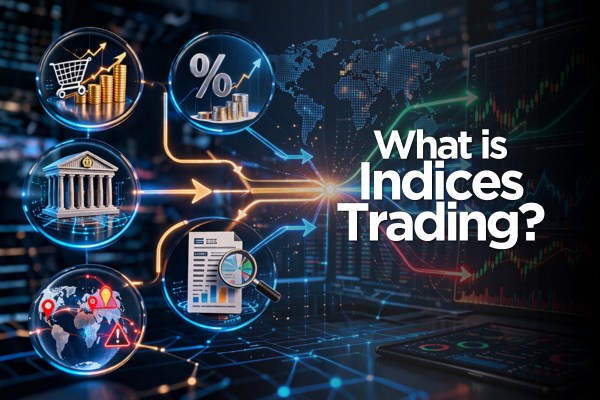
Indices trading refers to speculating on the price movements of stock market indices such as the S&P 500, Nasdaq 100, FTSE 100, DAX 40, and Nikkei 225 through financial instruments such as CFDs, ETFs, futures, and options. These indices represent baskets of listed companies and are widely used as benchmarks for tracking market performance across countries, sectors, and investment themes.
Rather than trading individual stocks, market participants gain exposure to a diversified segment of the equity market in a single position. This makes indices a core instrument for both short-term traders and long-term investors.
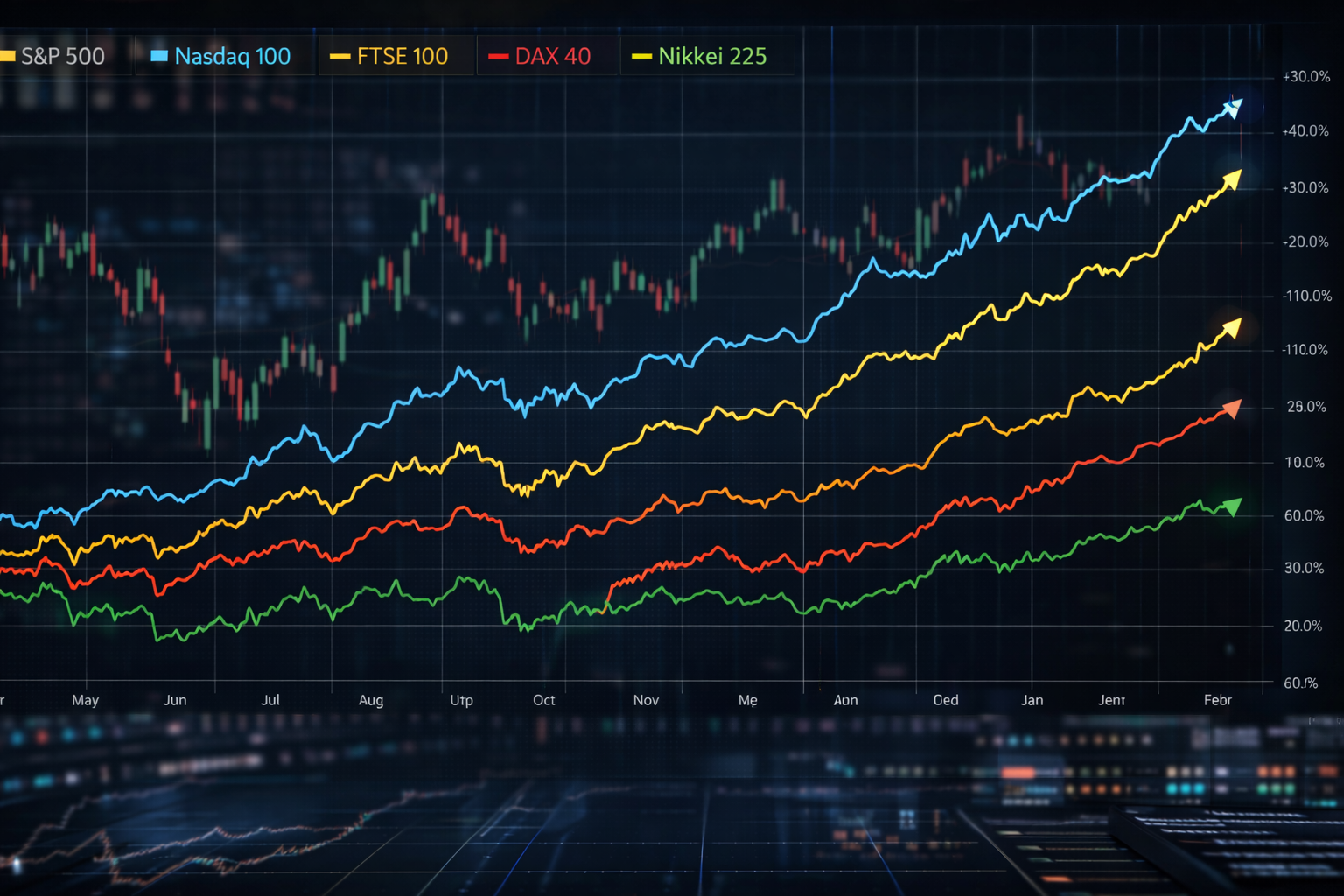
Indices trading provides exposure to a basket of stocks through a single instrument.
Indices are commonly classified into national, regional, sector, and thematic categories.
Trading is typically executed via CFDs, ETFs, futures, and options.
Index movements are driven by macroeconomic data, central banks, earnings, and sentiment.
Understanding index types helps traders identify market opportunities more effectively.
Indices trading involves taking a position on the price movement of a stock market index without owning the underlying shares. A stock index tracks the performance of a selected group of companies and is often weighted by market capitalisation, meaning larger companies have a greater impact on index movement.
For example:
The S&P 500 represents 500 of the largest publicly listed companies in the United States.
The FTSE 100 tracks the largest companies listed on the London Stock Exchange.
The Nasdaq 100 is heavily weighted toward technology and growth stocks.
If major US technology companies such as Microsoft, Apple, and Nvidia report strong earnings and their share prices rise, the Nasdaq 100 is likely to increase even if smaller companies in the index decline.
A trader may respond by:
Going long on Nasdaq 100 via a CFD or ETF if expecting continued momentum
Shorting the index if expecting macroeconomic headwinds or valuation pressure
This allows traders to express a broad market view rather than relying on a single stock outcome.
For example, brokers such as EBC Financial Group provide access to indices trading through instruments like CFDs, enabling traders to speculate on both rising and falling markets with flexible positioning.
Stock market indices are commonly grouped into four main categories based on what they represent: geography, sector exposure, regional coverage, and investment themes.
National indices track the performance of a single country’s stock market and are the most widely followed benchmarks.
Examples include:
S&P 500 (United States)
Nasdaq 100 (United States)
FTSE 100 (United Kingdom)
Nikkei 225 (Japan)
DAX 40 (Germany)
These indices are often used to gauge a country's economic and corporate performance.
Regional indices track equity performance across multiple countries within a geographic region.
Examples include:
Euro STOXX 50 (Eurozone blue-chip companies)
MSCI Asia Index (Asian equity markets)
MSCI World Index (developed global markets)
These indices are useful for understanding broader regional economic trends and cross-border capital flows.
Sector indices track companies within a specific industry or economic sector.
Examples include:
Technology indices (semiconductors, software, hardware)
Energy indices (oil, gas, renewables)
Healthcare indices (pharmaceuticals, biotech, medical devices)
Financial indices (banks, insurance, asset management)
Sector indices are commonly used by traders to express targeted views on industry performance rather than the overall market.
Thematic indices track long-term investment trends or structural themes rather than geography or industry classification.
Examples include:
ESG indices (environmental, social, governance-focused companies)
Artificial intelligence (AI) indices
Clean energy indices
Dividend-focused indices (e.g., dividend aristocrats)
Thematic indices are increasingly popular among investors seeking exposure to long-term structural growth narratives.
Indices are not directly bought or sold in their raw form. Instead, traders use financial instruments that replicate or derive value from index performance.
Trading hours vary depending on the underlying exchange and derivative market access. While cash markets operate during local exchange hours, derivatives such as futures and CFDs may extend trading availability.
CFDs and futures often allow extended trading hours, enabling traders to react to global macroeconomic news outside standard exchange sessions.
1. Macroeconomic Data: Inflation, GDP growth, employment data, and consumer confidence influence expectations about economic growth and corporate profitability.
2. Central Bank Policy: Interest rate decisions and forward guidance from central banks, such as the US Federal Reserve and the European Central Bank, directly impact equity valuations.
3. Corporate Earnings: Since indices are composed of large listed companies, earnings results from major constituents can significantly influence overall index performance.
4. Market Sentiment: Investor risk appetite and liquidity conditions often drive correlated movements across global equity indices.
5. Geopolitical Events: Trade tensions, geopolitical conflicts, and energy shocks can trigger broad market volatility and rapid repricing of risk assets.
Trend Following Strategy: Traders aim to capture sustained directional moves using indicators such as moving averages and momentum signals.
Breakout Strategy: Positions are taken when price breaks key support or resistance levels, often during high-impact news events or volatility spikes.
Range Trading Strategy: Used when indices trade within defined support and resistance levels, focusing on mean-reversion opportunities.
Swing Trading Strategy: Targets medium-term price movements driven by earnings cycles or macroeconomic shifts over several days or weeks.
Macro Trading Strategy: Based on macroeconomic expectations, including interest rate changes, inflation trends, and global liquidity conditions.
In 2026, global equity indices continue to reflect evolving macroeconomic conditions, including inflation normalisation, interest rate cycles, and structural growth trends such as artificial intelligence, digital transformation, and energy transition.
For example:
Strong earnings from major US technology companies can drive the Nasdaq 100 higher.
Broader economic resilience can support gains in the S&P 500.
European indices such as the DAX 40 may react strongly to industrial output and energy pricing trends.
A trader anticipating continued AI-driven growth may position long on Nasdaq 100 via ETFs or CFDs, while a trader expecting tightening financial conditions may adopt a defensive or hedging stance.
While indices offer diversification, they still carry significant trading risks.
Leverage Risk: CFDs and derivatives can amplify both profits and losses.
Market Volatility: Indices can experience rapid swings during macroeconomic events.
Systemic Risk: The entire equity market can decline during recessions or crises.
Gap Risk: Prices may open significantly higher or lower due to overnight news.
Liquidity and Spread Risk: Trading conditions may vary across instruments and brokers.
Effective risk management tools include stop-loss orders, position sizing, and diversification across asset classes.
Indices trading is the practice of speculating on the price performance of a specific basket of stocks that represent a particular market, sector, or theme. Instead of purchasing individual shares in a single company, a trader takes a position on the collective value of a group of companies. Because an index is a mathematical figure rather than a physical asset, participants typically gain exposure through financial derivatives, such as CFDs or Exchange-Traded Funds (ETFs).
The financial markets categorise indices based on the specific "universe" of stocks they are designed to track. National or benchmark indices monitor the largest companies within a specific country, such as the S&P 500 in the United States or the FTSE 100 in the UK. Regional indices track broader geographic areas, such as Europe or Asia, while sector-specific and thematic indices focus on particular industries, such as technology, or on specific investment trends, such as renewable energy.
The price of an index fluctuates with broad macroeconomic drivers that affect the collective health of its constituent companies. Key factors include national economic data such as GDP and inflation, as well as shifts in central bank interest rate policy. Furthermore, the overall index value is heavily influenced by corporate earnings reports from its largest members and by general changes in global investor sentiment regarding geopolitical stability.
Indices trading is accessible to beginners, provided they choose the financial instrument that best matches their experience level. Many new investors start with ETFs or index funds because these products offer a straightforward way to track market growth without the complexities of high-frequency trading. However, beginners should approach leveraged products like CFDs with caution, as these require a sophisticated understanding of volatility and a strict commitment to risk management.
Indices are widely considered a cornerstone of long-term investment strategies due to their inherent diversification. By spreading capital across an entire market or sector, an investor reduces the risk that the failure of a single company will devastate their entire portfolio. Historically, major benchmark indices have tended to appreciate over time in alignment with long-term economic growth, making them a preferred choice for wealth-building and retirement planning.
Indices trading provides a structured way to gain exposure to global equity markets through diversified benchmarks rather than individual stocks. By understanding index classifications, trading instruments, market drivers, and trading hours, traders can better interpret market behaviour and develop informed strategies. However, due to the use of leverage and derivatives, disciplined risk management remains essential.
Disclaimer: This material is for general information purposes only and is not intended as (and should not be considered to be) financial, investment or other advice on which reliance should be placed. No opinion given in the material constitutes a recommendation by EBC or the author that any particular investment, security, transaction or investment strategy is suitable for any specific person.