Published on: 2026-01-02
Updated on: 2026-01-02
Index trading is the practice of taking exposure to a broad market benchmark rather than to a single stock. That distinction changes everything. Indices are driven less by company-specific news and more by interest rates, earnings expectations, liquidity conditions, and shifts in risk appetite.
A profitable approach to how to trade indices is not built on a single indicator. It is built on choosing the right instrument for the holding period, understanding how index-linked products are priced, and applying a small set of strategies that fit the market regime. The goal is repeatability, not prediction.
An index is a published benchmark level. It cannot be bought or sold directly.
Trading an index means trading a product designed to track that benchmark, typically through futures, options, ETFs, or OTC derivatives such as CFDs. Different products can track the same benchmark with small but meaningful differences because of financing, dividends, and expiry mechanics.
The fastest way to improve results is to treat index trading as a process. The process starts with instrument selection, then pricing, strategy, risk, and execution.

The best instrument is the one that matches the intended holding period and risk control style. Many trading problems begin with a mismatch, such as using a short-term product for a long-term thesis.
Futures are standardised contracts with fixed expiries and deep liquidity in major benchmarks.
They are well-suited to active trading because they often have tight pricing and a clear market structure. Futures also embed carry effects and converge toward the cash index as expiry approaches, so understanding expiry and rollover is part of the craft.
Options are useful when the trade idea involves volatility, tail risk, or a defined downside.
Options demand stronger risk literacy than linear products. Time decay, implied volatility, and strike selection can dominate outcomes even when the direction is correct.
ETFs can be a simple way to express index exposure for medium- to long-term horizons.
They behave like cash market instruments. That simplicity can be a strength, especially for traders who want fewer moving parts, such as expiry cycles.
CFDs are OTC derivatives that typically mirror index price movements without an exchange-listed expiry.
They are often chosen for their flexible sizing and ease of access to multiple indices from a single account. The main practical point is holding costs. For many CFD structures, financing adjustments apply when a position is held past a daily cut-off, so they are generally more efficient for short-term trading than for long holds.
World’s Best brokers, including EBC Financial Group, provide index access through derivatives. The relevant question for any platform is not marketing. It is execution quality, cost transparency, and whether the product structure fits the intended holding period.
Index trading becomes clearer once pricing is understood. Many avoidable mistakes come from confusing the cash index level with a dated futures price.
A standard no-arbitrage framework for equity index futures links the futures price to the spot index, interest rates, expected dividends, and time to expiry. In continuous terms, a common expression is:
F = S × e^((r − q)T)
Here, S is the spot index level, r is the financing rate, q is the dividend yield, and T is the time to expiry.
This relationship explains why a futures contract can trade above or below the spot index without any “mispricing.” It often reflects financing costs versus expected dividends over the life of the contract.
For practical trading, this means chart selection matters. A cash-based chart and a futures-based chart can differ slightly over time. A trader should analyse and execute on the same reference price.
Indices respond to information that changes the market’s aggregate discount rate and earnings path.
The main drivers are:
Indices often reprice when markets change their expectations for the path of interest rates. The effect is usually stronger in indices with higher valuation sensitivity to the discount rate.
Over weeks and months, sustained index trends are commonly anchored in changes to forward earnings and margins.
Volatility clusters, meaning high-volatility periods tend to be followed by high-volatility periods, and calmer periods tend to persist. This feature is central to modern volatility modelling and is one reason volatility-sensitive risk controls work in practice.
Intraday volatility and volume are not constant. A widely documented pattern is that volatility tends to be higher near the open and close and lower in the middle of the session, which affects spreads, slippage, and the reliability of tight targets.
A strategy works when it can be executed consistently at realistic costs and has defined conditions for use. Indices are competitive markets, so the most durable approaches are usually simple and regime-aware.
Trend following aims to capture sustained directional moves driven by macro narratives and earnings re-rating cycles.
Academic evidence documents “time series momentum” across futures, including equity index futures, where an instrument’s own past returns can predict its future returns over horizons such as one to twelve months, with partial reversal at longer horizons.
A practical implementation uses a clear trend filter and a disciplined exit rule.
A workable rule-set looks like this:
Trend filter: Price above a medium-term moving average for long bias, below for short bias.
Entry: Breakout close above a multi-week level, or a pullback that holds above prior support in an uptrend.
Exit: Volatility-based trailing stop or a close back through the trend filter.
Best conditions: Persistent macro themes and stable leadership.
Failure mode: Choppy ranges that trigger repeated stop-outs.
Volatility scaling is not an entry technique. It is a survival technique.
Research on volatility-managed exposure finds that reducing risk when volatility is high and increasing it when volatility is low can improve risk-adjusted outcomes for broad market exposure.
This is how it can be applied in trading:
A simple method is:
Measure recent realised volatility or average true range.
Set a fixed cash risk per trade.
Size the position so the stop distance represents that fixed risk.
This prevents the most common index-trading failure: trading the same size in a calm and a stressed regime.
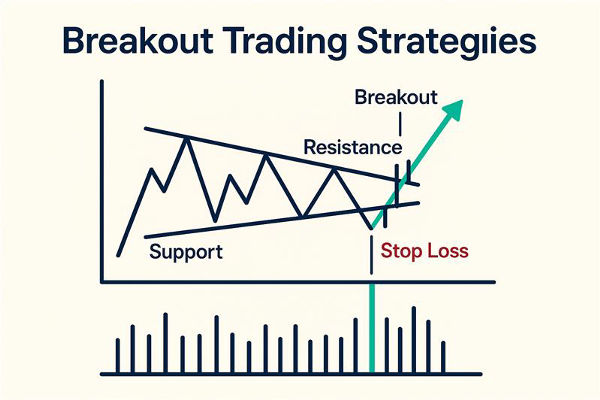
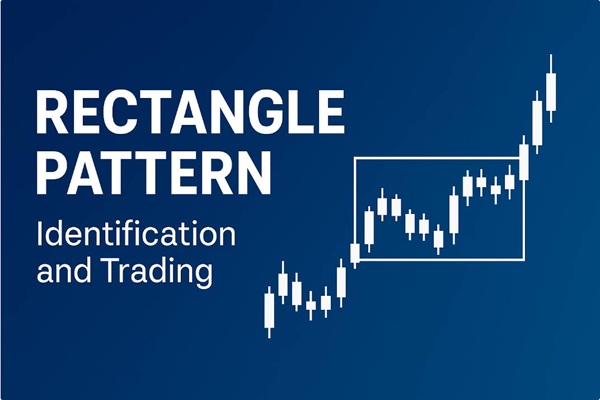
Breakout strategies work best when the market transitions from balance to imbalance.
The key is confirmation. Many breakouts fail because traders enter on the first spike, then get trapped when the price snaps back into the range.
A more robust breakout framework:
Require a clear consolidation range and a clean level.
Enter only after a close beyond the level and evidence of follow-through.
Place the stop where the breakout is invalidated, usually back inside the range.
Take partial profits into strength, then trail the rest with a volatility stop.
This strategy is strongest when there is a catalyst and rising participation supports the move.
Mean reversion aims to profit from overshoots that revert back toward a reference value.
In index markets, mean reversion is most reliable in stable-range regimes and least reliable during fast-repricing phases when trends accelerate.
A practical mean reversion setup:
Trade only when the index is clearly ranging on the timeframe that matters.
Wait for a failed breakout and a close back inside the range.
Take profit near the midpoint first, then consider the opposite side.
Use a hard stop beyond the range boundary.
The discipline is not the entry. The discipline is refusing to mean revert during trend days.
Opening moves can be powerful because liquidity and information flow concentrate at the start of the session.
However, the open is also where execution risk is highest. Spreads can widen, and slippage can increase. Intraday volatility patterns are often elevated near opens and closes, which is why open-based strategies must be designed around liquidity and fills, not just signals.
A professional way to use opening momentum:
Trade it only on days with a clear scheduled catalyst or strong pre-session imbalance.
Use a smaller size than normal because execution uncertainty is higher.
Require follow-through after the initial impulse, not just a level break.
Stop trading it when the market becomes gap-driven and unstable.
Indices can move quickly and gap around major events. A risk plan should assume that intended stop levels may not always be filled at the chosen price in fast conditions.
Risk rules should be written in advance and applied mechanically.

A practical framework includes:
Fixed risk per trade as a percentage of equity.
A daily loss limit that stops trading after a defined drawdown.
A weekly loss limit that forces a reset after a poor run.
Volatility scaling so position size reduces when ranges expand.
Stops should be placed where the trade thesis is invalidated, not where the loss feels smaller.
Many traders use volatility-based stops. Average true range was introduced as a volatility measure in classic technical work and remains widely used for stop placement and position sizing because it adapts to changing ranges.
Index trading edges are often thin. Execution decides whether the edge survives contact with reality.
Costs that matter most are:
Spread and slippage
Commission and exchange fees, where applicable
Overnight financing adjustments for products that apply to them
A simple rule is useful. If a strategy targets small profits, it must be traded in the most liquid hours. Otherwise, friction will consume the expected return.
Intraday volatility patterns also matter for execution timing. The well-documented U-shaped volatility profile implies that the open and close can be productive for movement, but riskier for fills and tighter stops.
A trading plan is a decision filter. It keeps trading consistently when the market is noisy.
Choose one to three indices and specialise in them.
Specialisation improves pattern recognition and execution. It also makes the review meaningful because trades are comparable.
Use two simple labels:
Trending versus ranging
Volatility expanding versus contracting
Volatility clustering is a reason regime definition should include volatility state, not only direction.
Each strategy should define:
Entry trigger
Stop location
Profit-taking method
Time stop, if applicable.
Conditions that disable the strategy
Track behaviour, not only profit.
A useful review includes:
Average win, average loss, win rate
Slippage and average cost per trade
Results by regime
Rule adherence, especially oversizing and moving stops
Start with one index, one strategy, and strict risk limits. The first objective is consistency of execution. The second objective is controlled exposure. Profit comes after process.
There is no single best strategy across all regimes. Trend following can perform well in persistent macro-driven moves, while mean reversion can perform well in stable ranges. Volatility scaling improves risk consistency across both.
Because futures prices incorporate financing and expected dividends over time through cost-of-carry relationships, the futures price reflects more than the spot index level.
Day trading requires exceptional execution because costs are a larger share of expected profit. Swing trading often suits more traders because it reduces decision frequency and allows wider stops aligned with volatility.
Stops should sit where the trade thesis is invalidated. Volatility-based methods such as ATR are commonly used because index ranges expand and contract across regimes.
Oversizing. Volatility regimes shift. A position size that feels safe in calm conditions can become dangerous when ranges expand, which is why volatility-aware sizing is a core professional habit.
How to trade indices properly is a matter of structure. Traders need to choose an instrument that fits the holding period.
Understand pricing so that the traded product is not mistaken for the cash index. Use a small playbook of strategies that match the regime, and disable them when conditions are wrong. Control risk with position sizing that adapts to volatility, and treat execution as part of the strategy.
Index trading rewards discipline and clarity. It punishes improvisation, oversizing, and cost-blind decision-making.
Disclaimer: This material is for general information purposes only and is not intended as (and should not be considered to be) financial, investment or other advice on which reliance should be placed. No opinion given in the material constitutes a recommendation by EBC or the author that any particular investment, security, transaction or investment strategy is suitable for any specific person.