Published on: 2026-06-02
Updated on: 2026-06-02
Palo Alto Networks has taken Wall Street on a wild ride. In a massive show of market momentum, the Palo Alto Networks stock surged right past the $300 psychological barrier on Monday, closing at an unprecedented all-time high of $300.48. This explosive 6.67% single-day rally comes at a dramatic moment: it is the literal eve of the company’s fiscal third-quarter 2026 financial results, scheduled for release on Tuesday, June 2.
This latest breakout lifts the company’s total market value to a staggering $243.69 billion, cementing its status as the heavy hitter of the corporate digital defense sector. While the rest of the tech sector has been sweating through a mixed bag of trading sessions, investors are aggressively piling into the enterprise security provider. They are betting big that tomorrow's financial release will completely blow past Wall Street's official estimates.
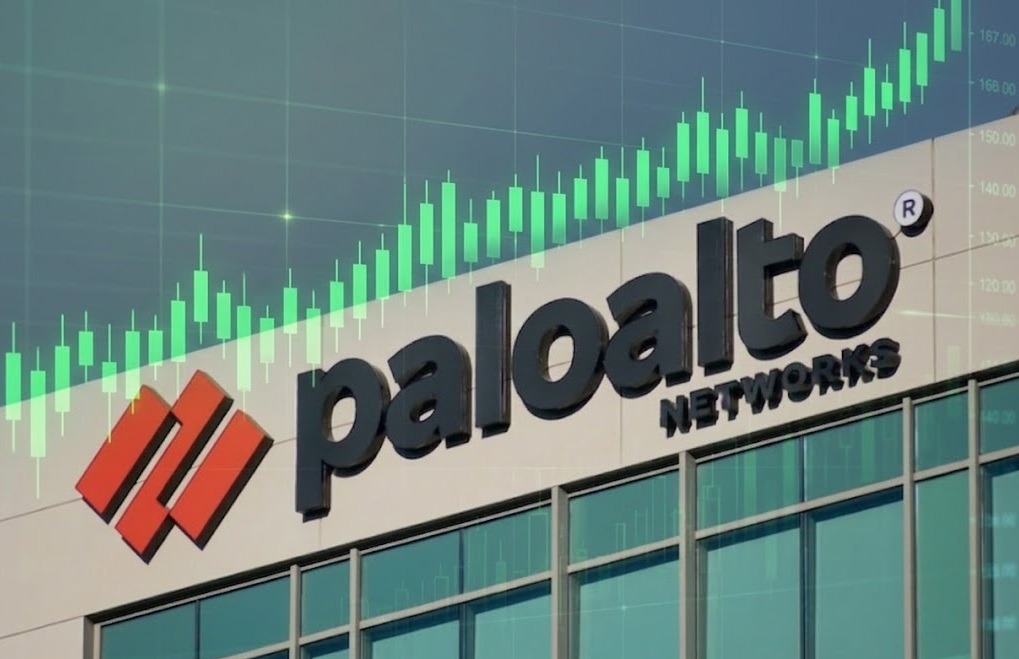
It is usually pretty rare for a massive technology stock to run up this aggressively right before an earnings call. Normally, institutional traders back off or lock in profits to avoid getting caught in the volatility if things go south. However, the market has completely rewritten the script this quarter, with Palo Alto Networks stock gaining over 62% in just the last 30 days.
So, why is everyone suddenly scrambling to get a piece of the action? Market insiders point to a few big reasons driving this massive influx of cash:
The "Platformization" Strategy is Winning: When CEO Nikesh Arora first announced a shift toward "platformization"—basically pushing bundled, all-in-one security packages instead of selling standalone products—the market was pretty skeptical. That skepticism has completely evaporated. Enterprises are tired of managing dozens of different security vendors, and Palo Alto Networks is swooping in to snap up those massive corporate contracts.
A Brutal Cyber Threat Landscape: High-profile ransomware attacks, sophisticated corporate espionage, and new vulnerabilities tied to rapid AI deployments have changed the game. Corporate IT departments can no longer treat cybersecurity as a negotiable IT expense; it is now a top-tier operational priority.
A Track Record of Crushing Expectations: Wall Street's fear of missing out (FOMO) is real, and it's backed by history. During the last earnings report in February, the firm posted an actual EPS of $1.03. handily beating the consensus analyst estimate of $0.76 by an astonishing 35.53%. Traders are clearly positioned for a repeat performance.
Because of this momentum, major Wall Street research houses have been scrambling to update their models. Just hours before the closing bell, firms like Baird lifted their price targets to $300. expressing high confidence that the company will comfortably surpass consensus expectations regarding its Next-Generation Security (NGS) annual recurring revenue and free cash flow.
For the fiscal third quarter, Wall Street analysts have set a relatively conservative bar, expecting a projected EPS of $0.72 on revenues of approximately $2.94 billion. But given the company's recent track record, the word on trading desks is that these official targets might actually be way too low for Palo Alto Networks stock.
To get a sense of the financial engine supporting this rally, we can look at how the firm performed in the preceding quarter alongside their updated full-year guidance:
| Financial Metric | Fiscal Q2 2026 Results | Official Fiscal Q3 2026 Guidance | Full-Year Fiscal 2026 Outlook |
| Total Revenue | $2.6 Billion (+15% YoY) | $2.941B to $2.945B (+28% to 29% YoY) | $11.28B to $11.31B (+22% to 23% YoY) |
| Non-GAAP EPS | $1.03 (vs. $0.76 est.) | $0.78 to $0.80 | Expected Strong Upward Revision |
| Remaining Performance Obligations (RPO) | $16.0 Billion | $17.85B to $17.95B (+32% to 33% YoY) | $20.2B to $20.3B (+28% YoY) |
| Next-Gen Security (NGS) ARR | $6.3 Billion (+33% YoY) | N/A | $8.52B to $8.62B (+53% to 54% YoY) |
The most telling figure in this whole chart is the Remaining Performance Obligations (RPO). This measures contracted revenue that has been locked in but not yet recognized. Standing at an estimated $17.9 billion for Q3. it proves that the company has built a remarkably predictable, recession-proof stream of recurring cash flows.
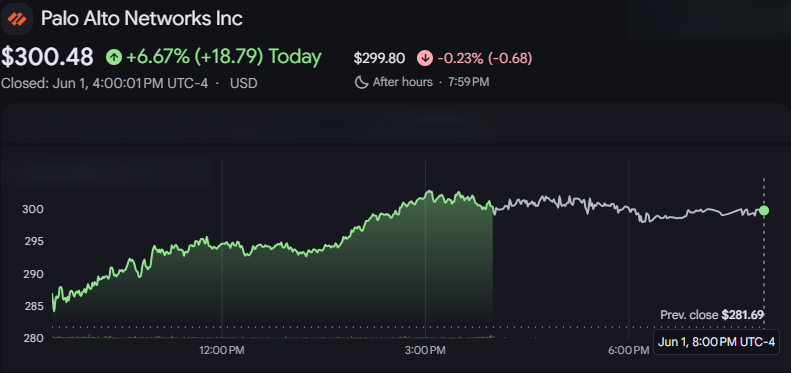
From a purely technical perspective, the vertical trajectory of Palo Alto Networks stock is nothing short of breathtaking. Shares have completely obliterated their previous 52-week trading range of $139.57 to $283.71, entering a clean, undisputed "blue-sky" breakout pattern with absolutely no historical overhead resistance to slow it down.
Moving Average Convergence Divergence (MACD): The MACD histogram on the daily chart is flashing a strong positive divergence. The MACD line crossed sharply above the signal line back in mid-May and the gap keeps widening, signaling intense, institutional-driven buying pressure.
Relative Strength Index (RSI): The 14-day RSI has pierced deep into overbought territory, currently sitting at an elevated 76.5. In a normal market environment, this would be a warning sign of an impending drop. However, during high-momentum pre-earnings run-ups, tech stocks can stay technically overbought for quite a while as short-sellers are forced to buy back shares to cover their losses.
Moving Averages: The stock is trading way above its 50-day moving average ($212.50) and its 200-day moving average ($185.30). The widening gap between the current price and these long-term lines highlights just how fast the upward momentum has accelerated over the last month.
If the earnings report sparks a "sell-the-news" event where investors decide to lock in profits, institutional buyers will likely look to defend the primary support level at the previous breakout zone of $281.69. If a broader market pullback happens, a deeper support floor rests at $260.58, which aligns perfectly with where the stock consolidated in late May. On the flip side, if the earnings numbers blow past the $0.80 high-end guidance, there is a clear technical path for Palo Alto Networks stock toward the $325 to $330 price corridor.
Beyond traditional firewalls and cloud infrastructure, the hidden engine behind this accelerating demand is how the company is making real money from artificial intelligence. The firm has successfully integrated smart machine-learning modules across its Cortex and Prisma platforms, allowing corporate security teams to automatically spot, isolate, and neutralize cyber threats on the fly without needing human intervention.
Furthermore, recent strategic corporate integrations and mergers are beginning to feed directly into the top-line numbers. According to recent software sector analyses, the company's strategic initiatives are expected to reflect over $1.47 billion in pure next-generation security revenue contributions this quarter alone.
By executing a highly effective upselling strategy, Palo Alto Networks is managing to increase the average contract value of its existing 80.000+ enterprise clients, effectively growing its revenues vertically even when new customer acquisition naturally slows down in a mature macroeconomic market.
There is no denying that Palo Alto Networks stock is priced for absolute perfection heading into Tuesday afternoon's earnings call. Trading at a hefty premium forward price-to-earnings (P/E) ratio relative to its industry peers, the software giant has left itself very little margin for error.
However, this spectacular run to $300.48 indicates that institutional investors are not merely gambling on short-term numbers; they are actively pricing in a structural shift in global enterprise IT spending. In an era where a single digital breach can cost a multi-national corporation hundreds of millions of dollars in damages and reputational ruin, Palo Alto Networks stock is no longer viewed by Wall Street as a speculative software play, but rather as an essential, foundational utility for the modern digital economy. All eyes now turn to Nikesh Arora and his executive team to see if they can deliver the goods to justify this historic market coronation.