Published on: 2026-04-02
Updated on: 2026-04-02
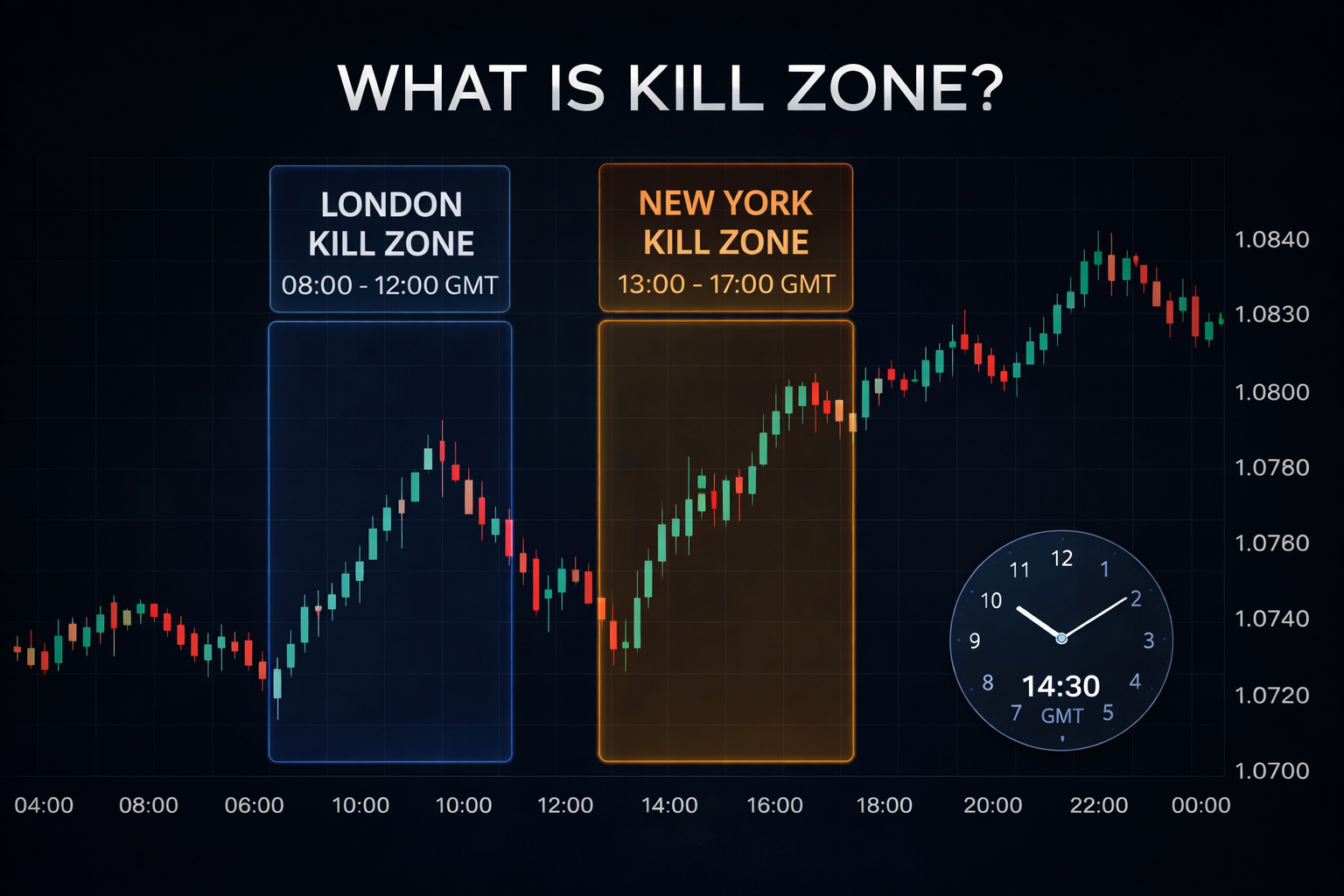
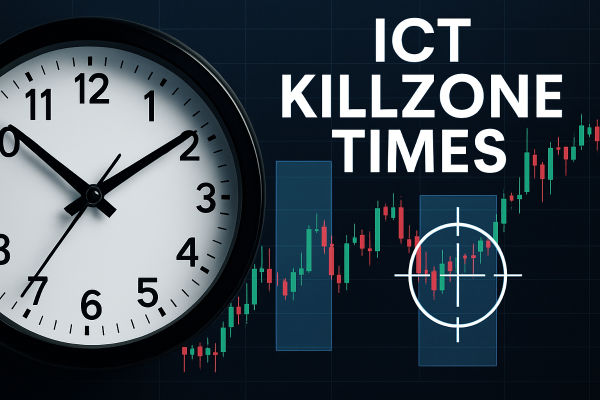
A kill zone refers to defined periods of heightened market activity, during which increased liquidity and participation often lead to more decisive price movements. For traders, understanding these intervals can improve execution timing and better align with institutional order flow.
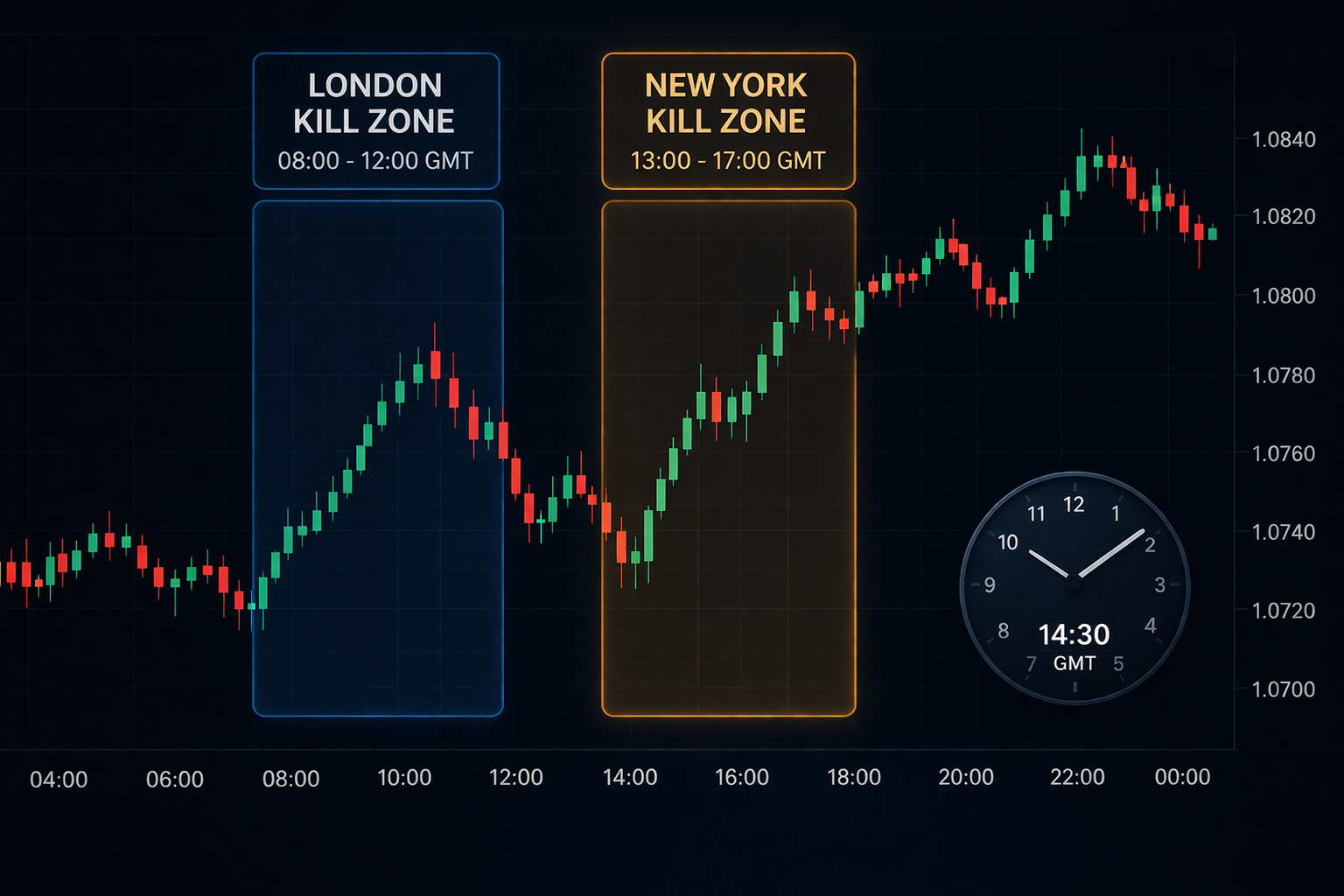
Kill zones are defined as intraday periods characterised by elevated liquidity and volatility.
They typically align with major trading session opens, particularly London and New York.
These periods reflect concentrated institutional participation and order flow.
Kill zones amplify market conditions rather than dictate direction.
Effective use requires integration with market structure and disciplined risk management.
A kill zone represents a window during which trading conditions become more favourable due to increased market participation. During these intervals, traders typically observe:
Higher trading volume
Deeper liquidity
More efficient price discovery
Increased directional movement
These characteristics can enhance execution quality and improve the reliability of short-term trading signals compared to quieter periods.
The concept is most relevant for:
Intraday traders
Short-term systematic strategies
Active participants in foreign exchange and index markets
Institutions execute large orders during high-liquidity periods to minimise market impact.
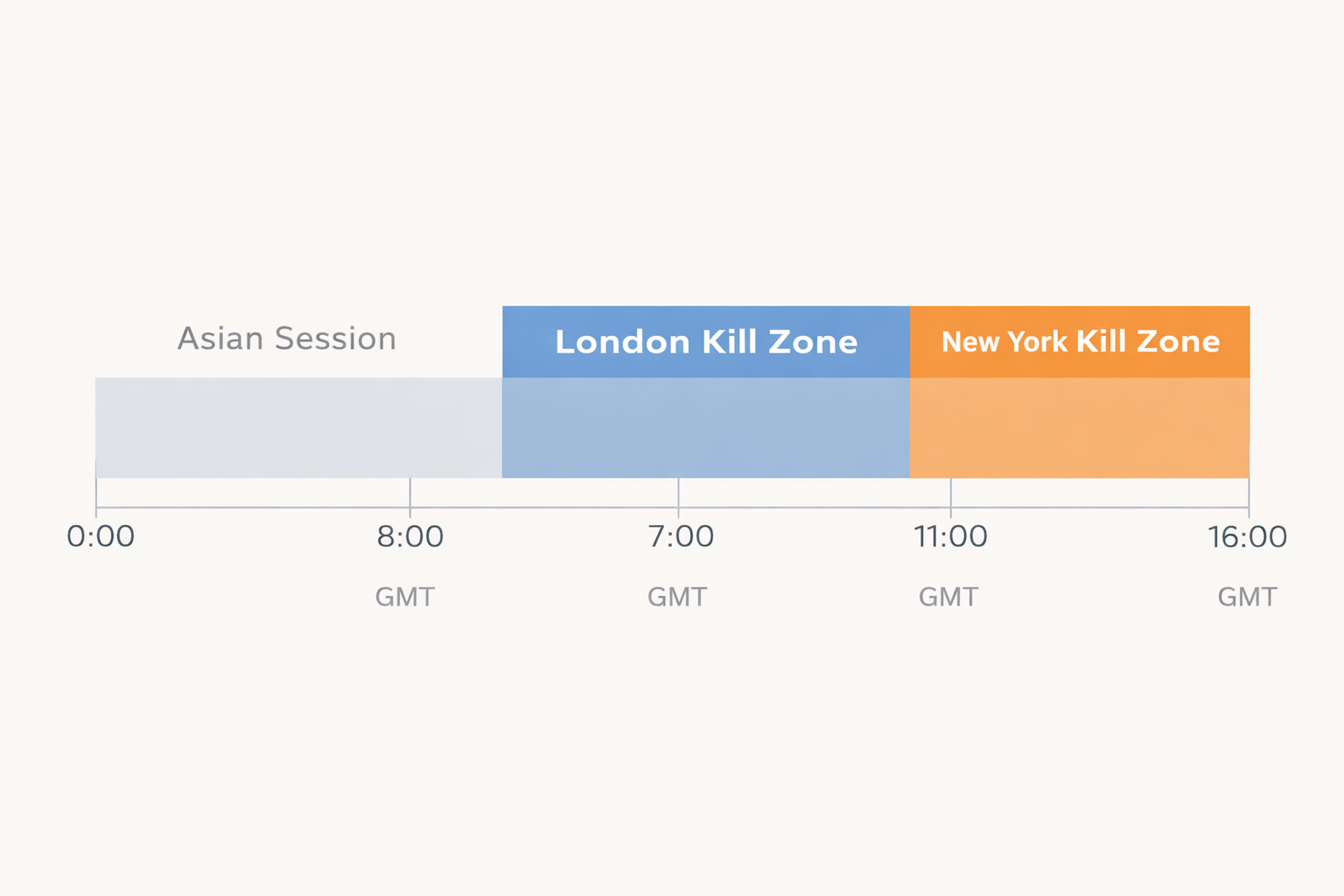
Kill zones broadly correspond to the opening hours of major financial centres, when global capital and trading activity overlap significantly.
Large institutional participants typically execute during high-liquidity periods to minimise market impact and optimise execution efficiency. This clustering of activity contributes to more meaningful price movements.
Overlapping sessions, particularly between London and New York, create deeper liquidity pools. This environment supports:
Tighter spreads
Faster execution
More efficient price discovery
Price action during kill zones often reflects the interaction between institutional positioning and retail order flow. This can result in:
Short-term price dislocations
Stop-loss triggering (liquidity sweeps)
Subsequent directional expansion
Importantly, kill zones do not generate direction independently; they amplify underlying market conditions, including prevailing trends, macroeconomic drivers, and positioning.
Kill zones are most effective when analysed in conjunction with broader market structure.
Key considerations include:
Support and resistance levels
Higher timeframe trend direction
Consolidation and breakout patterns
Areas of liquidity concentration
A commonly observed sequence is:
Consolidation during low-activity periods
A liquidity event at the start of a kill zone
Directional expansion following the initial move
While such patterns are frequently observed, they are not guaranteed and should be interpreted within the broader market context.
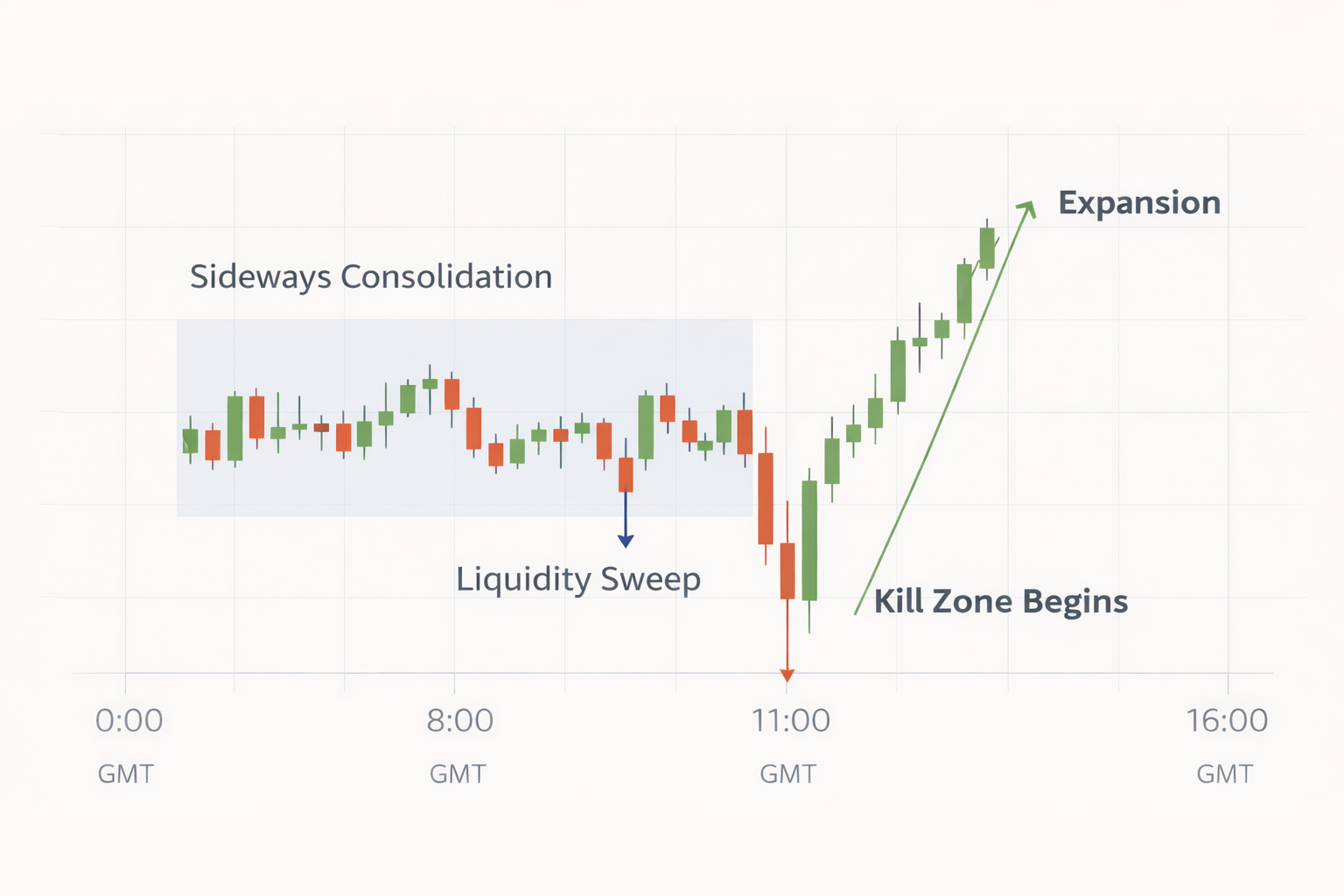
Consider a scenario in the EUR/USD market:
While not all session opens produce clean reversals, this framework illustrates how liquidity events can precede more sustained directional movement.
The relevance of kill zones extends beyond foreign exchange markets.
Equity indices often exhibit increased volatility during the New York open.
Precious metals, such as gold, often respond to U.S. data releases during periods of high liquidity.
Energy markets, including crude oil, may experience sharp movements aligned with institutional activity.
This makes kill zones applicable across a wide range of liquid instruments.
Despite their usefulness, kill zones are often misapplied.
Common pitfalls include:
Trading indiscriminately during all session openings
Entering positions before volatility has meaningfully developed.
Ignoring higher timeframe context
Reacting to initial breakouts without confirmation
Underestimating risk during high-volatility conditions
Additionally, increased volatility can lead to erratic price behaviour, particularly during major economic releases, where spreads may widen and execution conditions may deteriorate.
A disciplined approach to kill zones typically involves:
Identifying key technical levels and broader market structure
Monitoring price action as a kill zone approaches
Assessing for liquidity events or breakout attempts
Entering positions based on confirmation rather than initial movement
Applying strict risk management, including stop-loss placement and position sizing
In fast-moving conditions, factors such as slippage and execution latency can materially impact outcomes, particularly for short-term strategies.
Yes, kill zones apply to all liquid markets, including equities, indices, and commodities. They are most commonly associated with forex due to its continuous trading cycle, but the underlying principles are broadly applicable.
The London and New York sessions are generally the most impactful due to their high liquidity and frequent overlap, which often lead to stronger, more sustained price movements.
Kill zones can enhance timing and execution efficiency, but they do not guarantee profitability. Their effectiveness depends on integration with broader analysis and disciplined risk management.
Preparation typically involves identifying key levels, understanding prevailing market conditions, and monitoring scheduled economic events that may influence volatility during the session.
Kill zones are primarily relevant for short-term trading approaches. Long-term strategies generally focus on macroeconomic trends and fundamental analysis rather than intraday timing.
Kill zones represent structurally important periods within the trading day where liquidity, participation, and execution efficiency converge. While they do not determine market direction, they play a critical role in shaping price discovery and short-term trading conditions.
Aligning trades with these intervals can improve execution quality. Effective application requires market structure analysis, macro awareness, and disciplined risk management.
Disclaimer: This material is for general information purposes only and is not intended as (and should not be considered to be) financial, investment or other advice on which reliance should be placed. No opinion given in the material constitutes a recommendation by EBC or the author that any particular investment, security, transaction or investment strategy is suitable for any specific person.