Published on: 2026-07-21
Updated on: 2026-07-21
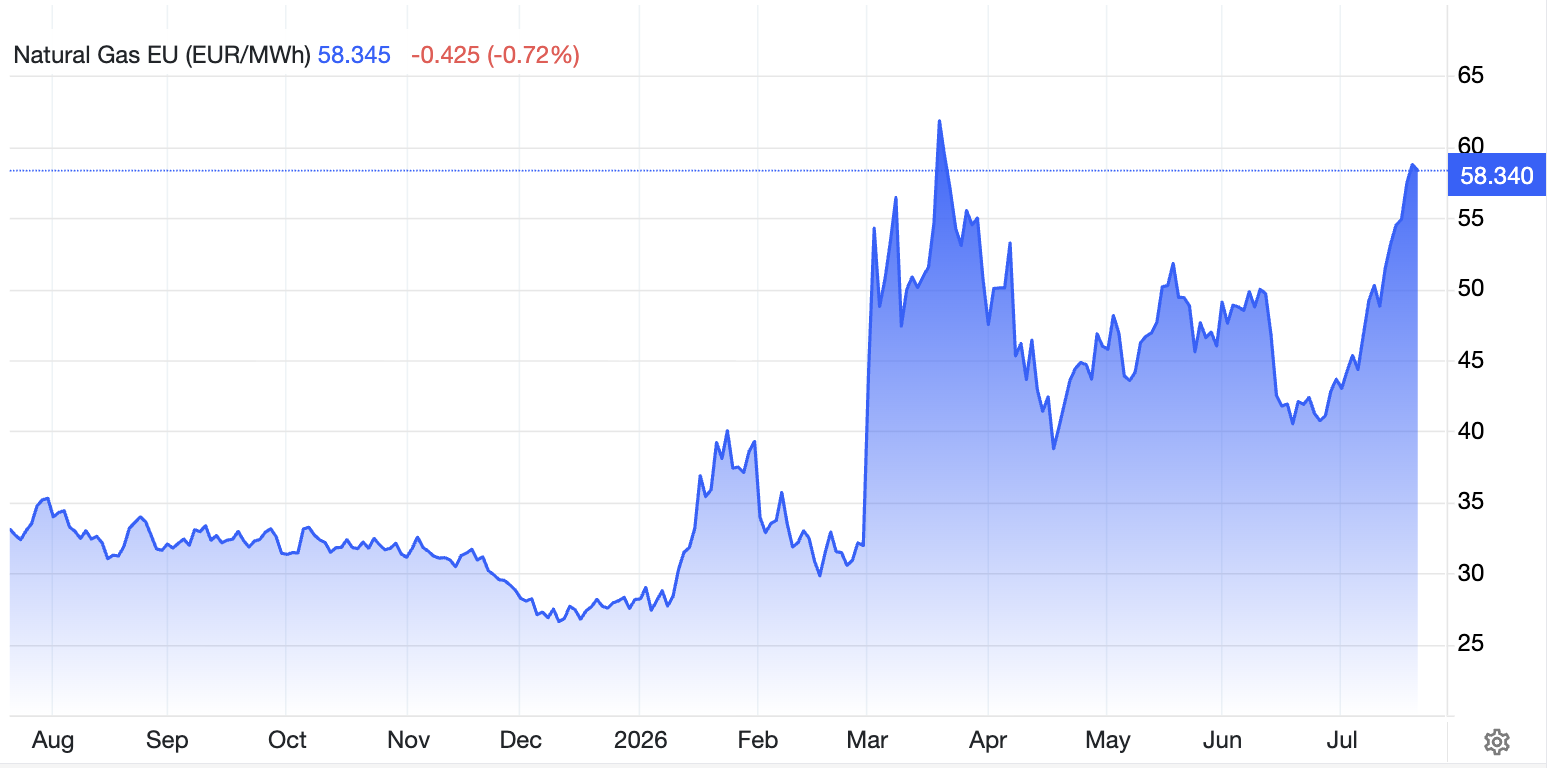
European gas prices in 2026 have surged back toward €60 per megawatt-hour at a difficult moment for the European Central Bank. Front-month Dutch TTF futures, the continent’s benchmark, traded around €58 on 21 July after briefly topping €60 the day before, leaving the benchmark roughly three-quarters higher than a year earlier, just as the ECB prepares to set policy on 23 July.
The question is not whether Europe will physically run short of gas this winter. It is narrower: has the rise in gas prices become persistent enough to alter the ECB’s inflation path, or can policymakers still treat it as a temporary supply shock they can look through? The bank publishes its decision on 23 July at 14:15 CET.
Front-month Dutch TTF futures traded around €58 per megawatt-hour on 21 July after briefly topping €60, roughly three-quarters higher year over year, as renewed US-Iran hostilities disrupt LNG flows.
EU gas storage is only about 53% full, versus roughly 64% a year ago and some 15 points below the five-year norm, the lowest for this point in at least five years.
The ECB is expected to hold its deposit rate at 2.25% on 23 July, but about 70% of economists in a Reuters poll expect one more hike in 2026, most likely to 2.50% in September.
With June headline inflation at 2.8% and the ECB’s illustrative adverse scenario pointing to 3.3% this year, the decisive risk is second-round inflation: higher energy costs passing into wages and services, which the ECB cannot easily ignore.
The immediate trigger is geopolitical. Renewed US-Iran hostilities have disrupted shipping through the Strait of Hormuz and curtailed LNG flows from the Gulf, tightening the global market Europe now depends on and pushing TTF to a roughly four-month high. But a pure geopolitical premium would fade as headlines calm.
What makes this move harder to dismiss is that it sits on structural weakness: Europe’s exit from Russian gas has increased its reliance on LNG and Norwegian pipeline supply, while lower consumption has filled part of the gap.
That leaves prices more exposed to any disruption in global cargo flows, and early-summer heat pulling gas into power generation has added to demand. The benchmark is rising for reasons that need not disappear when the conflict does.
Europe refills storage over summer to survive winter, and this year the refill is running behind. As of 17 July, EU facilities were around 53% full, against roughly 64% a year ago and about 15 percentage points below the five-year average, based on calculations using GIE data, the lowest for this point in five years. That follows an April injection season that began at only about 28% full after heavy winter withdrawals.
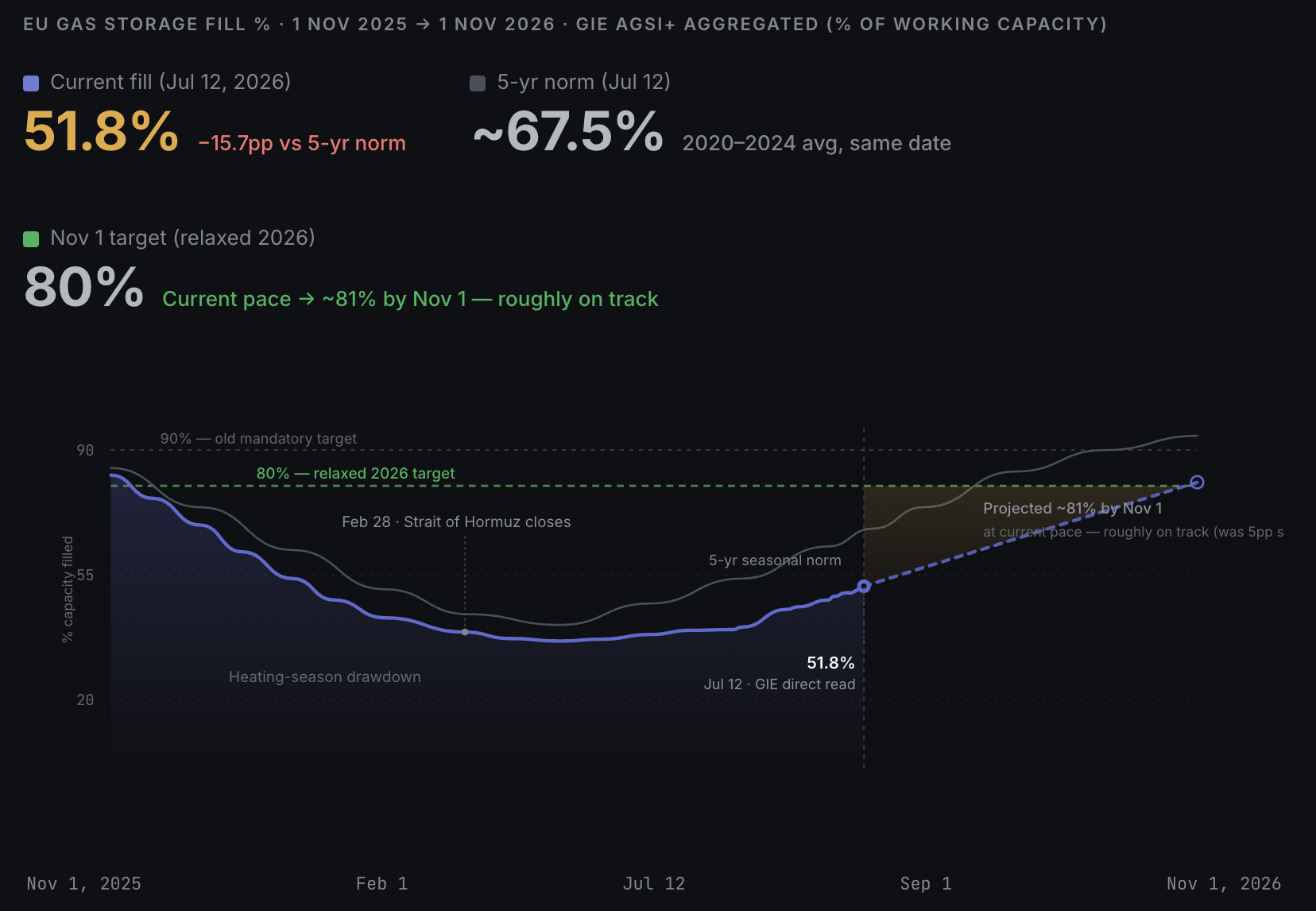
The EU’s binding storage target remains 90%, but countries may reach it at any point between 1 October and 1 December, and a 10-percentage-point flexibility margin can lower the effective threshold to 80% when difficult filling conditions apply.
An economist estimates storage would reach about 75% by end-October at the recent injection pace, rising to 78% in its base case of stronger injections.
The shortfall is not just one quarter’s bad luck. Iranian attacks in March knocked out roughly 17% of Qatar’s LNG export capacity; QatarEnergy has said the two damaged trains could take three to five years to repair, leaving a meaningful share of global supply offline well beyond this quarter.
The forward curve compounds the strain: the recent TTF curve has been backwardated, with near-dated gas priced above later winter contracts, which weakens the commercial incentive to buy prompt gas and store it, the very behaviour Europe needs to refill in time.
A market discouraging injection while storage sits below seasonal norms keeps upward pressure on TTF just when the ECB wants energy inflation to fade.
Gas prices reach the inflation data through a clear chain: lower storage and disrupted LNG lift TTF; higher TTF raises wholesale electricity and industrial energy costs; those costs lift headline inflation directly, then seep into goods and services if they persist.
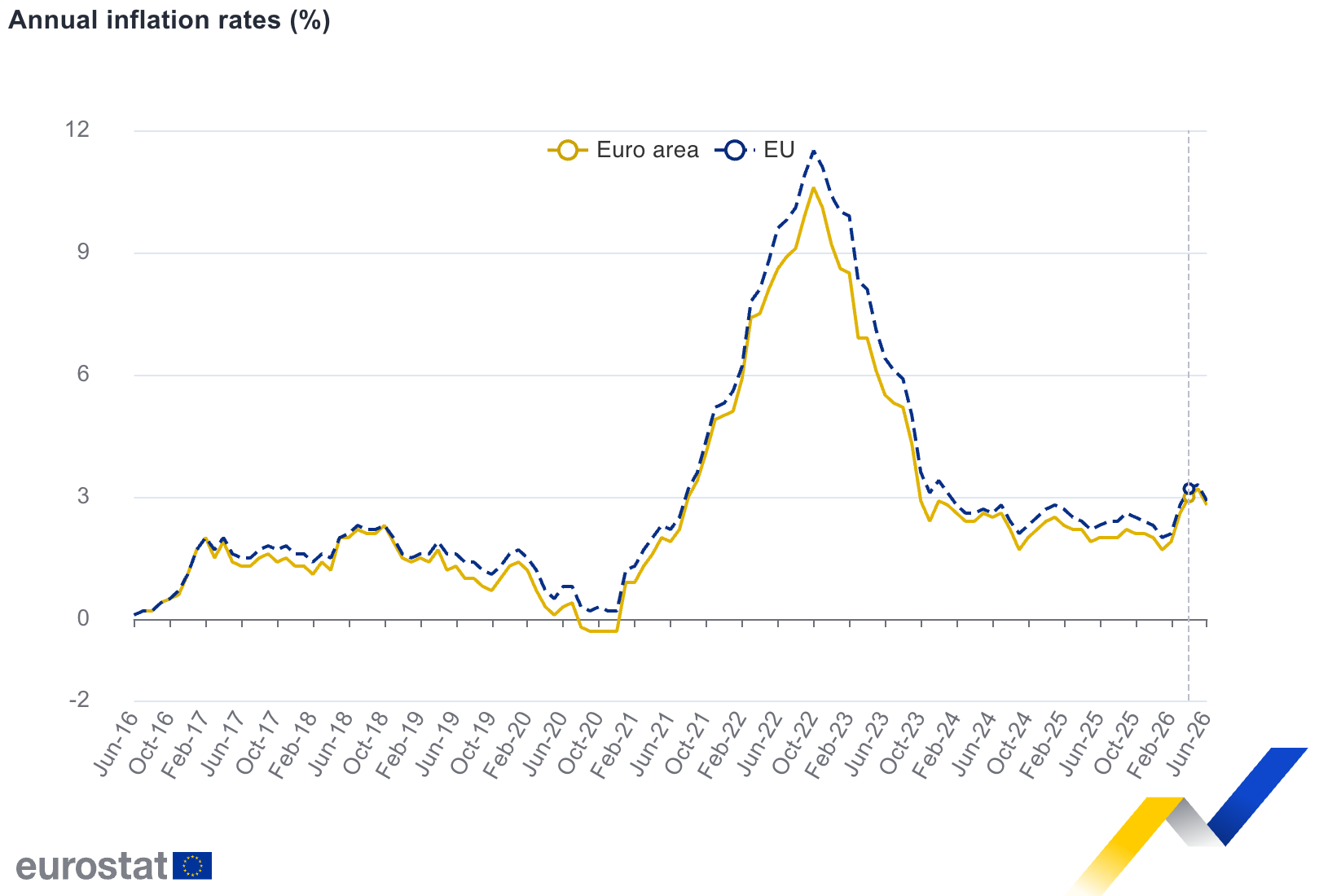
The June data show why the ECB is uneasy. Headline inflation eased to 2.8% from 3.2% in May, but energy still ran at 8.5% and services at 3.2%, both above levels consistent with the 2% target.
| Euro-area inflation component (annual %) | May 2026 | June 2026 | Read-through for the ECB |
|---|---|---|---|
| Headline HICP | 3.2% | 2.8% | Cooling, but still above the 2% target |
| Energy | 10.8% | 8.5% | Direct inflation channel; vulnerable to renewed TTF increases |
| Services | 3.5% | 3.2% | Still the clearest sign of persistent domestic pressure |
| Food, alcohol and tobacco | 1.9% | 1.5% | Contained for now |
| Non-energy industrial goods | 0.9% | 0.7% | Limited goods-price pass-through so far |
Source: Eurostat final June 2026 HICP release, 17 July 2026. A renewed TTF rally would first reappear in the energy line, then risk feeding the services line.
Economists split this pass-through into first-round and second-round effects. First-round inflation is the direct hit to energy and fuel bills; the ECB can usually look through it because it fades as prices stabilise. Second-round inflation is harder to ignore: firms raise prices, workers seek wage compensation and expectations drift higher, the same channels central banks monitor when supply shocks begin to affect interest-rate decisions.
Euro-area hourly wages and salaries rose 3.4% year over year in the first quarter of 2026, showing labour-cost pressure remained firm, though the ECB’s wage tracker points to negotiated growth of around 2.6% for 2026, suggesting underlying pressure is moderating.
Once a shock crosses into that second channel, it stops being temporary in any sense the ECB can safely ignore.
“Looking through” a shock means holding policy steady on the view that the price rise is temporary and will wash out of the annual comparison. The ECB has room to do so, since base effects should pull energy inflation lower into 2027 if prices stabilise, but its margin for error is slim.
Having already raised the deposit rate to 2.25% in June in response to the earlier energy surge, it revised its 2026 inflation projection up to an average of 3.0%. Its illustrative adverse scenario, in which the energy shock proves persistent, puts headline inflation at 3.3% in 2026 and 3.0% in 2027, though the ECB stresses these scenarios are not forecasts and carry no assigned probability.
A renewed gas rally makes that path more plausible, and thin storage raises the odds that elevated prices persist long enough to trigger the second-round effects the bank cannot look through.
A hold on 23 July is close to unanimous, so the live question is September, when fresh staff projections are due. In the latest Reuters poll, 52 of 74 economists, about 70%, expected one more 2026 hike, most likely to 2.50% in September, and markets have priced more tightening since the conflict re-escalated.
Three signals would tip the balance toward that hike: TTF holding near or above €60 for weeks rather than spiking and retreating; a forward curve that shifts from today’s backwardation toward a firm winter premium, showing the market pricing scarcity deep into the heating season; and any pickup in core inflation, services inflation or wage settlements that signals second-round pass-through.
If the September projections have to embed a higher energy path and firmer underlying inflation, a measured move to 2.50% becomes hard to resist.
| Scenario | Gas and storage path | Likely ECB response |
|---|---|---|
| Benign | Middle East tensions ease, Gulf LNG flows recover, storage reaches the upper end of forecasts and TTF falls | The ECB looks through the July spike and holds rates through autumn |
| Base | The conflict neither resolves nor worsens; storage ends the season in the mid-to-high 70s and TTF remains elevated but rangebound | One increase to 2.50% in September, followed by a pause |
| Adverse | LNG disruption deepens, storage finishes near or below 75%, and a cold start to winter pushes TTF well above €60 | The ECB tightens beyond current market expectations |
The base case’s September outcome matches the Reuters poll, though its TTF and storage assumptions are illustrative; the gap between the benign and adverse paths turns almost entirely on how long Gulf supply stays disrupted and how cold the winter’s opening weeks prove.
A system-wide physical shortage is not the base-case concern, though official outlooks are scenario assessments rather than guarantees. The sharper risk is the price Europe must pay to secure enough winter gas, and whether that price stays high long enough to spread from the energy component into wages and services. A hold on 23 July looks secure.
By September, the ECB will have to decide whether it can still credibly call this shock temporary, or whether the winter storage math forces it to treat gas as a monetary-policy problem rather than a passing one.