Published on: 2026-09-04
Rising oil prices tend to favour currencies of major net exporters and put pressure on economies that rely heavily on imported crude. The Canadian dollar and Norwegian krone sit on the exporter side, while the Japanese yen, Indian rupee and euro face higher energy costs when oil becomes more expensive. The eventual currency move also reflects the source of the oil rally, interest-rate expectations, the US dollar and global risk sentiment.
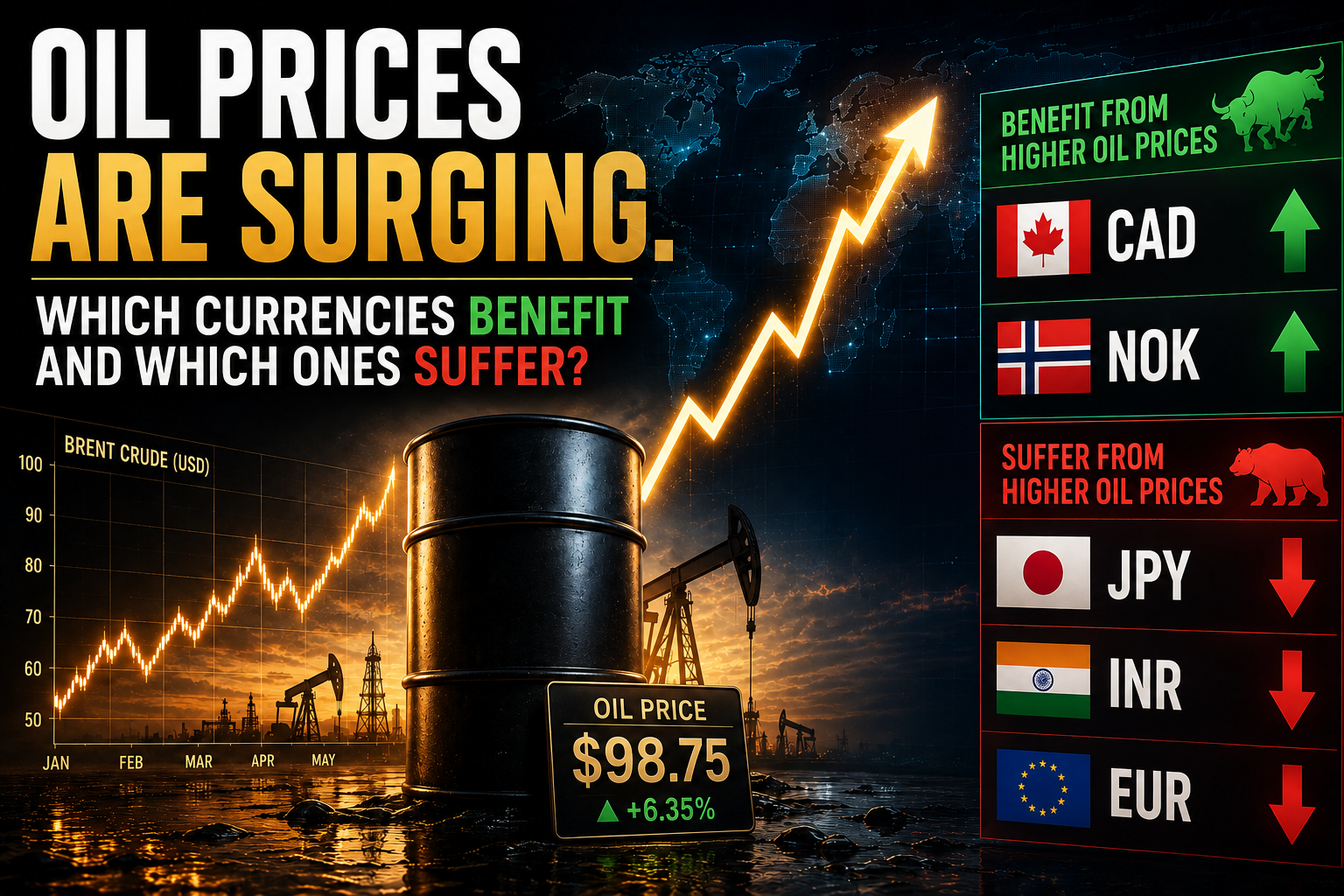
Higher oil prices can improve export income and terms of trade for major net exporters while increasing costs for heavy oil importers.
CAD and NOK tend to have positive oil exposure, although neither currency follows crude consistently.
JPY, INR and EUR can face pressure from higher energy import costs, with different economic and monetary-policy effects in each market.
An oil rally driven by strong demand can produce a very different FX reaction from a supply shock caused by conflict or production disruption.
Oil changes how much money moves between producing and consuming economies. A net exporter can earn more from the same volume of crude when prices rise, supporting export revenues and national income. A large importer has to spend more to secure the same supply, placing additional pressure on its external balance.
Terms of trade: The prices a country receives for its exports relative to the prices it pays for imports. Higher oil prices generally improve this balance for major oil exporters and weaken it for economies that import large amounts of energy.
The exporter-importer divide provides the starting point for understanding how oil can affect currencies. The relationship becomes less predictable once interest rates, capital flows and broader market conditions enter the picture.
Oil can rise for very different reasons, and the cause changes how currencies respond.
Demand-driven rally: Stronger global growth, industrial activity and transport demand can push oil prices higher. Exporters earn more from crude, while healthier global demand can support trade and risk appetite across a wider group of economies. Oil importers still face higher costs, although stronger economic activity can offset part of the strain.
Supply-driven shock: Wars, production cuts, sanctions or disruptions to major shipping routes can remove oil from the market. Energy costs rise as growth expectations weaken, creating a more difficult combination for importing economies. Geopolitical supply shocks can also lift demand for safe-haven assets and the US dollar.
Currencies of large net oil exporters tend to receive the clearest support, although their sensitivity to crude can change over time.
Canada is a major net energy exporter, so higher oil can increase export revenues and improve the country’s terms of trade. The Bank of Canada says Canada tends to fare better than many economies during an oil-price increase due to its exporter status. The recent relationship with CAD has been weaker than in the past: during the 2026 oil surge, the Canadian dollar remained broadly flat even as higher oil improved Canada’s terms of trade.
Higher crude no longer produces the same investment response seen in earlier oil booms. That reduces one source of additional demand for Canadian dollars and leaves CAD more exposed to interest-rate expectations and broad USD moves.
Petroleum exports are a major source of Norwegian income, giving NOK positive exposure to higher energy prices. Norges Bank reported that the krone’s appreciation in early 2026 coincided with sharply higher oil prices, a weaker dollar and wider interest-rate differentials. It also said the rise in oil after the Middle East conflict pulled NOK toward further appreciation, while financial-market uncertainty limited the move.
Norway also invests a large share of its petroleum wealth overseas through its sovereign wealth system. Higher petroleum income can strengthen Norway’s finances without converting every additional dollar of revenue into domestic-currency demand.
CAD and NOK are useful examples of exporter currencies, yet neither should be treated as a direct proxy for crude oil.
Large oil importers face the opposite first-round pressure. Their import bills increase, purchasing power falls and external balances can deteriorate.
Japan depends heavily on imported oil and gas. Higher crude raises the amount the economy pays for energy and can weaken its terms of trade. JPY is harder to classify than a typical importer currency, as changes in Japanese and US interest rates and occasional safe-haven demand can pull the yen in the opposite direction.
India’s exposure is more direct. RBI data show that crude oil import dependence rose from 77.6% in 2013–14 to 88.2% in 2024–25. A sustained oil rally can increase India’s import bill, add inflation pressure and weaken the external balance, creating additional pressure on INR.
The euro area is a large net energy importer. The ECB describes an energy-price shock as a transfer of real income abroad that worsens the terms of trade and compresses household income. Higher energy costs can also slow consumption and business activity while lifting inflation.
The basic exposures can be summarised as follows:
Currency |
Oil exposure |
Higher oil tends to |
CAD |
Major net energy exporter |
Support CAD |
NOK |
Major petroleum exporter |
Support NOK |
JPY |
Heavy energy importer |
Pressure JPY |
INR |
Heavy crude importer |
Pressure INR |
EUR |
Large net energy importer |
Pressure EUR |
These are economic tendencies rather than fixed FX relationships. Rates, the dollar and market risk can weaken or reverse the expected move.
Oil may point to a stronger exporter currency or a weaker importer currency, yet FX markets price several forces at once.
Higher oil can increase inflation while reducing household purchasing power. Currency markets then assess how central banks are likely to respond. Expectations for higher interest rates can support a currency, even in an oil-importing economy, while expectations for easier policy can offset support from strong oil exports.
Most international oil trading is priced in dollars. An importing economy can face additional pressure when oil and USD rise together.
If crude climbs 15% and the importer’s currency also loses value against USD, the domestic cost of oil rises by more than the headline move in crude alone. Companies and households pay more per barrel and more dollars to buy it.
Oil supply shocks often arrive alongside war, sanctions or fears of weaker global growth. Investors may respond by moving toward liquid or defensive currencies such as USD, CHF or, in some circumstances, JPY.
ECB research found that geopolitical shocks disrupting oil supply have historically been associated with a stronger dollar and higher market risk indicators.
Extra oil revenue does not automatically stay inside the producing economy. Governments can save it, companies can distribute profits to overseas shareholders, and sovereign wealth funds can invest it abroad.
These flows help explain why a country’s national income can improve without its currency rising by the same degree as crude.
Oil can tilt currency pressure in one direction, while rates, the dollar, and global capital flows pull it elsewhere.
No. Higher oil can improve Canadian export income and terms of trade, but CAD also responds to Bank of Canada policy, US interest rates and broad dollar movements. The Bank of Canada noted in 2026 that CAD remained broadly flat during an oil surge despite Canada’s position as a net energy exporter.
Japan depends heavily on imported energy, so higher crude can increase its import bill and weaken its terms of trade. Changes in Japanese and US interest rates can outweigh that pressure, and episodes of strong risk aversion may also support the yen.
Both currencies have meaningful oil exposure, and the strength of each relationship changes over time. Petroleum plays a particularly large role in Norway’s external income, while the krone also reacts to Norwegian interest rates, the dollar and market volatility. Norges Bank has identified all three alongside oil when explaining recent NOK moves.
Yes. A geopolitical supply shock can lift crude while investors move toward dollar assets. The United States is also a net primary energy exporter, giving the modern dollar-oil relationship a different structure from the period when the US depended more heavily on imported energy.
Oil exporters such as Canada and Norway generally receive more income when crude rises, while import-dependent economies such as Japan and India face higher external costs. That first-round effect explains why currencies can develop positive or negative oil exposure.
The relationship becomes less reliable once interest rates, the dollar and global risk sentiment start moving at the same time. Oil prices are one part of the FX picture, rather than a fixed signal for where a currency must go.