Published on: 2025-12-05
Updated on: 2025-12-05
Natural Gas has quietly become one of the loudest trades on the screen. After spending most of 2023–2024 stuck in a bear market, U.S. Henry Hub prices have ripped higher, punching above $5/MMBtu for the first time since late 2022 and sitting around a three-year high as we move into peak winter demand.
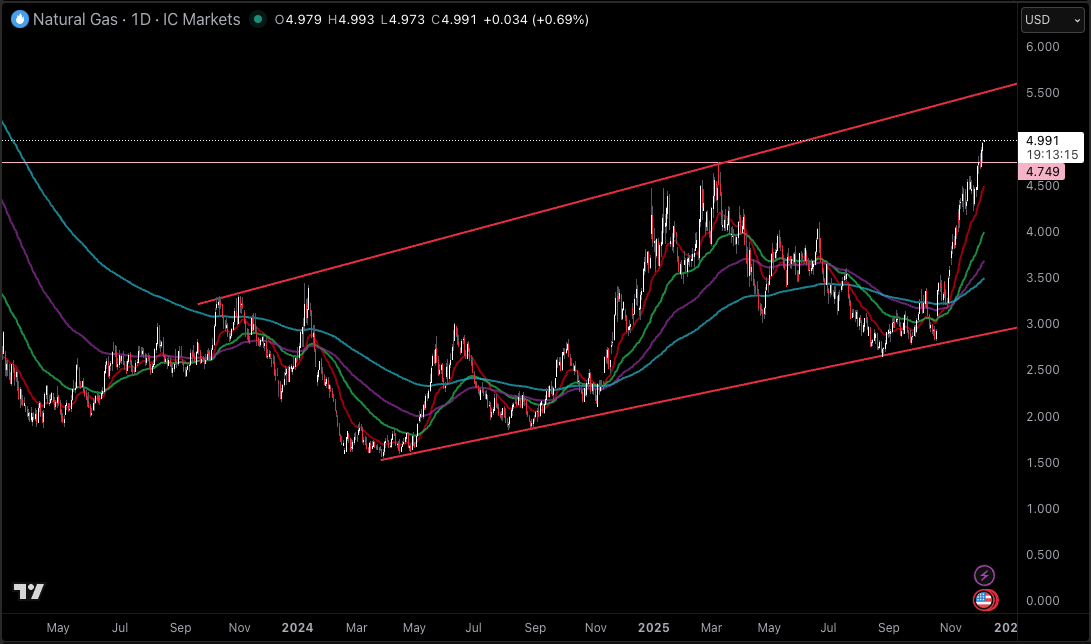
This isn't a one-day short squeeze. Prices are up roughly 50% from late October, fuelled by a cold start to winter, record LNG exports and a global gas market that's still re-pricing post-Ukraine. For traders, utilities and industrial buyers, the question now is simple: is this the start of a bigger bull leg, or just a weather-driven spike that begs to be hedged or faded?
In this article, we'll walk through what this three-year high really means, where the key technical levels sit, and how LNG exports and winter risk could shape the next leg.
Listed below is a table of the latest Natural Gas Prices Snapshot in December 2025:
| Metric | Latest reading (early Dec 2025) | Why it matters |
|---|---|---|
| Henry Hub futures price | Around $5.1/MMBtu, intraday range near $5.08–$5.10 | Highest in ~3 years; confirms a decisive break from the $2–$3 range that dominated 2023–2024. |
| Henry Hub spot (Dec 1) | $4.81/MMBtu; up ~50% YoY | Spot strength confirms tight physical balances, not just futures speculation. |
| Rally since mid-October | Futures up ~65% from mid-October lows to early December | Classic cold-weather + LNG squeeze; momentum is extended but still intact. |
| US working gas in storage | ~3,923–3,935 Bcf, ~5% above 5-yr avg, slightly below last year | Inventories are comfortable but no longer excessively loose; draws will be watched very closely. |
| US LNG exports (EIA 2025) | Forecast ~14.7–14.9 Bcf/d, up about 25% vs last year | LNG is now on track to become one of the largest single sources of U.S. gas demand. |
| EU gas storage | Around 83% full heading into winter 2025–26 | Europe starts winter comfortable, but end-of-season levels will depend heavily on weather and US LNG. |
From the table, we can see we have a textbook tension: prices are high, but storage isn't "crisis-low", and U.S. production remains near record levels. The tightness is coming more from strong demand (LNG + weather) than an outright supply collapse.
Weather models moved sharply colder for December across key U.S. heating regions (Midwest, Northeast), triggering a jump in residential and commercial demand.
Analysts estimate heating-related demand surged into the low-40s bcf/d, significantly tightening balances compared with milder autumn weeks.
Energy Intelligence and other industry sources flagged "frigid December forecasts" as the catalyst that pushed NYMEX past $4.50 and then toward $5.
The key point: this is classic seasonal tightening, but layered on top of an already stronger structural demand base than pre-COVID.
U.S. LNG exports hit 10.9 million tonnes in November, a record for the second month in a row.
Feed-gas demand for liquefaction averaged 18 bcf/d and briefly topped 19 bcf/d. It is effectively another "mega-region" of gas demand sitting on the Gulf Coast.
About 70% of exports went to Europe, with Turkey emerging as a standout buyer, while Asia took ~16% amid softer spot demand.
At the same time, the U.S. is now comfortably the world's largest LNG exporter, and new projects approved in 2025 will add a record 83 bcm/year of capacity into the next wave (2027–2028).
It matters because Henry Hub is no longer just a domestic story. When export terminals run at full capacity, U.S. balances become closely linked to TTF and JKM benchmarks, even as the arbitrage window narrows.
A surge in U.S. output and new global LNG capacity has pushed European TTF and some Asian prices lower, even as Henry Hub has climbed.
The HH–TTF spread has compressed to roughly $4.7/MMBtu, its tightest since 2021, squeezing LNG profit margins.
If that spread dropped toward $2/MMBtu, some U.S. LNG capacity would likely become uneconomic at the margin, limiting upside for Henry Hub. For now, spreads still support strong exports, but the cushion is thinner than during the 2022 gas crisis.
Latest EIA data shows working gas in storage around 3,935 Bcf, about 4% above the five-year seasonal average and ~1% below last year.
Earlier in Q4, inventories sat roughly 4–8% above average, but stronger-than-normal draws are already eroding that cushion.
Real Investment Advice notes that, despite starting winter above average, EIA expects stocks to tighten notably into 2026, supporting structurally firmer prices.
So the message from storage is nuanced: we're not short yet, but the direction of travel is tightening, and that's enough to justify a risk premium when everyone is watching the weather.
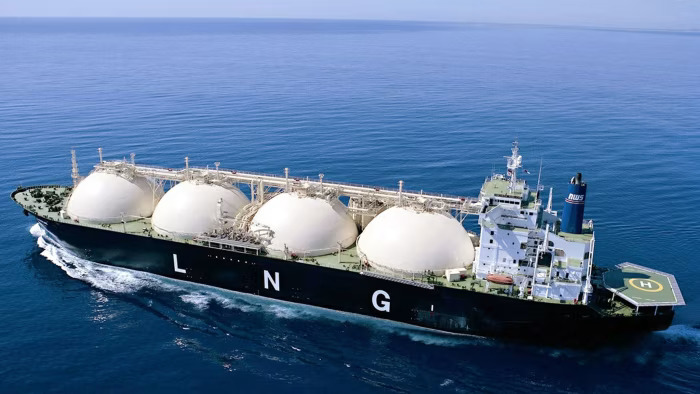
LNG has become the swing factor for U.S. gas:
Export volumes now routinely exceed 18 bcf/d, compared with near-zero a decade ago.
Several terminals can adjust output in response to relatively small price signals, allowing any dip in global spreads to impact U.S. balances immediately.
At today's prices, Henry Hub is above $5, while TTF sits near $10–11. It still supports exports, but the days of "free money" spreads are over.
High gas prices are already changing behaviour:
As Henry Hub has neared three-year highs, U.S. power utilities have ramped up coal burn, reversing some of the recent gas-for-coal substitution.
Reports suggest coal-fired output rose about 16–21% year-on-year in recent months, while gas-fired output dipped as utilities tried to control costs.
That effectively caps some of the upside in gas demand from the power stack, especially if prices stay elevated into late winter. But it also carries policy and ESG risk down the road if emissions spike.
| Aspect / Indicator | Current View (qualitative) | Takeaway |
|---|---|---|
| Price zone | ~$4.9–5.1/MMBtu at three-year highs | Market is testing major resistance, not mid-range. |
| Major resistance | $4.80, $4.90–5.00 (March high + psych level + channel top) | Clustered resistance and classic "profit-taking" zone. |
| First support | ~$4.40 (prior breakout / MA retest area) | Pullback towards here would still be bullish. |
| Deeper support | ~$4.20 then ~$4.00 (wave analysis support, prior swing lows) | Break below $4 opens room for a larger correction. |
| Trend vs moving averages | Price above key daily MAs; recent “bullish structure” and MA support noted. | Medium-term trend is up while above those MAs. |
| RSI (14-day) | Above 50, nudging toward or into overbought (>70). | Strong momentum but vulnerable to a shake-out. |
| MACD | Positive but showing slowing or minor bearish crossovers. | Momentum still positive but no longer accelerating. |
| Positioning (CFTC specs) | Non-commercial net positions still net short (~-150k). | Rally has unfolded against a net short spec base, fuel for short-covering, but also future supply if shorts rebuild. |
From the table above, gas isn't just "up", it's approaching serious levels. In trading terms, gas is bullish but stretched. The tape is sending a simple message: trend is up, but late longs are vulnerable if weather or exports wobble.
Key elements keeping the tape supported:
Record or near-record LNG feedgas flows, even as margins compress.
Cold early-winter weather across parts of North America is pushing cash prices and regional hubs higher.
Gas-to-coal switching constraints. Utilities have shifted back to coal amid rising gas prices, but supply constraints and policy headwinds limit the extent of that switch, thereby supporting gas demand during peak periods.
From a pure chart perspective, as long as price holds above $4.25–$4.35, the bulls have the ball. That zone aligns with the prior breakout area plus a likely cluster of recent volume.
On the other side of the ledger:
Storage is still above average. There is no structural shortage yet; a run of milder weeks could quickly ease tightness.
NOAA and EIA forecast a slightly warmer-than-normal winter overall, with lower residential and commercial gas demand compared to last year.
European gas prices are declining despite the cold weather, due to robust LNG inflows and healthy storage levels, which cap the upside potential for U.S. LNG margins.
LNG export margin squeeze. As Henry Hub climbs and TTF drops, any further spread compression could force some optimisation on export flows.
If the market starts trading the seasonal outlook more than the weekly forecast, you should expect a deeper retracement at first toward $4.70, then the $4.25–$4.35 band.
Here's a simple roadmap many professionals will be watching:
Above $5.20: Opens the door to an extension into $5.50; would likely need another cold-weather upgrade or strong LNG utilisation data.
$4.70–$4.85: First buy-the-dip zone for trend followers; holds keep the uptrend intact.
$4.25–$4.35: Critical medium-term pivot. A clean weekly close below here would signal that the "3-year high" was a blow-off rather than the start of a new regime.
Below $4.00: Market is telling you that storage, weather, or LNG flows have decisively turned against the bulls.
Because three forces are aligned at once: a colder-than-expected start to winter, record U.S. LNG exports and inventories that are above average but now drawing faster than usual.
No. European TTF prices are elevated but far below the 2022 blow-off, and storage in both Europe and the U.S. is more comfortable.
Structurally, demand from LNG, power and data centres points to firmer average prices than the 2020–2023 lows, and the EIA's forecast supports that view. But gas remains a high-beta, weather-driven market, so even in a stronger regime, deep corrections are part of the game.
On most daily and multi-timeframe charts, traders are watching $4.80 and the $4.90–5.00 band as major resistance, and $4.40–4.20 as first meaningful support zones. RSI and MACD show strong but stretched momentum, increasing the odds of a corrective pullback if the weather narrative softens.
Natural gas has finally woken up, and it hasn't done it quietly. A three-year high near $5/MMBtu is less about a sudden supply shock and more about a new balance of power: record U.S. LNG exports, higher structural demand and winter weather pushing an already tighter system.
For traders and hedgers, the message is nuanced. The medium-term trend is up, supported by LNG and a higher structural floor, but the market is crowded into resistance with overbought momentum and decent storage cushions.
That combination usually produces a two-way opportunity: room for further spikes if cold weather worsens, but also meaningful air below if the forecast eases or global spreads narrow.
Disclaimer: This material is for general information purposes only and is not intended as (and should not be considered to be) financial, investment or other advice on which reliance should be placed. No opinion given in the material constitutes a recommendation by EBC or the author that any particular investment, security, transaction or investment strategy is suitable for any specific person.