Published on: 2026-02-27
Updated on: 2026-02-27
Block's move tonight is not a normal earnings bounce. Block stock closed at $54.53 on Feb. 26 and then jumped to about $67.36 in after-hours trading, a sharp reprice in just a few hours.
The headline drivers were simple:
Management raised its 2026 outlook, including a full-year gross profit target of $12.2 billion and adjusted EPS of $3.66.
The company announced it will eliminate over 4,000 positions, reducing its workforce from more than 10,000 to below 6,000, representing approximately a 40% reduction in jobs.
Still, the move is not just "cost cuts equal higher profits." It is also a wager that Block can continue to innovate even as it undergoes significant downsizing. That is where the next few quarters will decide whether this surge holds.
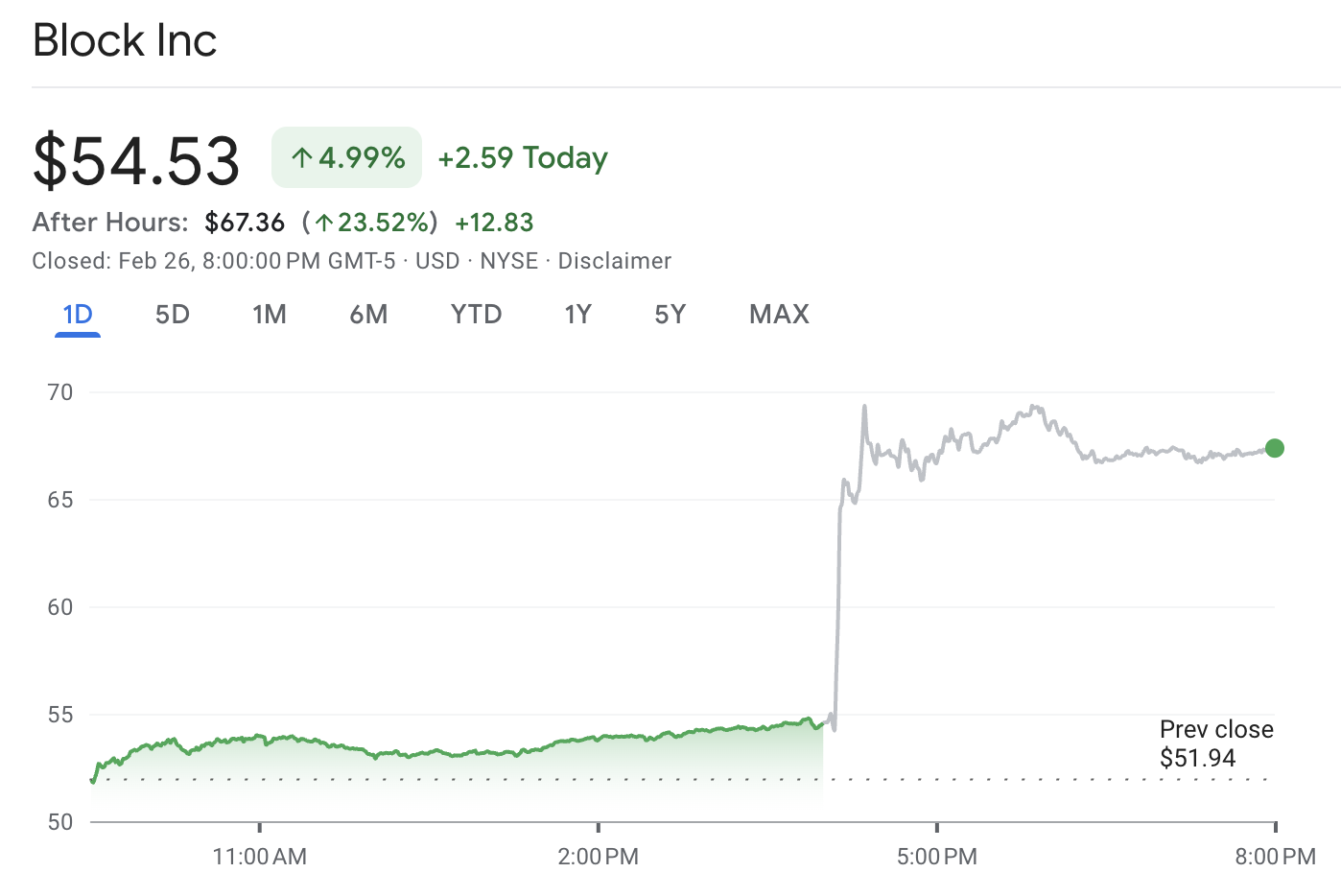
Into the close, Block was already firm. Then, after-hours liquidity hit, and the market priced in a different 2026.
Latest trading snapshot (Feb. 26 close):
Close: $54.53
Day change: +4.99%
After-hours: ~$67.36 (+23.52% vs close)
The stock had been trading heavily for weeks. A violent after-hours jump often means positioning was cautious, and guidance forced funds to re-rate the story.
It was not a "revenue blowout" type quarter. The market cared more about gross profit and what it implies for long-run earnings power.
Q4 gross profit: $2.87 billion, up 24% year over year.
Consumer app gross profit: $1.83 billion (up 33%).
Seller ecosystem gross profit: $993 million (up 7%).
Consumer app monthly active users: 59 million.
Seller ecosystem payment volume growth: 10% YoY in Q4 (management also broke out U.S. and international rates).
2026 gross profit outlook: $12.2 billion (about 18% growth).
2026 adjusted EPS outlook: $3.66.
It also included a near-term marker:
Q1 outlook: $0.67 EPS and $2.8 billion gross profit
Management also highlighted a significantly higher profit margin outlook for 2026 compared to 2025, driven by a reduced expense structure.
At Block's investor day a few months earlier, the company laid out a 2026 plan that included:
2026 gross profit: $11.98 billion
2026 adjusted EPS: $3.20
The new gross profit number (~$12.2B) is not just "slightly higher." It signals management believes the business can carry more profit through the model, and that costs can be tightened faster than expected.

Block said it is cutting around 4,000 jobs, roughly 40% of staff, taking headcount from over 10,000 to under 6,000. A 40% workforce cut sounds like distress in most industries. Here, the market treated it as a margin reset.
Management framed the move as a shift toward an "intelligence-native" operating model, arguing that new tools enable smaller teams to ship faster while still growing.
In fact, leadership pointed to internal productivity gains, including a claim that engineering output rose sharply over recent months.
Markets tend to reward cost resets when:
The company is not in a demand crash
Management pairs cuts with higher guidance
That is exactly what happened here. The market was not only buying "better 2026 numbers." It was buying into the idea that Block can deliver those numbers with a structurally lower cost base.
A cut from 10,000+ people to under 6,000 people is not a minor reshuffle. It is a full operating redesign.
Product velocity risk: If shipping slows down after layoffs, the market will quickly punish the stock because "the promise of being a faster company" is broken.
Customer experience risk: Cost cuts that manifest as reduced support or increased friction can subtly damage retention before this impact is reflected in financials.
Talent mix risk: The goal is to retain the best builders while simplifying processes. However, achieving this cleanly at such a large scale is challenging.
The market is celebrating the decision tonight. The market will grade it over the next two to three quarters.
If you strip away the emotion of layoffs and the excitement of after-hours moves, Block stock will follow a short list of operating signals.
Does gross profit growth stay strong after the reset?
Do Cash App engagement and monetization stay healthy (users, banking users, product attach)?
Is Square continuing to grow its payment volume without sacrificing its pricing?
How quickly do restructuring costs clear, and what does the cost base look like exiting Q2 2026?
There are two charts now:
The regular session closed at $54.53
The after-hours price is near $67
That gap is where most trading decisions will sit.
These indicator snapshots were before the full after-hours repricing, so treat them as "setup context," not the new post-gap reality.
| Indicator | Value | What it suggests |
|---|---|---|
| RSI (14) | 38.10 | Weak momentum / near oversold |
| MACD | -3.52 | Negative trend momentum |
| 50-day moving average | 62.56 | Stock was below this level into the print |
| 200-day moving average | 67.94 | After-hours move pushes price close to this level |
These levels combine near-term volume support, common retracement zones, and the levels highlighted by technical commentary around the last close.
| Zone | Level | Why it matters |
|---|---|---|
| Immediate gap support | $54.50–$55.00 | The close before earnings. If price loses this, the market is rejecting the story fast. |
| First support | $53.38 | Noted as a volume support area. |
| Secondary support | $50.75–$51.00 | Prior close cluster and another noted support band. |
| First resistance | $60.11 | A commonly flagged resistance band in current technical summaries. |
| Gap decision zone | $66.50–$68.50 | Where after-hours traded. This becomes the first real battlefield at the open. |
| Bigger resistance | $70.00–$72.25 | A prior January trading zone that can act like supply. |
Block stock surged because management is trying to accelerate profit growth by raising its 2026 targets while shrinking the cost base.
It can be bullish if the company maintains product quality and customer support while reducing expenses, as margins can expand meaningfully. It can be bearish if the cuts slow execution, weaken risk controls, or cause service problems that hurt growth.
Yes. These post-news surges can fade if the market decides the move was too fast, if broader risk appetite weakens, or if management's commentary suggests execution risk is rising. Stocks that gap up on headlines often retrace part of the move as traders lock profits and wait for proof in the next quarter.
In conclusion, Block's stock increased due to a more optimistic outlook for 2026 and a significant cost reset, which management states is intended to enhance the company's speed and efficiency.
The revised 2026 targets prompted investors to adjust the stock rating, while the workforce reduction indicates a sense of urgency.
The trade-off is execution risk. While cutting costs significantly can quickly improve profitability, it may also cause hidden operational damage that reveals itself later.
Disclaimer: This material is for general information purposes only and is not intended as (and should not be considered to be) financial, investment or other advice on which reliance should be placed. No opinion given in the material constitutes a recommendation by EBC or the author that any particular investment, security, transaction or investment strategy is suitable for any specific person.