Published on: 2026-06-04
On June 1, 2026, Alphabet announced an $80 billion equity capital raise to help fund its artificial intelligence infrastructure buildout, the largest single equity raise in US corporate history.
The more revealing detail is who is raising it. Alphabet is among the most cash-generative companies in the world, the kind that returns capital to shareholders rather than asking them for more. That it is issuing equity at all is the signal worth watching.

The move shifts the conversation away from a question the market has asked repeatedly, how much these companies are spending, toward one it has largely overlooked: how they intend to pay for it. Alphabet’s answer turns on share supply and capital structure, and on whether internal cash flow can still cover mega-cap ambitions in AI.
Alphabet announced an $80 billion equity capital raise on June 1, 2026, the largest single equity raise in US corporate history
The structure is three parts: about $30 billion in underwritten public offerings, a $40 billion at-the-market program, and a $10 billion private placement to Berkshire Hathaway
The company guided 2026 capital expenditures to between $180 billion and $190 billion, with 2027 expected to rise further
Around $30 billion of the at-the-market program is earmarked for employee equity tax obligations rather than new growth capital
For a company long associated with buybacks and surplus cash flow, raising equity reframes the mega-cap capital-allocation narrative
The open question is whether other large technology firms eventually face the same funding pressure
Alphabet’s stated reason is demand. The company said interest in its AI products from enterprises and consumers is running at levels that exceed its available supply, and that scaling its infrastructure is meant to capture that growth.
Google Cloud’s order backlog has reportedly expanded to around $460 billion, which grounds the spending in booked commercial demand rather than speculation.

The figures behind the plan are substantial. Alphabet guided 2026 capital expenditures to between $180 billion and $190 billion, well above prior years, and signalled a further increase in 2027. First-quarter 2026 capital spending alone reached $35.7 billion, most of it directed at servers and data centers.
The $80 billion arrives in three distinct pieces, and the distinction matters for everything that follows.
| Component | Approximate Size | Form |
|---|---|---|
| Underwritten public offerings | $30 billion | Mandatory convertible preferred and common stock |
| At-the-market (ATM) program | $40 billion | Common stock sold gradually into the market, beginning Q3 |
| Private placement | $10 billion | Direct investment by Berkshire Hathaway |
The Berkshire piece carries symbolic weight beyond its size. An anchor commitment from one of the most scrutinized capital allocators in the market lends institutional credibility to a transaction that, in scale and structure, has no real precedent.
Alphabet has framed the raise as one part of a balanced funding approach, sitting alongside operating cash flow and recent debt issuance, rather than a sign that its balance sheet is under strain.
For most of the past decade, mega-cap technology told a consistent capital story. Free cash flow grew, share counts shrank through buybacks, and earnings per share rose partly because profits were divided across fewer shares. Buybacks functioned as a structural tailwind beneath the headline growth.
Issuing equity runs that logic in reverse. New shares lift the count rather than reduce it, so each existing share represents a slightly smaller claim on future earnings. That is the mechanical definition of dilution, and it is why a large equity raise draws sharper scrutiny than an equivalent amount of debt or internally funded spending.
The concern is less about affordability than absorption. The market now has to take down a very large block of new stock at the same time it is digesting IPOs, convertibles, and steady passive inflows.
For this group of companies, share supply had become something investors assumed would only shrink. Alphabet has turned it back into an open variable.
Alphabet has authorized tens of billions of dollars in buybacks in recent years, which is what makes the pivot to issuance notable: a company that spent years retiring its own shares is now selling new ones.
The temptation is to call this the end of the buyback era. That framing overreaches. The raise does not end that era, but it does challenge the assumption that mega-cap technology can fund every AI ambition from internal cash flow alone.
With capital spending set to keep climbing through 2027, even Alphabet’s cash generation is being asked to cover infrastructure, operations, and shareholder returns at once.
That is the real capital-allocation story, and it is not that Alphabet is short of money. It is that the cost of staying competitive in AI has grown large enough to change how the company sources its capital.
Investors weighing the raise face two separate questions: how much genuine dilution occurs, and whether the returns on the spending will justify it.
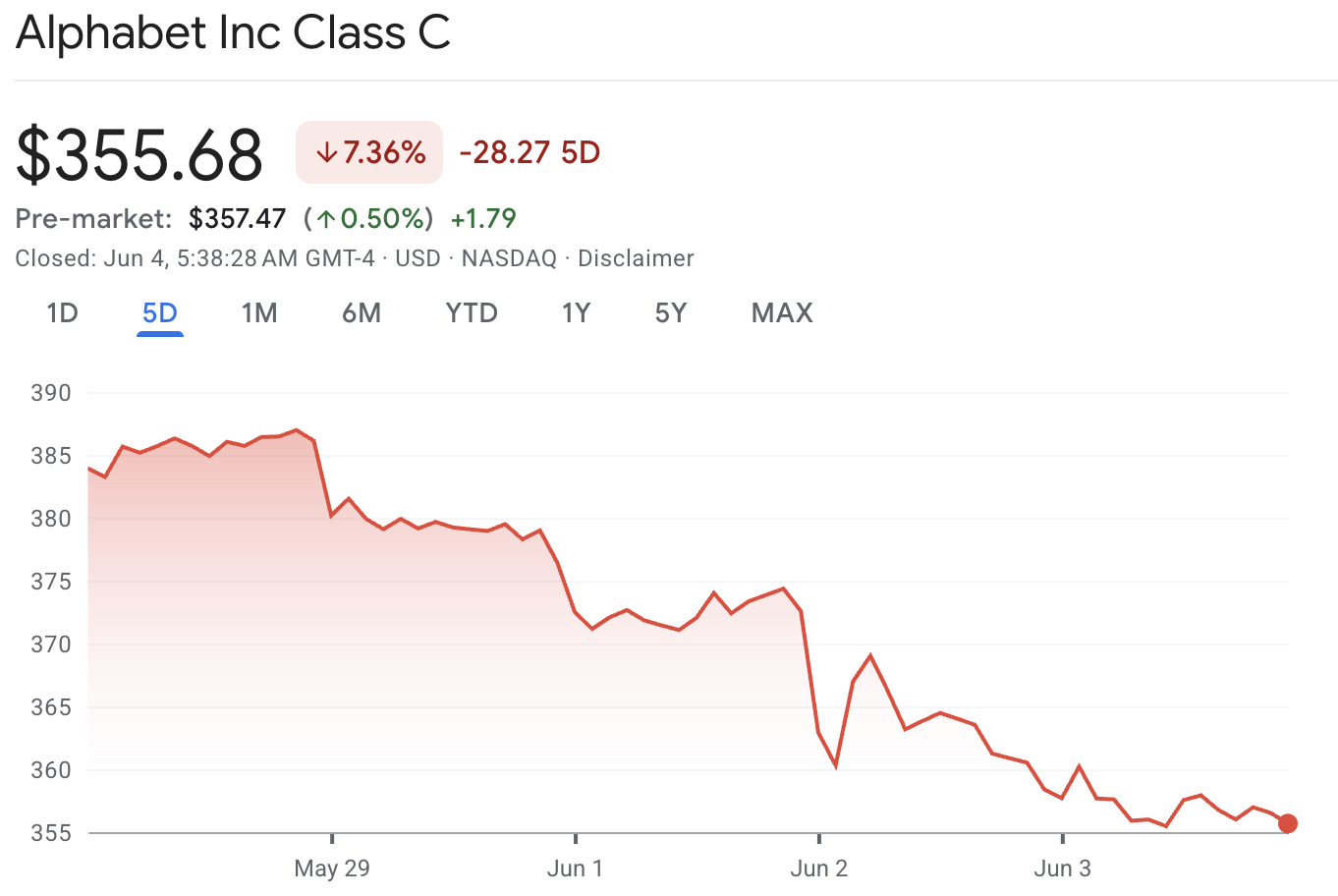
On the first, the headline figure overstates the effect, and the structure was clearly designed to limit it. Around $30 billion of the $40 billion ATM program is not destined for data centers at all.
It funds an administrative change in how Alphabet settles tax obligations on vesting employee equity, issuing shares into the market to cover those payments in a manner similar to a sell-to-cover model, an accounting mechanism rather than a growth-capital call.
The convertible preferred tranche, meanwhile, carries capped call transactions designed to blunt dilution if the shares eventually convert. Taken together, the new-share dilution tied to actual infrastructure spending is meaningfully smaller than $80 billion suggests.
The second question is harder and will take longer to answer. The case for accepting any dilution rests on AI returns that have not yet fully reached the income statement. If the infrastructure converts into durable cloud and AI revenue at strong margins, the trade is sensible.
If those returns disappoint, shareholders will have ceded a slice of the company to fund spending that did not pay off. That tension, not the raw share count, is what should drive how the market judges the raise over time.
None of this constitutes a view on the stock itself; it is the framework through which the decision should be read.
If a company with this level of cash generation concludes that outside equity is an efficient way to fund AI infrastructure, investors are entitled to ask whether peers eventually arrive at the same point.
Microsoft, Meta, and Amazon are all scaling capital expenditure aggressively, and combined industry investment in AI infrastructure is projected to run into the trillions over the coming years.
Most of that has been financed through cash flow and debt so far, with the bond market absorbing heavy issuance without obvious strain. Alphabet’s move puts equity on the table as a live option for the group.
Whether others follow will hinge on their own balance sheets and, more immediately, on how this raise is received: a smooth absorption would make large equity issuance a more normal tool for the biggest companies, while a difficult one would stand as a warning.
Alphabet’s $80 billion raise will be read first as an AI infrastructure story, and that reading is fair. The sharper point concerns capital structure: the prevailing assumption that the largest technology companies are too cash-rich to ever need outside equity has just been shown to have limits.
What the market gains from this episode is a new variable to price. The strongest balance sheets in technology may still reach for outside capital when AI spending scales fast enough, and the supply of mega-cap shares can grow as well as shrink. Where Alphabet’s stock trades next matters less than that shift in the underlying logic, which is the part worth watching.