Published on: 2026-05-29
Updated on: 2026-05-29
Anthropic’s $65B Series H has lifted its private valuation to $965B, while run-rate revenue has crossed $47B. The IPO test is whether that growth can survive public-market scrutiny once margins, cash burn and compute costs become visible.
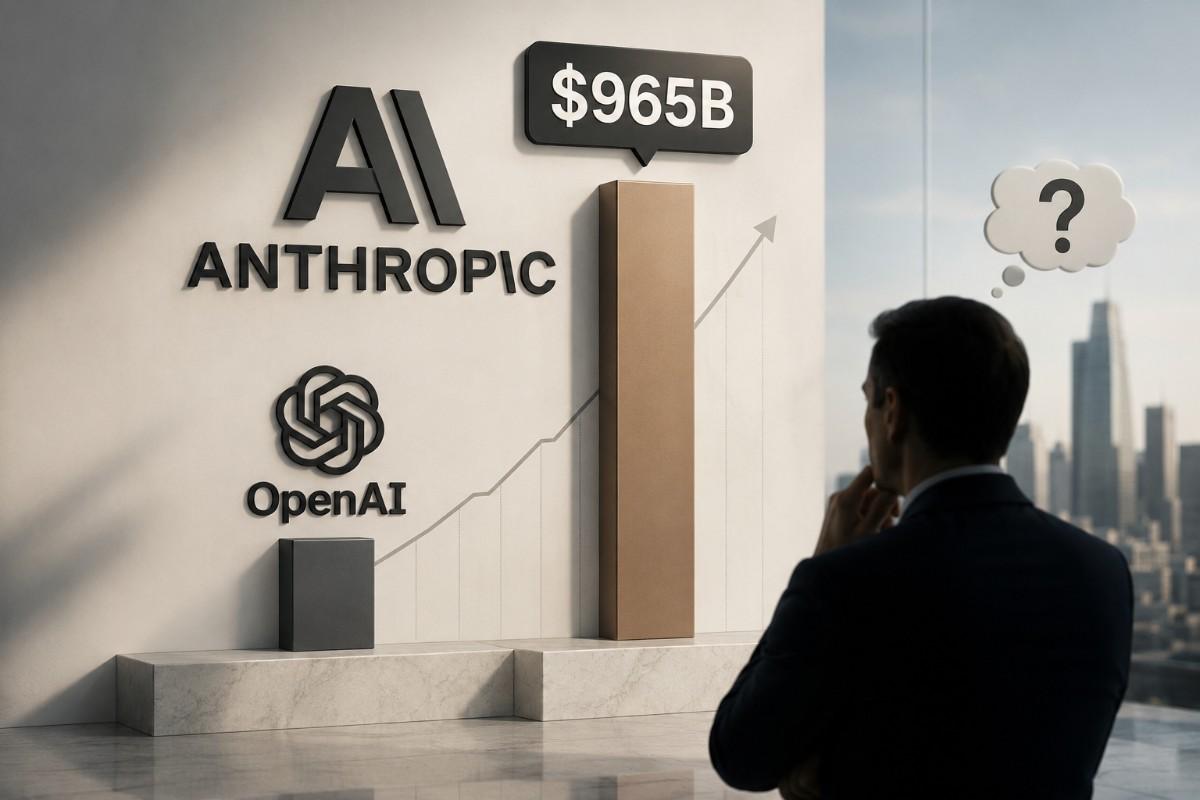
Anthropic stock is not public, yet its $965B valuation is already forcing investors to price it like a future mega-cap. The contradiction is hard to ignore: Anthropic has no public ticker, no IPO prospectus, and no audited financial statements, yet its valuation now exceeds OpenAI’s latest disclosed valuation.
Even more unusually, the company appears to be scaling fast enough to challenge the idea that the valuation is only speculative. Is this operating leverage, or the most expensive compute trade in technology?
Anthropic’s $65B Series H values the company at $965B, only $35B below $1T, before any public IPO filing.
Run-rate revenue has risen from $14B in February to $47B in May, cutting the implied valuation multiple from roughly 27.1x to 20.5x.
Anthropic now tops OpenAI’s latest disclosed $852B valuation, but the sharper signal is that Anthropic appears cheaper on run-rate sales.
The bear case is compute intensity: Anthropic’s growth depends on massive infrastructure commitments from AWS, Google, Broadcom, and SpaceX.
The deciding event is not the reported October 2026 IPO window, but an S-1 filing that reveals gross margin, cash burn and revenue quality.
The direct answer is yes: Anthropic’s $965B valuation is rich before IPO. It prices the company near the largest listed technology platforms before public investors have seen audited revenue, gross margin or cash burn.
But rich is not the same as irrational. The valuation debate turns on one signal: Anthropic’s reported run-rate revenue is rising faster than its private valuation.
The table below shows why the headline number alone does not settle the argument. The key figure is not the jump from $380B to $965B, but the drop in the implied valuation-to-revenue multiple.
| Funding Event | Date | Post-Money Valuation | Run-Rate Revenue | Implied Valuation / Revenue |
|---|---|---|---|---|
| Series G | Feb. 2026 | $380B | $14B | ~27.1x |
| Series H | May 2026 | $965B | $47B | ~20.5x |
The most important figure is the fall from 27.1x to 20.5x. Anthropic’s valuation rose sharply, but its reported run-rate revenue rose faster.
That does not make Anthropic cheap. It means private investors are underwriting revenue acceleration, not only multiple expansion.
The missing variable is profitability. Run-rate revenue does not show gross margin, cloud credits, customer concentration or inference costs. Public investors will not price Anthropic on revenue speed alone; they will price the spread between growth and compute intensity.
The table below shows the valuation gap that matters. Anthropic has the higher headline valuation, while OpenAI carries the richer implied revenue multiple.
| Company | Latest Disclosed Valuation | Revenue Signal | Implied Valuation / Revenue |
|---|---|---|---|
| Anthropic | $965B | $47B run-rate revenue | ~20.5x |
| OpenAI | $852B | $2B monthly revenue, or ~$24B annualised | ~35.5x |
The key figure is OpenAI’s roughly 35.5x multiple. It means OpenAI appears more expensive per dollar of annualised revenue, even though Anthropic has the larger valuation.
OpenAI still has the wider consumer footprint, with more than 900 million weekly ChatGPT users and $2B in monthly revenue. That scale supports a platform premium, but it also raises the growth hurdle.
Anthropic’s edge is more institutional. Its February disclosure showed more than 500 customers spending over $1M annually, eight of the Fortune 10 using Claude, and Claude Code generating more than $2.5B in run-rate revenue.
That changes the IPO question. Anthropic does not need to prove that AI demand exists. It needs to prove that enterprise demand can become recurring, high-margin revenue.
October 2026 matters as a reported window, but the S-1 matters more than the calendar. A listing date can move. A prospectus cannot avoid the numbers.
Reports have said Anthropic is exploring a public listing as early as October 2026 and has held early discussions with Goldman Sachs, JPMorgan Chase and Morgan Stanley. The same reporting says no final decision has been made.
That makes the IPO date a secondary signal. The real trigger is the first filing that turns Anthropic from a private-market valuation story into an audited financial statement.
The S-1 would reveal revenue recognition, customer concentration, cloud-credit treatment, gross margin, operating losses, equity dilution and related-party economics with strategic investors. Those details will decide whether $965B is a defensible IPO anchor or a private-market high-water mark.
Compute is Anthropic’s moat and its largest unresolved cost risk. More capacity allows Claude to scale, but it also turns growth into a capital-allocation test.
Anthropic has said its latest funding will help expand compute to meet demand. It has signed agreements for up to 5GW of Amazon capacity, 5GW of Google and Broadcom TPU capacity, and access to GPU capacity from SpaceX. AWS remains its primary cloud provider and training partner.
That scale can protect Anthropic if demand keeps rising. It gives the company access to scarce infrastructure while rivals compete for chips, power and cloud capacity.
The risk is operating leverage in reverse. If model usage grows faster than compute efficiency improves, revenue can rise while margins remain under pressure. That is why Anthropic’s valuation depends less on model hype than on whether Claude can turn heavy infrastructure spending into profitable enterprise usage.
Gross margin is the decisive line item. Anthropic can defend a $965B valuation only if each additional dollar of Claude usage becomes more profitable as infrastructure scales.
Revenue quality comes next. Public investors will need to know how much of the $47B run rate reflects recurring enterprise demand, rather than usage bursts, credits or early adoption pull-forward.
Customer concentration will also matter. A broad base of enterprise customers would support the platform argument, while dependence on a small number of large accounts would make the valuation more fragile.
Compute flexibility is the final test. If cloud and chip commitments remain manageable even as AI pricing compresses, Anthropic can argue that infrastructure scale is a moat. If not, the business will look more like a capital-intensive utility than a software platform.
Private-market prices can show demand, but they are not clean price discovery. Anthropic shares remain restricted, liquidity is thin, and indirect exposure can carry structural risk.
Anthropic has warned that unauthorised stock transfers will not be recognised on its books and that public SPV-style offerings may have no value. That makes secondary pricing useful as a sentiment gauge, not a valuation anchor.
For valuation, the cleaner benchmark remains the $965B post-money Series H because it is tied to a company-announced financing round.
No. Anthropic has no public ticker and does not trade on a stock exchange. Any private-market exposure should be treated differently from listed stock because liquidity, transfer approval and shareholder rights can be restricted.
Anthropic’s latest disclosed valuation is $965B post-money after its $65B Series H. Post-money means the valuation includes the new capital raised, so it should not be read the same way as a live public market capitalisation.
There is no confirmed Anthropic IPO date. October 2026 has been reported as a possible window, but the key trigger is the S-1, the IPO filing that would disclose revenue quality, margins, losses and ownership structure.
The valuation looks too rich if growth depends on heavy compute spending without margin expansion. The clearest warning signs would be weak gross margin, concentrated revenue, high cash burn or slowing enterprise adoption.
The next test is Anthropic’s first IPO filing. It will show whether $47B of run-rate revenue carries software-like margins or infrastructure-like cost drag.
If the S-1 shows expanding gross margins, diversified enterprise demand, and controlled compute spend, the $965B valuation can withstand public-market scrutiny. If it does not, Anthropic is now the clearest test of how much investors will pay for frontier AI before profits are visible.