Published on: 2026-07-17
Updated on: 2026-07-17
There was a time, not too long ago, when Wall Street seemed perfectly happy writing blank checks to big tech. If a company mentioned "artificial intelligence" on an earnings call, shares went up. No questions asked. But the honeymoon is officially over. Today, institutional desks are demanding proof of concept, looking past flashy demos to inspect the actual plumbing of these corporate balance sheets.
Against this backdrop of heightened scrutiny, Meta stock has put on a masterclass in resilience. After weathering a brutal summer dip that dragged the price down to a support floor near $540, the social media giant has fought its way back. Boosted by solid ad revenues and rumors of a new compute-leasing model, Meta stock is currently trading at $664.54.
Yet, beneath this impressive rebound lies a quiet, lingering anxiety. Investors are beginning to realize just how much capital it takes to keep Mark Zuckerberg's virtual empire running—and they are starting to ask how long they will have to subsidize it before seeing a direct return on investment.
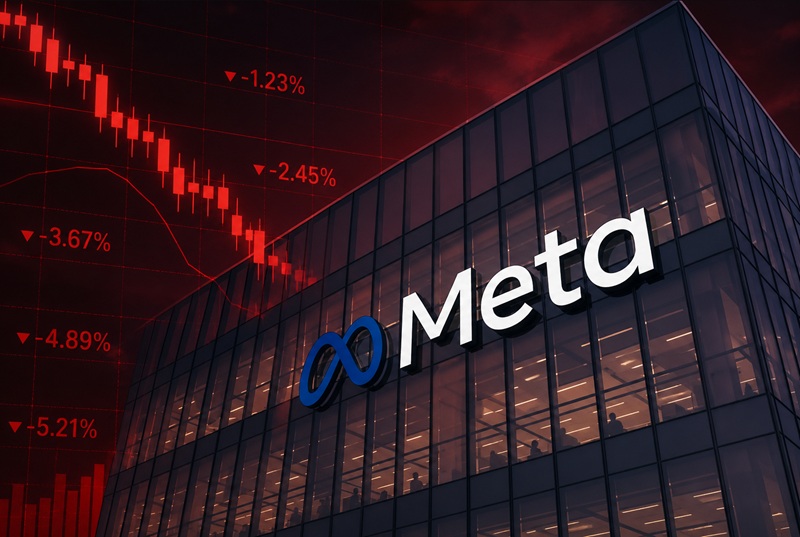
The main issue keeping a lid on a full-blown breakout for Meta stock isn't a lack of users. Facebook, Instagram, and WhatsApp still command the daily attention of billions. Instead, the pressure comes from the sheer, jaw-dropping cost of the hardware needed to power the next generation of AI.
In its latest financial updates, Meta raised eyebrows by adjusting its full-year capital expenditure (capex) forecast to an unprecedented range of $125 billion to $145 billion. This isn’t just a minor line item; it is a massive, multi-year bet on real estate, data centers, and high-end silicon.
The Cash Squeeze: Siphoning nearly $20 billion into capital expenses in a single quarter represents a significant diversion of cash that would otherwise head toward stock buybacks or dividends.
The Depreciation Trap: Tech infrastructure degrades and becomes obsolete quickly. Wall Street is waking up to the reality of an escalating depreciation bill, which could push Meta's total operating expenses toward $169 billion in the near term.
For anyone holding or trading Meta stock, these numbers require a shift in perspective. The company is no longer just a lean, high-margin software business; it is rapidly morphing into a capital-heavy infrastructure giant.
What makes the current valuation of Meta stock so heavily debated is how the market evaluates AI spending across the tech sector.
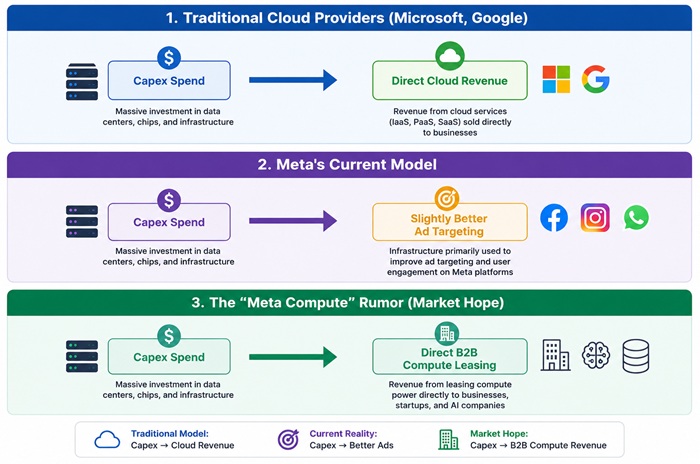
When cloud giants like Microsoft or Amazon buy servers, they can immediately lease that capacity to enterprise customers, booking clear, direct revenue. Meta doesn't have a massive enterprise cloud division to offset its spending.
Instead, the company relies on AI under the hood to make its ad-targeting algorithms more precise and to keep users hooked on Reels. While this has worked incredibly well—ad impressions have steadily climbed alongside average ad prices—critics argue that spending up to $145 billion simply to make social media ads slightly more efficient is an incredibly expensive trade-off. It’s this exact skepticism that has caused several prominent research desks to temper their near-term targets, even as the stock sits at a healthy $664.54.
The spark that helped ignite the recent recovery in Meta stock was a whisper that the company might disrupt the enterprise cloud market. Reports surfaced suggesting that Meta was exploring plans to lease out its excess, highly advanced computing power to third-party developers and startups.
On paper, the thesis is incredibly compelling:
It immediately monetizes idle server racks.
It transforms a massive capital expense into an active revenue stream.
It positions Meta as a direct competitor to traditional cloud providers.
However, the enthusiasm has been tempered by structural realities. Building a competitive, enterprise-grade cloud service is a massive undertaking. It requires entirely different security architectures, dedicated corporate sales forces, and potentially even more capital spending. Some proprietary financial models suggest that a serious push into the public cloud could drive Meta's annual capital expenditures past $200 billion by 2027. Investors quickly realized that this "solution" to the capex problem might actually end up compounding it.
From a pure technical standpoint, the price action on Meta stock shows a market locked in a fierce tug-of-war.
The recovery to $664.54 has successfully repaired much of the damage from the summer sell-off, pushing the price back above its key short-term moving averages. However, the stock is still trading below its previous all-time highs, indicating that major institutions are taking a "wait-and-see" approach.
Chartists are eyeing the $680 level as the next major area of overhead resistance. A clean break above this could open the door for a retest of the $700 mark. On the flip side, if macro pressures or interest rate anxieties trigger a broader market pullback, the first line of defense for the bulls sits around $610, with deeper structural support resting at the summer low of $540.
While the artificial intelligence debate dominates the headlines, Meta’s other massive, long-term project continues to run quietly in the background. Reality Labs—the division tasked with building out the metaverse, virtual reality ecosystems, and smart glasses—remains a persistent drag on the company's margins.
The division continues to operate deeply in the red, posting multi-billion-dollar quarterly operating losses against nominal hardware revenues. While consumer reception to Meta's latest smart glasses has been genuinely positive, the path to mass-market profitability is still measured in years. Balancing a long-term spatial computing bet alongside an immediate, aggressive AI buildout is a double-front war that is keeping some risk-averse investors on the sidelines.
Traders looking for CFD exposure to Meta Platforms can find it listed as META on EBC's stock CFD platform . A CFD position allows both long and short exposure to the share price—useful around corporate earnings events where the immediate market direction is genuinely uncertain. Because stock CFDs are leveraged products, traders should carefully review margin requirements and consider reducing position sizes during high-impact earnings windows when intraday volatility is typically elevated.
The recent price performance of Meta stock proves that the company’s core business remains an absolute cash machine. Advertisers still view the platform as irreplaceable, and user engagement across the family of apps is remarkably sticky.
But the game has changed. The market is no longer buying into tech promises on faith alone. Every dollar flowing into data centers must eventually show up on the bottom line. As the next earnings cycle approaches, the spotlight won't be on user growth or creative presentations—it will be on operating margins. Until Zuckerberg can prove that his massive infrastructure bet is translating into highly profitable enterprise scale, expect Meta stock to remain a highly volatile battleground for Wall Street's bulls and bears alike.