Published on: 2026-07-17
Wall Street just got a reminder that Eli Lilly has plenty of tricks up its sleeve beyond weight-loss drugs. In a massive surprise to the market, Eli Lilly and Company announced a definitive deal to buy AtaiBeckley for up to $3.8 billion. It is a bold, high-stakes move for the world’s most valuable drugmaker, marking its official entry into the rapidly growing field of psychedelic-based mental health therapies.
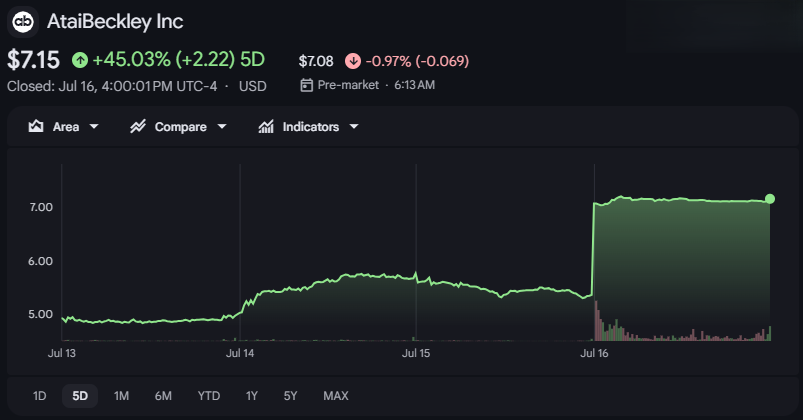
The market’s reaction was instant. While Eli Lilly’s massive size kept its own share price relatively flat and steady, the target company saw a massive buying frenzy. AtaiBeckley shares skyrocketed, closing up 33.4% on heavy trading volume as investors rushed to price in the big premium Lilly is paying. For anyone tracking Eli Lilly stock, this biotech adquisition is a loud signal that management is looking far past its current diabetes goldmines to capture the next multi-billion-dollar frontier in chronic healthcare.
To see why this deal has everyone talking, you have to look at how Lilly is laying out the money. Under the terms of the agreement, Lilly is paying $6.75 per share in upfront cash. That values the initial piece of the company at roughly $2.8 billion.
The real intrigue, however, lies in the Contingent Value Rights (CVRs). AtaiBeckley shareholders could bag an extra $2.50 per share—adding another $1.0 billion to the total pool—if the drugs hit specific clinical and regulatory milestones down the road. Specifically, those payouts hinge on how well AtaiBeckley's depression programs progress through late-stage testing.
This is a massive payday for AtaiBeckley, which was formed just last year when Germany’s atai Life Sciences and the UK’s Beckley Psytech joined forces. By combining their research and clinical trial assets, they built a highly attractive portfolio that was essentially a prime target for a big-pharma buyer.
For Wall Street, this structure is a major win. By using CVRs, Lilly protects its balance sheet if the clinical trials hit an unexpected roadblock. It is exactly this disciplined approach to spending cash that keeps institutional investors incredibly comfortable holding Eli Lilly stock, even when the company goes on an aggressive buying spree.
What makes AtaiBeckley so incredibly valuable to Lilly isn't just a generic drug pipeline—it’s a realistic shot at curing treatment-resistant depression (TRD). Millions of people worldwide struggle with TRD, meaning standard everyday antidepressants like SSRIs simply do not work for them. Traditional medications can take weeks or even months to show any effect, and they often come with a long list of side effects.
Lilly’s new lead asset, BPL-003. is trying to change that entire approach. It is a synthetic, nasal-spray version of 5-MeO-DMT designed to trigger rapid neuroplasticity. Instead of just masking symptoms or tweaking chemical balances daily, it aims to help the brain physically rebuild damaged neural connections.
The clinical data behind this psychedelic medicine portfolio is what really convinced Lilly to pull the trigger:
Fast and Lasting Relief: In Phase 2b clinical trials, BPL-003 delivered remarkably rapid, deep, and long-lasting drops in patients' depressive symptoms.
The Two-Hour Window: Some older psychedelic trials required patients to be monitored in a clinic for an entire day. BPL-003 achieves its effects in an in-clinic visit lasting only about two hours on average, making it highly scalable for normal medical practices.
Regulatory Speed: The FDA has already granted the drug Breakthrough Therapy Designation, and Phase 3 clinical activities are already starting to roll.
Alongside BPL-003. Lilly is also picking up VLS-01, an orally dissolving film version of DMT currently in Phase 2b testing. Overnight, this biotech acquisition turns Lilly into an immediate frontrunner in the next generation of neuroscience.
For the past couple of years, Eli Lilly stock has been an absolute juggernaut. Driven by the historic success of its weight-loss and diabetes injections, Mounjaro and Zepbound, Lilly's market value has climbed to heights never before seen in the pharmaceutical world.
But high valuations bring incredibly high expectations. Wall Street has been quietly asking a fair question: What happens when the weight-loss hype cools off? With rivals racing to launch their own generic weight-loss pills and patent expirations always a threat down the line, Lilly needed a massive second act.
This acquisition is that second act. By using its massive cash reserves from GLP-1 sales to buy into a leading clinical-stage mental health pipeline, Lilly is securing its next decade of growth.
Typically, when a company announces a multi-billion-dollar cash acquisition, its stock takes a minor hit as investors digest the short-term cash drain. But Eli Lilly stock didn't follow that script. The steady performance of LLY shares following the announcement shows that investors aren't worried about the cash outlay; they are genuinely excited about the pipeline diversity.
Beyond the financial numbers, Lilly's purchase of AtaiBeckley is a massive regulatory and cultural milestone. For years, developers of psychedelic treatments operated on the fringes of medicine, struggling to secure funding and facing intense skepticism from health agencies.
Now, the world's largest drugmaker has put its stamp of approval on the sector. Lilly’s clinical development expertise, massive global distribution network, and sheer lobbying power will likely accelerate the path to market for these therapies in ways a smaller biotech never could.
The political backdrop is also working in Lilly’s favor. Bipartisan support and updated federal guidelines have cleared a path that was once blocked by bureaucratic red tape, making this the perfect moment for Lilly to strike.
Competitors are already feeling the heat. Johnson & Johnson has enjoyed a comfortable lead in the interventional psychiatry space with Spravato, its ketamine-derived nasal spray. But Spravato requires intensive clinic visits twice a week. If Lilly can successfully bring BPL-003 to market with its shorter, highly durable two-hour treatment profile, it could quickly capture a massive share of the market.
Traders taking a view on Eli Lilly ahead of its upcoming Q2 earnings release on August 6 can access the stock as LLY via EBC's stock CFD platform. Pharma and biotech stocks can move 20% or more on binary events - the CFD format allows short positions for downside scenarios as well as longs, but leverage makes position sizing relative to your account critical.
Biotech investing is always risky, and developing psychiatric drugs is notoriously difficult. But Lilly isn't gambling blindly here. By structuring the deal with heavy milestones and buying a company that has already secured Breakthrough Designation from the FDA, they have mitigated as much risk as possible.
For long-term holders of Eli Lilly stock, this deal is a phenomenal hedge. It ensures that even if the weight-loss market gets crowded and competitive, Lilly has a completely different, highly innovative growth engine ready to take over.
As the transaction looks to close by the end of September, the focus will turn entirely to those Phase 3 trials. If BPL-003 can replicate its early clinical success on a larger scale, Lilly's $3.8 billion bet won't just look like a smart business move—it could go down as the catalyst that changed the face of mental healthcare forever.