Published on: 2026-06-05
Updated on: 2026-06-05
Power stocks are no longer a hidden AI trade, and that is exactly what makes them harder to read. Data centres do not just need more computing power; they need generation, grid access, cooling, gas backup, and water capacity that can arrive on time.
That is where the tension sits now: which names still reflect a real infrastructure constraint, and which are already priced in years of flawless demand?
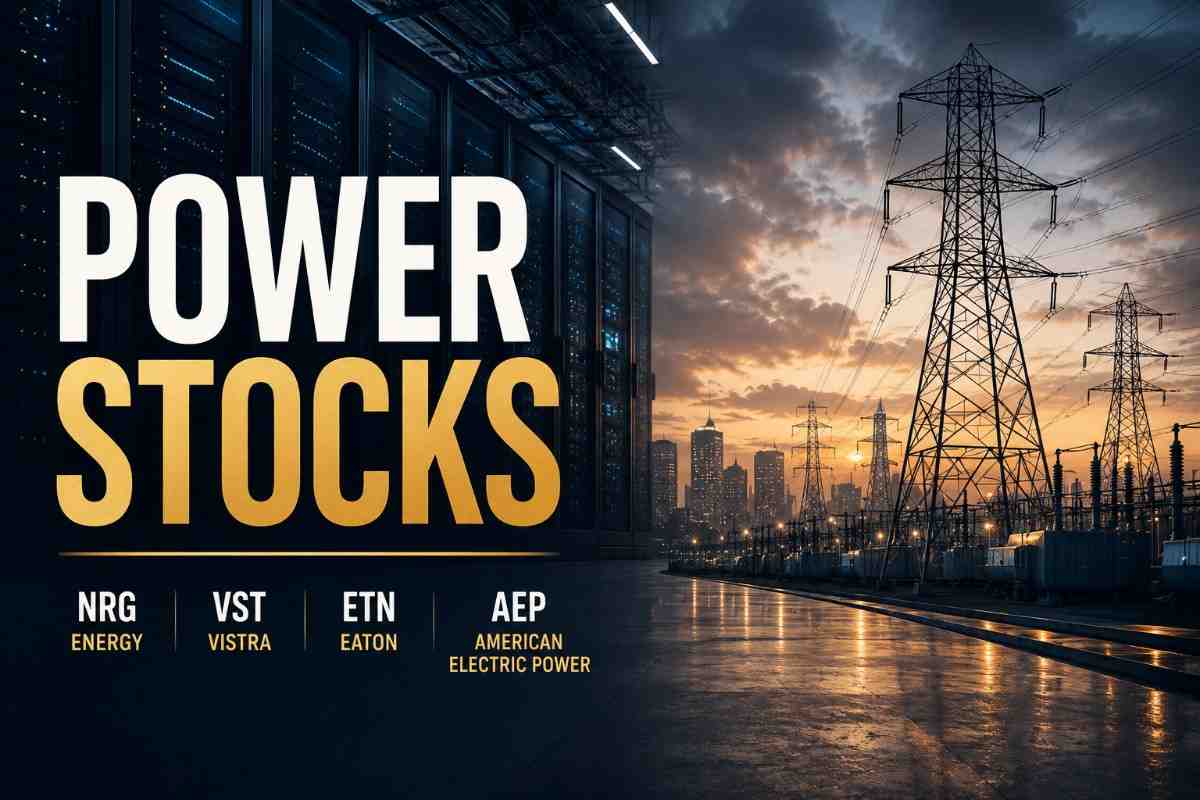
US electricity demand is forecast to rise 1.3% in 2026 and 3.1% in 2027, with data-centre-linked commercial load helping drive the increase. Power capacity is becoming a direct AI constraint, not a background utility issue.
This watchlist is organised by bottleneck role, not ranking. Nuclear, gas, grid construction, electrical equipment, cooling, utilities, and water each capture a different pressure point.
Earnings are the proof layer. A company belongs here only if recent results, backlog, orders, guidance, or capital plans indicate demand for the business.
Valuation is already the uncomfortable part of the trade. Several high-quality names have rallied hard, so the question is no longer only who benefits, but whose evidence still supports the multiple.
The 2026 test is conversion. The theme holds if power demand continues to translate into signed contracts, approved grid spending, equipment orders, and cash flow.
This is a watchlist, not a ranking by expected return. Each company had to meet two tests: it must be US-listed, and it must have a clear role in the AI power chain, from electricity supply and grid connection to cooling, gas flexibility, or water infrastructure.
Recent earnings, backlog, guidance, or capital plans then had to show that the role is visible in the business, not just in the market story.
Valuation figures referenced in this article reflect market data as of 5 June 2026 and are used to frame valuation risk, not to imply a trading decision.
| Power Stock | Role in the AI Power Chain | Main Watchpoint |
|---|---|---|
| Constellation Energy | Nuclear and 24/7 electricity supply | Data-centre power contracts and regulatory approval |
| Vistra | Merchant power, nuclear, and gas | Capacity pricing, hedges, and AI-linked power deals |
| GE Vernova | Gas turbines and grid equipment | Backlog quality and data-centre equipment orders |
| NRG Energy | Dispatchable power and retail electricity | Weather, hedging, and Texas power demand |
| Quanta Services | Grid construction | Backlog growth and electric infrastructure margins |
| Eaton | Electrical power management | Data-centre orders and margin discipline |
| Vertiv | Data-centre power and cooling | Hyperscaler capex and liquid-cooling demand |
| NextEra Energy | Regulated utility, renewables, and storage | Rate-base growth and project execution |
| American Electric Power | Transmission-heavy utility | 63 GW load pipeline and regulatory approvals |
| Xylem | Water infrastructure | Cooling, reuse, and water-system demand |
The most important column is the middle one. Not every energy stock is a power stock, and not every power stock deserves an AI premium.
Why it belongs: Always-on electricity is the core reason Constellation belongs here. Large data centres cannot run on intermittent supply alone, which makes nuclear attractive, but the stock’s real test is whether demand becomes approved contracts rather than headlines.
Latest earnings signal: Q1 adjusted operating earnings rose to $2.74 per share from $2.14 a year earlier, and management reaffirmed 2026 adjusted operating earnings guidance of $11.00 to $12.00 per share. The implication is that Constellation is not relying only on the AI narrative. Its current earnings base is already strong enough to support the scarcity argument.
What could go wrong: Nuclear-linked power deals can face regulatory scrutiny, project delays, and political pushback, especially when data-centre demand collides with consumer electricity costs.
Signal to watch: The next proof point is whether data-centre agreements keep moving from announcement to approved, contracted electricity demand.
Why it belongs: Scarcity pricing is the reason Vistra matters. Its nuclear, gas, retail electricity, and merchant generation exposure gives the company several ways to benefit when reliable power capacity becomes harder to find.
Latest earnings signal: Q1 ongoing operations adjusted EBITDA reached $1.49 billion, and full-year 2026 adjusted EBITDA guidance remained at $6.8 billion to $7.6 billion. The read-through is that scarcity pricing is already supporting earnings visibility, not only the stock’s market narrative.
What could go wrong: Vistra is powerful but messy. Weather, hedges, fuel costs, power prices, and derivative marks can make the earnings signal harder to read than the AI electricity story suggests.
Signal to watch: Capacity-market pricing and new long-term power agreements will show whether scarcity continues to convert into cash flow.
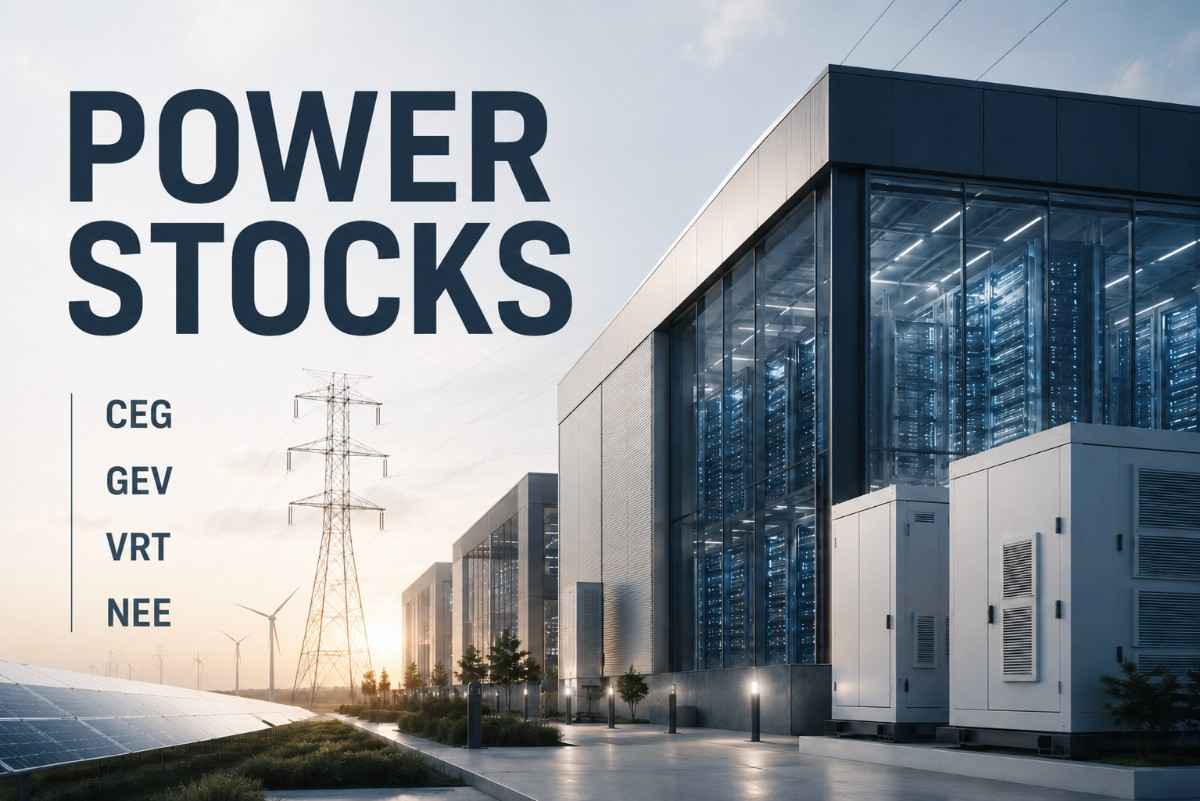
Why it belongs: Faster power deployment needs hardware before it needs theory. GE Vernova supplies gas turbines, grid systems, and electrification equipment at the point where rising demand collides with long construction timelines.
Latest earnings signal: Q1 revenue rose 16% to $9.3 billion, backlog increased by $13 billion sequentially to $163 billion, and management raised 2026 guidance. Its Electrification segment also booked $2.4 billion of data-centre equipment orders in the quarter, giving the AI Power Link a direct order signal.
What could go wrong: The stock has already rerated sharply, and the wind business still carries execution and margin pressure. Strong orders help the thesis, but they do not remove delivery risk.
Signal to watch: Electrification backlog quality matters more than headline bookings. Data-centre demand must convert into profitable delivery, not only larger orders.
Why it belongs: The grid still needs flexible power while longer-term solutions catch up. NRG is not the cleanest AI power story, but dispatchable electricity matters when demand outpaces new transmission, nuclear capacity, or renewable additions.
Latest earnings signal: Q1 adjusted EBITDA was $1.08 billion, adjusted EPS was $1.49, and management reaffirmed 2026 guidance. The stronger EBITDA confirms operating resilience, but negative free cash flow before growth investments shows the story is less clean than the headline result suggests.
What could go wrong: NRG carries weather, commodity, hedge, and retail-market exposure. Those moving parts can cloud the question of whether earnings strength is driven by structural power demand or by shorter-term market conditions.
Signal to watch: The key test is whether dispatchable assets and customer platforms continue to support earnings without hedge volatility overwhelming the demand signal.
Why it belongs: Electricity demand means little if power cannot reach the site. Quanta operates where the bottleneck becomes physical construction, including transmission lines, substations, interconnection work, and skilled grid labour.
Latest earnings signal: Q1 revenue rose to $7.87 billion from $6.23 billion a year earlier, adjusted diluted EPS rose to $2.68, and backlog reached a record $48.5 billion. The implication is direct: grid demand is already moving into reported revenue and future work.
What could go wrong: Quanta may be one of the cleanest grid winners, but a P/E near 99 means the stock has less room for delayed projects, labour inflation, or slower backlog conversion.
Signal to watch: Electric infrastructure margins will show whether Quanta can turn demand into profit, not only in larger projects.
Why it belongs: Higher electricity demand only becomes usable computing capacity after the electrical layer is built. Eaton sits inside that layer through switchgear, power distribution, circuit protection, and power management systems.
Latest earnings signal: Q1 sales rose 17%, organic sales rose 10%, Electrical Americas rolling orders rose 42%, and electrical backlog grew 48%. Eaton also raised 2026 organic growth guidance to 9%-11%, giving the stock one of the clearest earnings-confirmed links to electrification demand.
What could go wrong: Strong demand does not remove margin risk. Capacity expansion, acquisitions, and cost pressure can dilute the benefit of higher orders.
Signal to watch: Data-centre orders and segment margins need to move together. Orders without margin discipline would weaken the thesis.
Why it belongs: AI’s power problem becomes a heat problem inside the data centre. Vertiv turns higher rack density into demand for power systems, thermal management, liquid cooling, and uptime protection.
Latest earnings signal: Q1 net sales rose 30% to $2.65 billion, with Americas organic sales up 44% on strong data-centre demand. The signal is already visible in reported growth, not waiting in a long-term forecast.
What could go wrong: Purity is expensive. A P/E near 81 makes the stock sensitive to any sign that hyperscaler capex is slowing or shifting.
Signal to watch: Adoption of liquid cooling and hyperscaler capex commentary will determine whether Vertiv’s growth can continue to outpace its valuation.
Why it belongs: Not every power-stock exposure has to come from a high-multiple AI infrastructure winner. NextEra offers a steadier version of the theme through regulated utility growth, renewables, storage, gas infrastructure, and long-cycle project execution.
Latest earnings signal: Q1 adjusted EPS rose 10% year over year to $1.09, and Energy Resources added 4 GW of new renewables and storage projects to backlog, meaning projects moved into its contracted development pipeline. The read-through is that electricity demand is still moving into project development, although the payoff comes through execution over the years rather than in one quarter.
What could go wrong: The same scale that makes NextEra durable also makes it slower. Higher financing costs, regulatory pushback, and project delays can stretch the timeline between load growth and earnings growth.
Signal to watch: New renewables, storage, and transmission additions need to support earnings without turning the capital programme into a regulatory burden.
Why it belongs: Large-load growth becomes a utility question when the grid must be expanded and someone has to pay for it. AEP belongs because its service territory puts it directly inside that rate-base, transmission, and cost-recovery debate.
Latest earnings signal: Q1 operating earnings were $1.64 per share, full-year 2026 operating earnings guidance stayed at $6.15 to $6.45 per share, and new load additions expanded to 63 GW by 2030. AEP also raised its five-year capital plan to $78 billion, turning load growth into a larger regulated investment programme.
What could go wrong: Regulation can turn opportunity into delay. Cost recovery, interconnection timing, customer agreements, and ratepayer impact will shape the earnings path.
Signal to watch: The next test is whether the 63 GW pipeline becomes approved capital spending with acceptable customer cost offsets.
Why it belongs: AI’s electricity problem does not stop at the grid. Higher data-centre density increases cooling demand, and cooling makes water reuse, treatment, and system resilience part of the same infrastructure equation.
Latest earnings signal: Q1 revenue reached $2.1 billion, orders were $2.2 billion, and adjusted EPS rose 9%. The signal is steadier than that of the high-growth AI infrastructure names, but it gives the watchlist exposure to water stress rather than only to electricity hardware.
What could go wrong: The AI link is real but less immediate than it is for Vertiv or GE Vernova. Organic revenue and orders were flat, so Xylem needs clearer project acceleration before the theme becomes visible in growth.
Signal to watch: Water reuse, utility resilience, and cooling-linked project demand need to accelerate beyond the current steady-growth profile.
The first phase of the AI boom priced intelligence. The next phase must prove that intelligence can be powered.
That is why this watchlist is not about chasing every stock with an AI label. The opportunity is already visible, and visibility changes the risk. Some names now need earnings to justify their valuations, while others need load growth to become approved projects, orders, or cash flow.
The power-stock thesis does not need more excitement in 2026. It needs conversion.
The decisive signal comes in the next earnings cycle, when 2026 guidance updates and hyperscaler capex commentary show whether AI electricity demand is becoming signed contracts, profitable backlog, and approved grid investment.